
MELU-309 · Lesson 7 of 12 · 20 min
Duties and responsibilities of the Master Electrician License holder
▶ Video coming soon A video version of this lesson is on the way.
When Kari asked Dale what changes the day a journeyman becomes the contracting master, he answered with a stack of folders. Every wiring certificate Souris Bend files is filed in his name. Every apprentice on the payroll is supervised under his license. Every job the company bids is a job he is responsible for. If an apprentice works alone in a crawl space, if a certificate is filed late, or if a correction order is ignored, the board's letter comes to him. This lesson sets out the duties North Dakota's statute and rules place on a master, especially a contracting master, and the habits that keep a master out of trouble.
Responsibility follows the role
Lesson 1 introduced the three kinds of master in N.D. Admin. Code 24.1-03-01-02. The contracting master is responsible for compliance with all of North Dakota's wiring laws and rules on the work he or she contracts and supervises, and must show proof of liability insurance. The master of record is responsible for an organization's own work on property it owns or leases, with insurance covering the organization. The noncontracting master holds the license but carries journeyman-level responsibility and works under a contracting master or master of record. The duties in this lesson fall most heavily on the contracting master.
One shop, active supervision
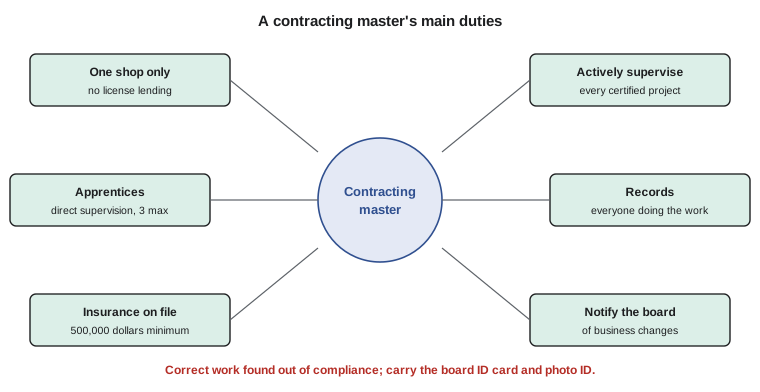
The rule on supervision and responsibilities, N.D. Admin. Code 24.1-03-01-09, contains the duties a master should know best. A master, class B or power limited electrician may hold privileges for only one shop or business. The master must follow the Secretary of State's contracting rules under Century Code chapter 43-07, actively supervise every project for which a wiring certificate is filed, and immediately notify the board of any change in the status of the business.
The one-shop rule exists to stop license lending, the practice of a master letting several companies use one license for a fee while supervising none of their work. A master who is the contracting master for Souris Bend cannot also be the contracting master for a cousin's company in Williston. If Kari takes over from Dale, Dale's master license stays valid, but he cannot qualify a second business while Kari is the master behind Souris Bend unless he gives up that role. The duty to actively supervise every certified project means more than signing certificates. The master must know what is being installed, make sure qualified people are doing it, and be able to answer for it.
Prompt notice of business changes matters because the board's records tell inspectors, utilities and the public who is responsible. If a contracting master leaves a company, the company can no longer contract or file certificates under that license. Arlo keeps a short list of events that trigger a call to the board: a change of contracting master, a change in the company's name or form, the master leaving the company, the company closing, and any lapse in insurance.
Apprentices: ratio, age and direct supervision
North Dakota's apprentice rules are strict and are enforced in the field. Under 24.1-03-01-09, a licensed electrician may supervise no more than three apprentices, and apprentices must be over sixteen years old. The licensed master, class B or power limited electrician may not let an apprentice work on any installation without direct, constant supervision by a North Dakota licensed electrician at the worksite. Section 43-09-18 of the Century Code adds that apprentices may work only under the personal supervision of a licensed electrician.
Direct, constant supervision at the worksite means a licensed electrician is on the job with the apprentice, not across town or on the phone. It does not mean the journeyman must hold the apprentice's hand on every wire nut, but it does mean an apprentice is never sent alone to a job. If the board finds an apprentice working without the required supervision, it may charge an investigative fee of 50 dollars an hour plus mileage, and failure to comply can lead to nonrenewal, suspension or revocation of the responsible license.
Worked problem
Staffing a crew within the ratio
Souris Bend has a farm service job and a shop job on the same day. Kari, a second journeyman and Dale are licensed; the company has five registered apprentices. How can the crews be set up?
Show solution
- Each licensed electrician may supervise no more than three apprentices.
- Three licensed electricians could supervise up to nine apprentices, so five is within the limit overall.
- But supervision is at the worksite: each crew must have a licensed electrician present for its apprentices.
- For example, Kari with three apprentices at the shop and the second journeyman with two at the farm; Dale is free to visit both.
Answer: Two crews, each led by a licensed electrician, with no more than three apprentices per licensed electrician on site.
# Checking crew plans against the 1-to-3 ratio (illustrative)
crews = {"shop job": {"licensed": ["Kari"], "apprentices": 3},
         "farm service": {"licensed": ["Journeyman B"], "apprentices": 2},
         "service call": {"licensed": [], "apprentices": 1}}
for job, c in crews.items():
    allowed = 3 * len(c["licensed"])
    ok = c["apprentices"] <= allowed and (c["apprentices"] == 0 or c["licensed"])
    status = "OK" if ok else "NOT ALLOWED: apprentice without a licensed electrician on site or over ratio"
print(f"{job}: {len(c['licensed'])} licensed, {c['apprentices']} apprentices -> {status}")shop job: 1 licensed, 3 apprentices -> OK farm service: 1 licensed, 2 apprentices -> OK service call: 0 licensed, 1 apprentices -> NOT ALLOWED: apprentice without a licensed electrician on site or over ratio
Apprentices must register with the board. Section 43-09-13.1 requires registration and an annual fee, and the board's fee rule sets a 10-dollar registration that expires each January 31. An unregistered helper doing electrical work is not an apprentice in the eyes of the board, and the master is responsible for letting that person work.
Records of everyone doing electrical work
The same rule requires contractors to keep records of everyone performing electrical or power limited work and to let the board examine and copy them. Everyone doing the work must be a licensed electrician or a board-registered apprentice. The fee rule adds that contractors must keep job records for four years. Arlo's records for each job include the wiring certificate, the contract and change orders, a crew list by day, and the license or registration number of each person on the crew.
The records protect the master as much as they serve the board. If an inspector asks who installed a feeder, or the board asks whether an apprentice was supervised on a given day, the master who can show the crew list and time sheets has an answer. A master who cannot is left to argue.
Carrying credentials and reporting
Licensed and registered electricians must carry the board's identification card and a government photo identification while working, under 24.1-03-01-01. A replacement fee applies if a card is lost. Section 43-09-09 requires licensees to report their licensing and renewals to the local electrical inspector where one exists, and section 43-09-19 requires licensees doing electrical work to file reports with the board on its forms. For a contracting master, the most important of those reports is the wiring certificate itself.
Advertising and association
Section 43-09-09.2 protects the public from businesses that advertise electrical contracting without a licensed electrician behind them. A person who advertises electrical contracting must be licensed or associated with a class B, master or power limited electrician, unless the person contracts through a licensed electrical contractor. When an association with an electrician ends, the person is jointly and severally liable for contracts made during the association. Violations carry escalating misdemeanor penalties: a class B misdemeanor with a fine of up to 100 dollars and no jail for a first conviction, a class A misdemeanor with a fine of up to 1,000 dollars and no jail for a second, and for a third or later, a class A misdemeanor with up to 1,000 dollars, up to 30 days in jail, or both.
For a master, the practical point is that a company's advertising must match its license. A general contractor that advertises electrical work must have a licensed electrician associated with it or subcontract the work to a licensed electrical contractor.
Correcting work and paying the board
The grounds for discipline in section 43-09-15 read like a list of duties. A master must install work that complies with the wiring standards, avoid gross negligence and misconduct, never commit fraud, correct work found out of compliance, keep the required insurance, pay debts owed to the board, and complete the required education. Failing to correct work after a correction order is a separate ground for discipline, along with the 50-dollar administration charge under the fee rule. A master who disagrees with an order should use the dispute process in Lesson 6 rather than ignore it.
What the master may let others do
Two exceptions are worth knowing. Under 24.1-03-01-09, maintenance staff employed by an owner or property manager may make minor repairs to existing wiring devices and appliances, but may not extend or alter existing circuits, feeders or other apparatus. And section 43-09-16 exempts certain work entirely, such as utility employees up to the first point of attachment except for meter work, telecommunications and cable providers within their scope, appliance dealers connecting appliances to existing receptacles, and installers of nonelectrical systems. A master asked whether a building's maintenance worker may add a circuit can answer clearly: no.
The handover
Dale and Kari have drafted a handover plan for April 30, 2027. On that date Kari becomes the contracting master, files proof of insurance with the board, and the company's records and e-cert account move to her name. Dale stays on as a noncontracting master for a year, working under Kari's license and helping with estimating. He will no longer file certificates, and he will not qualify any other business. Every open certificate filed under Dale's license will be either finished and finaled before the change or discussed with the board so that responsibility is clear.
Supervising at a distance
Souris Bend's service area covers a lot of ground, and Dale cannot be on every site. Active supervision does not require the contracting master to stand beside every crew, but it does require a system: licensed journeymen leading every crew, apprentices never on a site without a licensed electrician, regular site visits, a review of each job's scope before work starts, and a final walk-through or a report from the lead before the final certificate is filed. Kari plans to keep Dale's system and add a weekly call with each crew lead to go over open certificates, inspections and correction orders.
Supervision also means stopping work that is not right. A contracting master who finds that a crew installed a feeder in the wrong raceway, or that an apprentice was left alone, should correct it at once and record what was done. The board judges a master by what happens on the jobs filed under the license, and a record of prompt correction is the best evidence of active supervision.
Common mistakes
MistakeLetting an apprentice finish a small job alone.
InsteadApprentices need direct, constant supervision by a licensed electrician at the worksite.
MistakeSupervising four apprentices on one crew.
InsteadA licensed electrician may supervise no more than three apprentices.
MistakeQualifying two companies with one master license.
InsteadA master may hold privileges for only one shop or business.
MistakeAllowing a maintenance worker to add a circuit.
InsteadMaintenance staff may make minor repairs but may not extend or alter circuits.
MistakeIgnoring a correction order while arguing with the inspector.
InsteadUse the dispute process; failing to correct work is a ground for discipline.
Summary and key terms
- The contracting master is responsible for compliance on all work contracted and supervised under the license.
- A master may hold privileges for only one shop and must actively supervise every certified project.
- Apprentices must be registered, over sixteen and under direct, constant supervision at the worksite, no more than three per licensed electrician.
- Contractors keep records of everyone doing electrical work and keep job records for four years.
- Advertising electrical contracting requires a licensed electrician or a licensed electrical contractor.
- Notify the board immediately of business changes and correct work found out of compliance.
- One-shop rule
- The rule that a master may hold privileges for only one shop or business.
- Direct, constant supervision
- Supervision by a licensed electrician present at the worksite with the apprentice.
- Apprentice ratio
- No more than three apprentices per licensed electrician.
- Investigative fee
- A board charge of 50 dollars an hour plus mileage for staff time on certain violations.
- Joint and several liability
- Liability of each responsible person for the whole amount, here for contracts made while associated with an electrician.
Practice problems
Work each problem on paper first, then reveal the answer to check.
Can Dale remain Souris Bend's contracting master and also qualify his son's new company?
Show answer
No; a master may hold privileges for only one shop or business.
How many apprentices may Kari supervise on a job?
Show answer
No more than three.
May an apprentice drive to a customer's house alone to replace a failed receptacle?
Show answer
No; apprentices need direct, constant supervision by a licensed electrician at the worksite.
How long must a contractor keep job records?
Show answer
Four years.
What must electricians carry while working?
Show answer
The board's ID card and a government photo identification.
Lesson quiz · 5 questions
Score 60% or more to complete this lesson.
Create a free account to save your progress, take quizzes and earn a certificate.