
MELU-309 · Lesson 10 of 12 · 20 min
Workplace safety law and OSHA for electrical contractors
▶ Video coming soon A video version of this lesson is on the way.
Souris Bend has had one serious injury in Dale's thirty years. In 2014 an apprentice took a fall from a ladder in a grain elevator and broke his wrist. Dale still remembers the calls he had to make that day: to the hospital, to the apprentice's family, to Workforce Safety and Insurance, and to himself, asking how the ladder had been set. A contracting master is not only an electrician. He or she is usually also the person who runs safety for a crew, and in a small company may be the employer. This lesson covers who enforces workplace safety in North Dakota, the federal standards that matter most to electrical contractors, the reporting clocks after an injury, and the state's unusual workers compensation system.
Federal OSHA in North Dakota
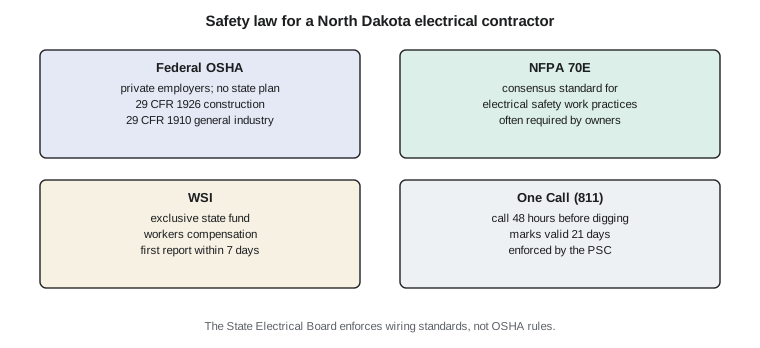
North Dakota does not run a state occupational safety and health plan. Private employers in the state, including electrical contractors, are covered by the federal Occupational Safety and Health Administration, which enforces federal standards through its area office for the region. That has two consequences for the exam. First, the safety rules are the federal ones in Title 29 of the Code of Federal Regulations, not a separate North Dakota code. Second, a question that names a North Dakota safety agency with OSHA's powers over private contractors is wrong.
Two sets of federal standards apply to electrical work. Construction work, such as wiring a new building or adding a service, falls under 29 CFR Part 1926, whose Subpart K covers electrical safety on construction sites, along with subparts on fall protection, ladders, scaffolds, excavations and personal protective equipment. Work on existing systems in an operating facility, such as maintenance in a plant or a grain elevator, can fall under the general industry standards in 29 CFR Part 1910, including Subpart S for electrical work practices and section 1910.147 for the control of hazardous energy, often called lockout and tagout.
The electrical hazards OSHA looks at
OSHA's electrical standards are about protecting workers from shock, arc flash and arc blast, and from the falls and burns those can cause. The core rule is that work should be done on deenergized equipment whenever possible, with the circuit locked and tagged out and verified dead before anyone touches it. Energized work is allowed only when deenergizing creates a greater hazard or is not feasible, and then only by qualified persons using proper procedures, protective equipment and insulated tools. The standards also cover ground fault protection for temporary power on construction sites, assured equipment grounding conductor programs, the condition of cords and tools, and clearances from overhead lines.
NFPA 70E, the standard for electrical safety in the workplace, is not itself federal law, but OSHA treats it as a recognized consensus standard, and many owners require it by contract. It sets out the risk assessment, approach boundaries, arc flash labeling and protective equipment that turn OSHA's general rules into a working program. Souris Bend's safety program follows 70E, and Kari leads the annual training. Lesson 11 notes that some continuing education providers offer 70E classes, though the board's code hours must be on the NEC.
Falls, ladders and confined spaces
Electrical contractors are hurt by falls as often as by electricity. The fall protection rules in Part 1926 require protection at specified heights on construction sites, and the ladder rules govern how ladders are set, secured and used. North Dakota work adds its own exposures: grain bins and elevators, where engulfment and dust are hazards, cold-weather work on icy surfaces, and oil-country sites with their own rules for hazardous locations. The state's wiring standards add surge arrestors and hot bearing detection for grain elevators because of those hazards, as Lesson 5 explains, but worker safety on those sites is still a federal OSHA matter.
Reporting clocks after a serious injury
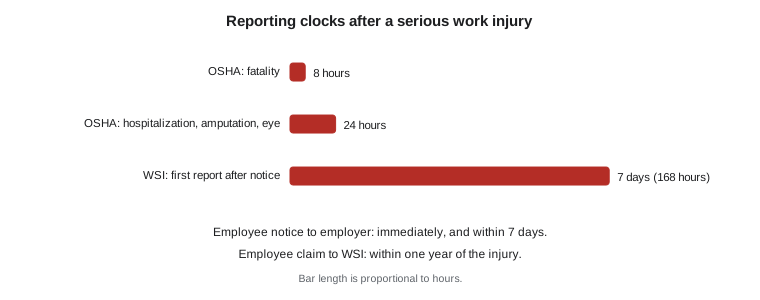
Two separate reporting systems apply after a work injury, and the exam likes to mix them up. The first is OSHA. Under 29 CFR 1904.39, an employer must report a work-related fatality to OSHA within 8 hours of learning of it, and an in-patient hospitalization, an amputation or the loss of an eye within 24 hours. The report can be made by phone or online. Employers above OSHA's size threshold must also keep injury and illness records on the OSHA logs.
The second is Workforce Safety and Insurance. Under section 65-05-01.2 of the Century Code, an injured employee must take immediate steps to notify the employer and, without good cause, no later than seven days after the accident or after the injury became apparent. Under section 65-05-01.4, the employer must file a first report of injury with WSI within seven days after receiving the employee's notice. An employer that fails to file is treated as admitting that the injury may be compensable. The employee's claim must be filed within one year after the injury, under section 65-05-01.
| Event | Report to | Deadline |
|---|---|---|
| Work-related fatality | OSHA | 8 hours |
| In-patient hospitalization, amputation or loss of an eye | OSHA | 24 hours |
| Injury reported by an employee | WSI first report of injury | 7 days after the employer receives notice |
| Employee's notice of injury to employer | Employer | Immediately, and within 7 days |
| Employee's claim | WSI | Within one year of the injury |
Workforce Safety and Insurance
North Dakota is one of a small number of states with an exclusive state fund for workers compensation. Private insurance companies do not sell workers compensation coverage for North Dakota employment. Every employer with employees covered by the law must obtain coverage from Workforce Safety and Insurance, known as WSI, and pay premiums into the state fund under section 65-04-04. A person performing services for pay is presumed to be an employee under section 65-01-03, so an electrical contractor should be careful about calling helpers independent contractors.
The coverage matters to licensing too. Lesson 8 noted that the Secretary of State contractor license requires a statement from WSI showing the contractor's account is in good standing, and the renewal requires certification that WSI premiums are paid. A contractor that falls behind with WSI can lose its contractor license.
Because coverage comes only from WSI, some protections that a private policy would include in other states are bought separately. Employers often buy employer's liability coverage, sometimes called stop-gap coverage, from a private insurer to cover claims that fall outside the workers compensation system. Whether a company needs it is a question for its insurance agent. For the exam, remember that workers compensation itself comes only from WSI.
Exclusive remedy and general contractors
When an employer is covered and has paid its premiums, workers compensation is the employee's exclusive remedy against the employer and co-workers for a work injury, under section 65-01-08, with narrow exceptions such as intentional injury. The injured worker may still sue a third party whose negligence caused the injury, and WSI shares in any recovery. Under section 65-01-02, employees of a subcontractor are treated as employees of the general contractor until the subcontractor obtains coverage and pays its premiums, and the general contractor's exposure in that case is the unpaid premium owed to WSI. A general contractor or an electrical contractor that hires subcontractors should collect a WSI certificate from each before the sub starts work.
Worked problem
Two clocks after one accident
On a Monday morning a Souris Bend journeyman is burned by an arc flash while troubleshooting a panel and is admitted to the hospital overnight. He tells Kari about the injury at the hospital that afternoon. What reports are due?
Show solution
- In-patient hospitalization must be reported to OSHA within 24 hours of the employer learning of it, so by Tuesday morning.
- The employee has given notice to the employer on Monday.
- The employer must file the first report of injury with WSI within seven days after receiving that notice, so by the following Monday.
- Preserve the scene and the equipment, and record the incident in the company's OSHA log if the company keeps one.
Answer: OSHA within 24 hours, WSI within 7 days.
# Two reporting clocks after one accident (illustrative times)
from datetime import datetime, timedelta
learned = datetime(2026, 11, 2, 15, 30)       # employer learns of the hospitalization
notice = datetime(2026, 11, 2, 15, 30)         # employee's notice to the employer
osha_due = learned + timedelta(hours=24)
wsi_due = notice + timedelta(days=7)
print(f"OSHA hospitalization report due by: {osha_due.isoformat(sep=" ", timespec="minutes")}")
print(f"WSI first report of injury due by: {wsi_due.date().isoformat()}")OSHA hospitalization report due by: 2026-11-03 15:30 WSI first report of injury due by: 2026-11-09
Digging safely
Electrical contractors dig: trenches for services, feeders to outbuildings, and runs to irrigation pivots and grain bins. North Dakota's one-call law, Century Code chapter 49-23, requires anyone planning to excavate to notify the one-call center by calling 811 at least 48 hours before digging. Facility operators mark their underground lines at no cost, and the Public Service Commission's page says markings are valid for 21 days. The Public Service Commission enforces the damage prevention law. A master should make the locate request part of every job that involves digging and keep the ticket number in the job file.
Building a simple safety program
Small contractors do not need a binder the size of the code book, but they do need a few things in writing: a lockout and tagout procedure, an energized work policy that says when energized work is allowed and who approves it, a fall protection plan for the work the company does, a list of required protective equipment, an injury reporting procedure with the OSHA and WSI clocks on it, and a record of training. Kari's version for Souris Bend fits on eight pages and is reviewed every January at the company meeting. WSI offers safety programs and resources for North Dakota employers, and using them can be part of a company's plan.
Training and young workers
Training is where safety programs succeed or fail. OSHA's standards require that workers who face electrical hazards be trained in the safe work practices that apply to their jobs, and that qualified persons be trained to recognize exposed live parts, determine voltages and keep the right approach distances. Training should be documented with the date, the content and the trainer. Apprentices in North Dakota must be over sixteen under the board's rules, and federal child labor rules limit the work younger workers may do. A master who hires a high school apprentice should check both before assigning work.
Kari's training records at Souris Bend list each worker's training on lockout and tagout, energized work, arc flash protective equipment, fall protection, ladders, grain bin hazards and first aid, with the date and the trainer for each. When the company bids work at a plant or a refinery, the owner often asks for those records before the crew is allowed on site.
Common mistakes
MistakeReporting a hospitalization to OSHA within seven days.
InsteadIn-patient hospitalization must be reported to OSHA within 24 hours; seven days is the WSI first-report clock.
MistakeBuying workers compensation from a private insurer for North Dakota employees.
InsteadNorth Dakota coverage comes only from WSI, the exclusive state fund.
MistakeAssuming North Dakota runs a state OSHA plan.
InsteadPrivate employers are under federal OSHA.
MistakeTreating NFPA 70E as optional because it is not a regulation.
InsteadOSHA treats it as a recognized consensus standard, and many owners require it.
MistakeStarting a trench before the locate request matures.
InsteadCall 811 at least 48 hours before digging.
Summary and key terms
- Federal OSHA enforces workplace safety for private employers in North Dakota; there is no state plan.
- Construction work falls under 29 CFR Part 1926 and plant maintenance can fall under Part 1910, including lockout and tagout.
- Report fatalities to OSHA within 8 hours and hospitalizations, amputations or eye loss within 24 hours.
- Employees notify the employer within 7 days; the employer files the WSI first report within 7 days of notice; claims are due within one year.
- WSI is the exclusive state fund for workers compensation, and its good standing is required for the Secretary of State license.
- Call 811 at least 48 hours before digging; marks are valid for 21 days.
- WSI
- Workforce Safety and Insurance, North Dakota's exclusive state workers compensation fund.
- First report of injury
- The employer's report to WSI, due within seven days after the employee's notice.
- Lockout and tagout
- Procedures under 29 CFR 1910.147 for controlling hazardous energy during service and maintenance.
- NFPA 70E
- The consensus standard for electrical safety in the workplace.
- Exclusive remedy
- The rule that workers compensation is the injured employee's only remedy against a covered employer.
Practice problems
Work each problem on paper first, then reveal the answer to check.
Which agency enforces OSHA standards on a Souris Bend jobsite?
Show answer
Federal OSHA; North Dakota has no state plan.
An employee loses a fingertip in a tool accident. How soon must it be reported to OSHA?
Show answer
Within 24 hours, as an amputation.
Can Souris Bend buy workers compensation coverage from a private insurer for its North Dakota crews?
Show answer
No; coverage comes only from WSI.
How long does an injured employee have to file a WSI claim?
Show answer
Within one year after the injury.
How far ahead must the company call 811 before trenching a service?
Show answer
At least 48 hours.
Lesson quiz · 5 questions
Score 60% or more to complete this lesson.
Create a free account to save your progress, take quizzes and earn a certificate.