
MELU-309 · Lesson 8 of 12 · 20 min
Contractor licensing, insurance and bonding
▶ Video coming soon A video version of this lesson is on the way.
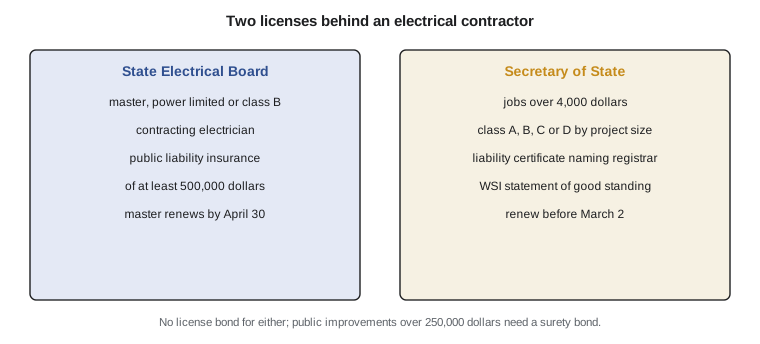
Souris Bend holds two licenses that most customers never see. The first is Dale's master electrician license from the State Electrical Board, which lets the company contract for electrical work. The second is a contractor license from the North Dakota Secretary of State, which every contractor needs for jobs over 4,000 dollars, whatever the trade. Behind both sit insurance certificates and a statement from Workforce Safety and Insurance. When Kari becomes the contracting master, the electrical side changes hands, and the Secretary of State file has to stay current too. This lesson covers both licenses, the insurance each requires, and where bonds do and do not come into it.
The electrical side: who may contract
Section 43-09-20 of the Century Code is the gate. Only a master or a power limited electrician may contract for electrical or power limited installations, and a class B electrician may contract only for farmstead wiring and residential wiring in one- and two-family dwellings in cities of 2,500 or fewer people. A business that wants to do electrical contracting must therefore have a licensed master, power limited or class B electrician who is its contracting electrician, within that electrician's scope.
The same section sets the insurance rule. A licensee acting as a contractor must file with the board proof of public liability insurance from a licensed insurance carrier, with limits of at least 500,000 dollars. The board's rule on masters says the same in its own words: a contracting master must show proof of liability insurance, and a master of record must show insurance covering the organization. Failing to keep the insurance is one of the grounds for discipline in section 43-09-15, so a lapse is not just a paperwork problem. Arlo diaries the policy renewal date and sends the new certificate to the board the week the policy renews.
The Secretary of State contractor license
Century Code chapter 43-07 requires a license from the Secretary of State, acting as registrar, to act as a contractor on any job where the cost exceeds 4,000 dollars. The definition of contractor is broad and includes subcontractors and nonresident contractors. The license is in addition to any trade license, and it is required whether the business is a general contractor, an electrical contractor or any other trade.
Section 43-07-07 sets four classes by the largest single project the contractor may take. The classes are not about trade or skill. They are about project size.
| Class | Largest single project | Initial fee | Renewal fee |
|---|---|---|---|
| A | No limit | 450 dollars | 90 dollars |
| B | Up to 500,000 dollars | 300 dollars | 60 dollars |
| C | Up to 300,000 dollars | 225 dollars | 45 dollars |
| D | Up to 100,000 dollars | 100 dollars | 30 dollars |
Under section 43-07-04, an applicant must be at least 18, file a sworn application describing experience and qualifications and naming the class, and include a copy of a certificate of liability insurance and a statement from Workforce Safety and Insurance showing that the contractor's coverage is in good standing. The registrar may request a criminal history record check at the applicant's expense. Nonresident applicants appoint the registrar as agent for service of process unless they already have a registered agent on file.
The contractor year and renewal
The contractor year runs from March 2 to March 1. Licenses expire on March 1, and renewal applications are due before March 2. A late renewal is allowed until June 1 with a 50-dollar penalty; after that the license expires. The renewal must list projects over 50,000 dollars completed in the prior calendar year, include a liability insurance certificate naming the registrar as certificate holder, and certify that the contractor has paid its payroll taxes, income tax, Workforce Safety and Insurance premiums and unemployment premiums.
Keep the two calendars apart. The Secretary of State license renews before March 2. Dale's master license expires on April 30. Kari's journeyman license expires on March 31. Arlo keeps all three dates on the office wall calendar with a reminder six weeks ahead.
# Souris Bend's licensing calendar for 2027 (from the statute and board rules)
from datetime import date, timedelta
deadlines = {
    "Secretary of State contractor license renewal (due before March 2)": date(2027, 3, 1),
    "Journeyman licenses expire": date(2027, 3, 31),
    "Master license expires": date(2027, 4, 30),
    "Late SOS renewal ends; license expires if not renewed": date(2027, 6, 1),
}
for what, when in sorted(deadlines.items(), key=lambda kv: kv[1]):
    remind = when - timedelta(weeks=6)
print(f"{when}: {what} (reminder {remind})")2027-03-01: Secretary of State contractor license renewal (due before March 2) (reminder 2027-01-18) 2027-03-31: Journeyman licenses expire (reminder 2027-02-17) 2027-04-30: Master license expires (reminder 2027-03-19) 2027-06-01: Late SOS renewal ends; license expires if not renewed (reminder 2027-04-20)
Good standing and lapses
A license can be classified as not in good standing if the contractor's liability insurance lapses or if its business name or entity registrations with the Secretary of State lapse. The contractor then has thirty days to correct the problem before revocation proceedings may begin. Name changes must be filed within ten days, with a 10-dollar fee. For a company like Souris Bend, the most likely problem is a lapse in insurance, which affects both the Secretary of State license and the master's standing with the electrical board at the same time.
Working without a license
Contracting without a required Secretary of State license is a class A misdemeanor under section 43-07-02, and the registrar may also assess a civil penalty of up to three times the license fee, which must be paid before a license will be issued. More important for a business, an unlicensed contractor may not bring or maintain a claim in court related to its contracting business. That means an unlicensed contractor may be unable to sue for payment, which can be the end of a collection or a lien claim. Lesson 9 returns to this.
The statute adds rules that affect bidding and permits. A bid must include a copy of the contractor's license, and the contractor must have held the license at least ten days before the bid date. A contractor applying for a building permit must give the license number. On public contracts, the contractor must show that delinquent state taxes are paid before the contract is signed, and public contracts must give a preference to North Dakota residents, with veterans given priority.
Insurance and Workforce Safety and Insurance
Two kinds of coverage are required. The first is liability insurance, which protects third parties and their property from harm caused by the contractor's work. It is required both by the electrical board, at the 500,000-dollar minimum, and by the Secretary of State, which asks for a certificate naming the registrar. Many owners and general contractors require higher limits by contract. The second is workers compensation, which in North Dakota is provided only by Workforce Safety and Insurance, the state's exclusive fund, as Lesson 10 explains. The Secretary of State requires a statement from WSI that the contractor's account is in good standing.
A business can carry other insurance, such as commercial auto, an umbrella policy, or tools and equipment coverage, but those are business decisions, not licensing requirements. The exam tests the required minimums and who receives the certificates.
Bonds
Insurance and bonds are different things. Insurance pays for losses the contractor causes. A surety bond is a promise by a surety company that the contractor will perform or pay; if it does not, the surety pays the owner or the unpaid workers and suppliers and then seeks repayment from the contractor. North Dakota does not require a license bond for either the electrician license or the Secretary of State contractor license. The old bond and undertaking provisions in both chapters were repealed.
Bonds do appear on public work. Section 48-01.2-10 requires a contractor on a public improvement contract over 250,000 dollars to give a surety bond at least equal to the contract price, conditioned on performing the contract and paying all bills for labor, supplies and materials, including those of subcontractors. Anyone with a lawful claim may sue on the bond. Because liens cannot attach to public property, the bond is the security for subcontractors and suppliers on public jobs, as Lesson 9 explains. Private owners may also require bonds by contract.
Worked problem
Choosing the right Secretary of State class
Souris Bend holds a class B Secretary of State license. A school district invites bids on a 640,000-dollar electrical package for a new gym. Can Souris Bend bid, and what else will the job require?
Show solution
- Class B allows single projects up to 500,000 dollars.
- The 640,000-dollar package exceeds that limit, so Souris Bend needs a class A license, held at least ten days before the bid date.
- The contract is a public improvement over 250,000 dollars, so a surety bond at least equal to the contract price is required.
- The electrical work still needs a contracting master, insurance on file with the board, and a wiring certificate.
Answer: Upgrade to class A at least ten days before the bid, arrange the bond, and keep the electrical side in order.
Retainage and warranties
Two more provisions of chapter 43-07 affect contracts. Section 43-07-23 limits retainage to one tenth of each estimate until the project is half complete, with interest payable on retained funds that are invested. Section 43-07-26 sets a notice procedure for defects in a one- or two-family dwelling or an improvement over 2,000 dollars: before suing or arranging non-emergency repairs, the owner gives the contractor written notice within six months of discovering the defect, and the contractor responds within thirty business days. The contractor must give the owner written notice of these rules at closing or completion.
Subcontracting and the license chain
Electrical contractors often work as subcontractors to a general contractor, and sometimes hire subcontractors of their own for specialty work such as fire alarm or low-voltage systems. Each business in the chain needs its own Secretary of State license if its share of a job exceeds 4,000 dollars, and the electrical work must be done under a contracting electrician of the right class. A general contractor that does not hold an electrical license may not contract for the electrical work itself unless it contracts through a licensed electrical contractor. Before hiring a sub, Arlo collects its Secretary of State license number, its liability certificate and its WSI certificate.
Subcontract terms deserve the same attention as license numbers. A written subcontract should say who files the wiring certificate, who pays the inspection fee, how changes are approved, and when payment is due. When Souris Bend works as a sub, the company's own contract with the general contractor sets those terms, and Arlo reads the payment and lien waiver clauses before Dale signs.
Common mistakes
MistakeThinking the electrician license is the only license a contractor needs.
InsteadJobs over 4,000 dollars also need a Secretary of State contractor license.
MistakeAssuming the Secretary of State class depends on trade.
InsteadClasses A to D are set by the largest single project the contractor may take.
MistakeBuying a license bond to get licensed.
InsteadNorth Dakota requires no license bond for either license; bonds arise on public work over 250,000 dollars or by contract.
MistakeLetting the liability policy lapse for a few days.
InsteadA lapse affects board discipline and Secretary of State good standing.
MistakeRenewing the Secretary of State license on April 30 with the master license.
InsteadThe contractor year ends March 1; renew before March 2.
Summary and key terms
- Only masters and power limited electricians may contract, and class B electricians only within their scope.
- Contracting electricians file proof of liability insurance of at least 500,000 dollars with the board.
- Jobs over 4,000 dollars need a Secretary of State contractor license, class A to D by project size.
- Secretary of State licenses renew before March 2, with late renewal to June 1 and a 50-dollar penalty.
- Unlicensed contracting is a class A misdemeanor and bars court claims related to the business.
- No license bond is required; public improvements over 250,000 dollars require a surety bond equal to the contract price.
- Registrar
- The North Dakota Secretary of State, acting under chapter 43-07.
- Contractor year
- The licensing year for Secretary of State contractor licenses, March 2 to March 1.
- Public liability insurance
- Insurance covering injury and property damage to others, required at 500,000 dollars for contracting electricians.
- Surety bond
- A promise by a surety that a contractor will perform or pay, with recourse to the contractor.
- Good standing
- Secretary of State status that can be lost when insurance or entity registrations lapse.
Practice problems
Work each problem on paper first, then reveal the answer to check.
Does a 3,500-dollar service call need a Secretary of State contractor license?
Show answer
Not under the 4,000-dollar threshold, though the electrical license, insurance and any certificate rules still apply.
What liability limit must a contracting electrician file with the board?
Show answer
At least 500,000 dollars.
Which Secretary of State class allows a 450,000-dollar project?
Show answer
Class B or class A.
When is the Secretary of State renewal due?
Show answer
Before March 2.
Does North Dakota require a license bond for an electrical contractor?
Show answer
No; bonds are required on public improvements over 250,000 dollars or by contract.
Lesson quiz · 5 questions
Score 60% or more to complete this lesson.
Create a free account to save your progress, take quizzes and earn a certificate.