
MELU-309 · Lesson 1 of 12 · 19 min
How electrical licensing works in North Dakota
▶ Video coming soon A video version of this lesson is on the way.
Kari Lindgren has been a licensed journeyman electrician in North Dakota since the spring of 2019. She finished a two-year electrical program, registered as an apprentice with the State Electrical Board, and logged her hours on farm services, oil-country shops and new homes before passing the journeyman exam in Bismarck. For the last five years she has run crews for Souris Bend Electric, Inc., a sixteen-person contractor in Minot. The company is invented for this course, but the questions it faces are real. Its owner, Dale Brekke, has been a contracting master electrician since 1996, and his license is what allows Souris Bend to contract for electrical work, file wiring certificates and supervise its electricians and apprentices. Dale is sixty-three and plans to step back when his license comes up for renewal on April 30, 2027. He has asked Kari to earn her master license so that she can take over as the company's contracting master, and this course follows her from her first question to exam day.
This is the North Dakota course in the HSM University master electrician exam prep series. The core courses, MELU-101 through MELU-107, teach the National Electrical Code skills that every master-level exam tests: navigating the code, load calculations, conductors and overcurrent protection, grounding and bonding, motors and transformers, special occupancies, and business and law. This course adds what is specific to North Dakota: the State Electrical Board and its statute, the license classes and how a master qualifies, the board's own examination, the wiring standards the board adopts on top of the NEC, wiring certificates and state inspection, contractor licensing through the Secretary of State, construction liens, safety law and Workforce Safety and Insurance, and renewal.
Two cautions apply to every lesson. First, licensing rules change. The facts in this course were checked in November 2026 against North Dakota Century Code chapter 43-09, the board's administrative rules in title 24.1 of the North Dakota Administrative Code, the board's licensing, examination, wiring certificate and continuing education pages, Century Code chapters 43-07 and 35-27, and the pages of Workforce Safety and Insurance and the Public Service Commission. The lessons say so when a detail could not be confirmed. Before you apply, pay a fee or sign up for an exam, check the current pages yourself or call the board. Second, electrical codes are copyrighted. This course cites code articles and sections by number and explains them in plain words, but it never reproduces their text, tables or figures. Keep your own copy of the code your exam uses open beside you.
One state board for the whole state
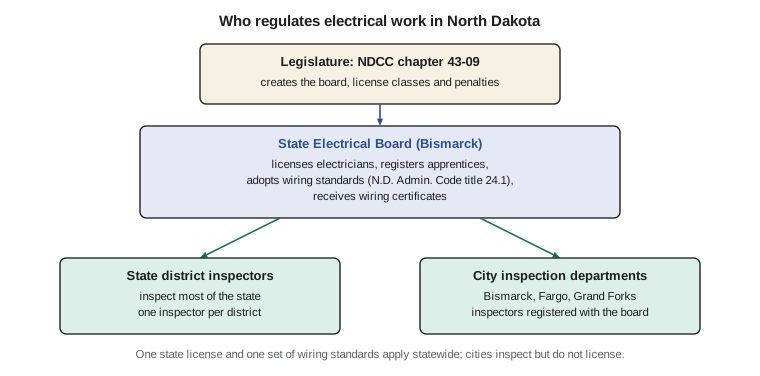
North Dakota licenses electricians at the state level. A single agency, the North Dakota State Electrical Board, examines and licenses electricians, registers apprentices, adopts the state's electrical wiring standards, approves continuing education, receives wiring certificates and runs a statewide inspection program. A license the board issues is good everywhere in the state. Cities do not issue their own electrician licenses, although a few large cities run their own inspection departments under the board's oversight, as Lesson 6 explains.
The board's authority comes from North Dakota Century Code chapter 43-09, titled Electricians. The chapter also covers elevators and other conveyances, which the board now regulates as well, but this course leaves conveyances aside. The board writes rules to carry out the statute, and those rules sit in title 24.1 of the North Dakota Administrative Code. Article 24.1-03 covers licensing, article 24.1-04 education, article 24.1-05 wiring certificates and fees, and article 24.1-06 the wiring standards that amend the National Electrical Code. A master candidate needs to know both layers, because the exam tests the laws, rules and wiring standards of North Dakota as well as the code itself.
The board and its staff
Section 43-09-02 sets up the board as six members appointed by the governor for five-year terms. The seats are spread across the industry and the public: a contractor master electrician, a journeyman, a member who represents rural electric cooperative consumers, an investor-owned utility representative, an elevator mechanic and a public member with no ties to the electrical industry. The board meets every January in Bismarck and can call special meetings on written notice. Day to day, an executive director and staff in Bismarck run the office, process applications and wiring certificates, schedule exams and supervise the state's electrical inspectors.
For the exam, remember who holds which power. The board as a body adopts rules, sets fees within the statute and decides license discipline. The executive director administers the laws and rules on the board's behalf, can grant special permission for an alternative method in writing before work begins, and decides disputes about inspections in the first instance, with an appeal to the board. Inspectors inspect, approve or condemn installations and issue correction orders.
The license classes
Section 43-09-10 creates four classes of electrician license: master, journeyman, class B and power limited. The board also registers apprentice electricians and power limited apprentices. Each class has its own scope, set by the definitions in section 43-09-01 and by the rules.
| Credential | What it allows | Experience basis |
|---|---|---|
| Master electrician | Plan, lay out and supervise electrical installations; a contracting master may contract | One year and 2,000 hours as a licensed journeyman |
| Journeyman electrician | Wire, install and repair under a contracting master or master of record | 8,000 hours over at least three years as a registered apprentice |
| Class B electrician | Farmstead wiring and one- and two-family dwellings in cities of 2,500 or fewer | 3,000 hours of farmstead or residential work |
| Power limited electrician | Plan and supervise power limited systems | 6,000 hours as a power limited apprentice, or a recognized certification |
| Apprentice registration | Learn the trade under direct, constant supervision | Register with the board and renew each year |
The master license is the one that matters for a company. Under section 43-09-20, only a master or a power limited electrician may contract for electrical or power limited installations, and a class B electrician may contract only within the class B scope. A journeyman cannot contract on his or her own. That is why Souris Bend's ability to bid, sign contracts and file wiring certificates depends on Dale's master license, and why the company needs Kari to have her own before Dale steps back.
Three kinds of master
The rules divide masters into three kinds, and the exam expects candidates to know the difference. A contracting master is an individual responsible for following all of North Dakota's wiring laws and rules on the jobs he or she contracts and supervises, and must show proof of liability insurance. A master of record is responsible for compliance on behalf of a partnership, company, corporation, limited liability company or association, must show insurance covering the organization, and may work only on property that the organization owns or leases, such as a plant or a campus. A noncontracting master has passed the master exam and holds the license, but carries the same responsibility as a journeyman and must work under the supervision of a contracting master or master of record.
Dale is a contracting master. A hospital maintenance chief in Minot who holds a master license and looks after the hospital's own buildings would be a master of record. A master electrician who works for Souris Bend as a foreman, without taking responsibility for the company's work, would be a noncontracting master. Lesson 7 returns to the duties that come with each role, including the rule that a master may hold privileges for only one shop or business.
What stays with each job
Because the board regulates the whole state, most of the rules that follow a job are the same wherever the job is. The 2026 edition of the National Electrical Code, as amended by the board's wiring standards, has applied statewide since July 1, 2026. A wiring certificate is required for installations valued at 500 dollars or more and for certain kinds of work regardless of cost, and the supervising master, class B or power limited electrician files it. A state inspector, or in Bismarck, Fargo and Grand Forks a city inspector, inspects the work, and the energy supplier does not energize an installation until the state's requirements are met. Lessons 5 and 6 cover these rules.
Some rules come from other parts of state law. A company doing any job over 4,000 dollars needs a contractor license from the Secretary of State under chapter 43-07, separate from the electrician license. Construction liens are governed by chapter 35-27. Workers compensation runs through Workforce Safety and Insurance, the state's exclusive fund, under title 65. Workplace safety standards for private employers are enforced by federal OSHA, because North Dakota has no state plan. Cities still issue building permits and zoning approvals and may run their own inspection programs within city limits.
Enforcement
The statute gives the board several tools. Under section 43-09-15 the board may deny, suspend, revoke or refuse to renew a license for reasons that include failing to follow the wiring standards, gross negligence or misconduct, fraud, failing to correct work found out of compliance, failing to keep the required insurance, unpaid debts to the board and failing to meet the education requirement. Under section 43-09-23 any violation of the chapter is a class B misdemeanor, and the board can issue cease and desist orders and ask a court for an injunction, with costs and attorney's fees. Section 43-09-09.2 adds escalating penalties for advertising electrical contracting without a license. The rules add investigative fees, late wiring certificate charges and reinspection fees, covered in later lessons.
For a master, enforcement is personal. The contracting master is the person the board holds responsible for the work done under the license. Dale's advice to Kari is to keep the paperwork dull: a current license and insurance certificate on file, a wiring certificate filed before work starts, apprentices registered and supervised, inspections requested before work is covered, corrections made on time and a job file for every certificate.
How this course is organized
The lessons follow Kari's path. Lesson 2 covers eligibility for the master license, Lesson 3 the application and the exam invitation, and Lesson 4 the exam format and references. Lesson 5 explains the NEC as adopted in North Dakota and the state amendments, and Lesson 6 wiring certificates, inspections and the inspection authority. Lesson 7 covers the duties and responsibilities of the master, Lesson 8 contractor licensing, insurance and bonding, and Lesson 9 contracts and construction liens. Lesson 10 covers safety law, OSHA and Workforce Safety and Insurance, Lesson 11 renewal and continuing education, and Lesson 12 a practice review and test-day strategy. Every lesson ends with a quiz that mixes multiple choice, true or false, number, ordering and matching questions, and the course ends with a final exam.
The calculator below shows the first planning Kari did. Dale wants to step back on April 30, 2027. Kari needs time to apply, have her experience verified, receive an exam invitation, study, sit the exam, possibly retest, receive her license and be named the company's contracting master with proof of insurance. Change the numbers to fit your own plan.
# Kari's planning check (illustrative months, counted from September 2026)
months_until_dale_steps_back = 8
steps = {
    "application and experience verification": 1,
    "exam invitation and sign-up": 1,
    "study for the closed and open book parts": 2,
    "sit the exam (December session)": 1,
    "retest allowance, if needed": 2,
    "license issued, insurance filed as contracting master": 1,
}
needed = sum(steps.values())
for step, months in steps.items():
    print(f"{step}: {months} months")
print(f"Total: {needed} months; margin: {months_until_dale_steps_back - needed} months")application and experience verification: 1 months exam invitation and sign-up: 1 months study for the closed and open book parts: 2 months sit the exam (December session): 1 months retest allowance, if needed: 2 months license issued, insurance filed as contracting master: 1 months Total: 8 months; margin: 0 months
The margin is thin, which is why Kari applied in September rather than waiting for the new year. The retest line matters: Lesson 4 explains that a low score adds a waiting period before a candidate can retest, so a poor first attempt can cost months, not weeks.
Common mistakes
MistakeAssuming cities issue their own electrician licenses in North Dakota.
InsteadThe State Electrical Board licenses electricians statewide; some cities inspect, but they do not license.
MistakeThinking a journeyman may contract for small jobs.
InsteadOnly a master or power limited electrician may contract, and a class B only within the class B scope (NDCC 43-09-20).
MistakeTreating every master license as the same.
InsteadThe rules distinguish the contracting master, the master of record and the noncontracting master.
MistakeBelieving the electrician license replaces the Secretary of State contractor license.
InsteadA company doing jobs over 4,000 dollars also needs a contractor license under chapter 43-07.
MistakeAssuming North Dakota runs a state OSHA plan.
InsteadPrivate employers in North Dakota are under federal OSHA.
Summary and key terms
- The State Electrical Board licenses electricians statewide under NDCC chapter 43-09, with rules in N.D. Admin. Code title 24.1.
- The license classes are master, journeyman, class B and power limited; apprentices register with the board.
- Only a master or power limited electrician may contract; a class B may contract only within its farmstead and small-city residential scope.
- The rules distinguish contracting masters, masters of record and noncontracting masters.
- The 2026 NEC with the board's wiring standards has applied statewide since July 1, 2026.
- Contractor licensing, liens, workers compensation and OSHA come from other bodies and other chapters of law.
- State Electrical Board
- The North Dakota agency that licenses electricians, adopts wiring standards and inspects electrical work.
- NDCC chapter 43-09
- The Century Code chapter on electricians that creates the board and the license classes.
- Contracting master
- A master responsible for compliance on the jobs he or she contracts, who must show proof of liability insurance.
- Master of record
- A master responsible for an organization's own electrical work on property it owns or leases.
- Noncontracting master
- A licensed master who works under a contracting master or master of record with journeyman-level responsibility.
Practice problems
Work each problem on paper first, then reveal the answer to check.
Who issues Kari's master license?
Show answer
The North Dakota State Electrical Board.
Can a journeyman sign a contract to wire a shop building?
Show answer
No; only a master or power limited electrician may contract for electrical installations (a class B only within its scope).
Which NEC edition applies to a job in Minot started in November 2026?
Show answer
The 2026 NEC as amended by the board's wiring standards, in effect statewide since July 1, 2026.
Which agency issues the company's contractor license?
Show answer
The North Dakota Secretary of State, under chapter 43-07.
A plant engineer with a master license maintains only his employer's plant. What kind of master is he?
Show answer
A master of record, limited to property the organization owns or leases.
Lesson quiz · 5 questions
Score 60% or more to complete this lesson.
Create a free account to save your progress, take quizzes and earn a certificate.