
MELU-308 · Lesson 9 of 12 · 19 min
Contracts and mechanics' liens in North Carolina
▶ Video coming soon A video version of this lesson is on the way.
The church fellowship hall outside Elon was a good job until the last payment. The building committee changed treasurers in the middle of the project, the final invoice for 21,400 dollars sat unpaid for six weeks, and the new treasurer stopped returning calls. Glenn handed the file to Keisha. "This is the part of the business exam people skip," he said, "and it's the part that decides whether you get paid." This lesson covers the contract basics an electrical contractor needs, North Carolina's mechanics' lien law in Chapter 44A, the lien agent system, the main deadlines, prompt payment rules and what happens on public jobs where liens are not available. Lien rights are strict, so the deadlines and notices deserve close attention.
Contract basics
Electrical work should be done under a written contract that identifies the parties by their exact legal names, describes the scope by reference to drawings and specifications, states the price and how it is paid, sets the schedule, and explains how changes are handled. For subcontracts, the general contractor's form often controls, and it may contain provisions on payment timing, retainage, insurance, indemnity, warranties, dispute resolution and termination. The contractor should read every subcontract before signing, mark up terms it cannot accept, and keep the signed copy in the job file. The NASCLA business guide on the board's reference list covers contract law in detail.
Change orders deserve special attention. Most contracts require changes to be authorized in writing before the work is done, and an electrician who installs extra work on a verbal request may have trouble getting paid for it. Change orders also count toward the project's value for license classification purposes, as Lesson 2 described. Haw River's rule was that every change got a written change order request with a price before the crew started, unless the work was an emergency, in which case the superintendent documented it the same day.
Who can claim a lien
North Carolina's lien law gives people who improve real property a way to secure payment. A contractor who deals directly with the owner can claim a lien on the owner's property for the amount owed. Subcontractors and suppliers who did not contract with the owner have rights too, through a combination of a lien on funds the owner owes the contractor above them and, in some situations, subrogation to the contractor's lien rights. The details depend on the tier of the claimant and the notices given, which is why lien law has a reputation for traps. An agreement that waives the right to file a lien in exchange for being awarded a contract is against public policy and unenforceable, although lien rights can be subordinated or released in other circumstances.
The lien agent system
North Carolina uses a lien agent system to protect lien rights against buyers and lenders who may not know about unpaid work. For projects where the improvement costs 30,000 dollars or more, measured at the time the original building permit is issued, the owner must designate a lien agent, who must be a title insurance company or title insurance agent licensed in North Carolina. The lien agent's identity is posted on the permit and available through the LiensNC online system. Contractors, subcontractors and suppliers protect themselves by serving a notice to lien agent, usually through LiensNC.
The notice to lien agent should be served within 15 days after the claimant first furnishes labor or materials to the project; a notice served later still has value if it is served before the property is conveyed to a buyer. Without a timely notice, a lien can be defeated by a sale or a new loan, even if the work was done and never paid for. Because the notice is simple and inexpensive, many contractors serve one on every project as soon as work starts, along with any notice of subcontract that the project calls for.
The notice of contract and notice of subcontract
On some projects, the owner or contractor files and posts a notice of contract within a set time after the contract is awarded or the permit is issued. When that happens, lower-tier subcontractors, such as a second- or third-tier sub, must give a notice of subcontract to receive notice of each payment and to protect certain rights. The rules are detailed, and the safest approach for an electrical subcontractor is to check the permit and the job site for posted notices, serve its own notices early, and ask the general contractor for the lien agent and any notice of contract at the start of the job.
The claim of lien
If payment is not made, the claimant may file a claim of lien on real property. Under section 44A-12, the claim must be filed with the clerk of superior court in each county where the property is located, no later than 120 days after the claimant last furnished labor or materials at the site. The claim follows a statutory form that includes the names and addresses of the claimant, the record owner and the party the claimant contracted with, a description of the property, the dates labor or materials were first and last furnished, a general description of the work and the amount claimed. The claimant must serve the claim on the record owner as the statute requires and certify that service. Amendments are not allowed, although a claim may be canceled and replaced within the original filing period.
Enforcing the lien
Filing a claim of lien is not the end. The claimant must start a lawsuit to enforce the lien within 180 days after the last furnishing of labor or materials, or the lien is lost. In practice, that means a contractor who files near the 120-day deadline has only about two months left to file suit. Many claims are settled after filing, because the owner cannot sell or refinance the property easily with a lien on record, but the suit deadline still controls.
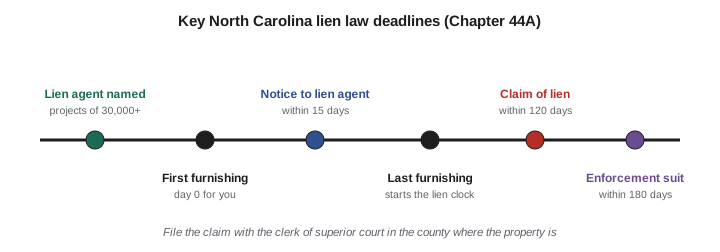
# Lien deadlines from furnishing dates (study aid; confirm with a lawyer)
from datetime import date, timedelta
first = date(2026, 3, 9)
last = date(2026, 8, 14)
print("notice to lien agent by:", first + timedelta(days=15))
print("claim of lien by:      ", last + timedelta(days=120))
print("enforcement suit by: ", last + timedelta(days=180))notice to lien agent by: 2026-03-24 claim of lien by: 2026-12-12 enforcement suit by: 2027-02-10
Worked problem
The fellowship hall lien
Haw River first worked at the fellowship hall on March 9 and last worked there on August 14, when it finished the final punch list. The church owes 21,400 dollars. Haw River served a notice to lien agent on March 16. By what dates must it file a claim of lien and start an enforcement suit, and is its notice timely?
Show solution
- The notice to lien agent was served 7 days after first furnishing, within the 15 days.
- The claim of lien is due within 120 days after August 14, which is December 12.
- The enforcement suit is due within 180 days after August 14, which is February 10 of the next year.
- Haw River contracted directly with the church, so it can claim a lien on the property.
Answer: The notice was timely; file the claim by December 12 and, if not paid, start suit by February 10.
In the end, a firm letter from Haw River's lawyer, attaching a draft claim of lien, produced a check within two weeks. Glenn's point to Keisha was that the threat worked only because the deadlines were still open and the notice to lien agent had been served in March.
Prompt payment
North Carolina has prompt payment rules for construction in Chapter 22C of the General Statutes, which in general terms require contractors to pay their subcontractors within a short period after receiving payment for their work, provide for interest on late payments, and limit the use of pay-if-paid clauses that make a subcontractor's payment depend on the owner paying the contractor. Public construction has its own payment and retainage rules. The exact time limits, exceptions and remedies are in the statutes and the NASCLA guide, and they are a common exam topic.
Public projects and payment bonds
Liens generally cannot be placed on public property, such as a public school or a city building. On public projects, subcontractors and suppliers rely instead on the payment bond that state law requires the prime contractor to furnish on contracts above statutory thresholds, as Lesson 8 described. A claimant who has not been paid makes a claim against the bond, following notice and suit deadlines in the statute that differ from the lien deadlines. On the Graham school addition, Haw River would be protected by the general contractor's payment bond, not by a lien on the school.
Retainage
Many construction contracts let the owner or general contractor hold back a portion of each progress payment, called retainage, until the work is complete. Retainage protects the payer if the contractor leaves work unfinished, but it also ties up a contractor's profit for months. North Carolina law limits retainage on public construction and sets rules for when it must be released, and private contracts set their own terms within the law. Contractors should read the retainage clause before signing, track retainage owed on every job, and request its release promptly at substantial completion with the documents the contract requires, such as lien waivers, warranties, operation and maintenance manuals and as-built drawings.
# Retainage held on a job (illustrative contract terms)
contract = 241000
billed_to_date = 168700
retain_rate = 0.05        # assumed contract rate for this example
held = billed_to_date * retain_rate
paid = billed_to_date - held
print(f"billed {billed_to_date:,}  held {held:,.0f}  paid {paid:,.0f}")
print(f"retainage at completion if unchanged: {contract * retain_rate:,.0f}")billed 168,700 held 8,435 paid 160,265 retainage at completion if unchanged: 12,050
Documentation that wins payment disputes
Whether a dispute is settled by a phone call, a lien or a lawsuit, the contractor with the better records usually wins. Useful records include the signed contract and every change order, daily reports showing who was on site and what was done, delivery tickets that prove when materials arrived, inspection results, correspondence about delays and changes, and pay applications with the owner's or general contractor's responses. Daily reports also prove the last date of furnishing, which starts the lien clock; a punch-list visit to fix a minor item may or may not extend that date, depending on the facts, so contractors should not rely on small trips to stretch a deadline.
Lien waivers and releases
Owners and lenders often ask for lien waivers or releases with each payment, especially on larger projects. A conditional waiver takes effect only when the payment is actually received; an unconditional waiver takes effect when signed. Contractors should sign only the waivers that match the payment they are receiving, avoid unconditional waivers before the money is in the bank, and keep copies. Remember that an agreement to waive lien rights in order to be awarded a contract is unenforceable, but waivers given in exchange for payment are a normal part of construction.
Common mistakes
MistakeWaiting until payment is late to serve a notice to lien agent.
InsteadServe it within 15 days after first furnishing, on every project where one is required.
MistakeCounting the 120 days from the invoice date.
InsteadThe claim deadline runs from the claimant's last furnishing of labor or materials at the site.
MistakeFiling a claim of lien and then waiting.
InsteadStart the enforcement suit within 180 days after last furnishing, or the lien is lost.
MistakeTrying to lien a public school.
InsteadUse the payment bond on public projects.
Summary and key terms
- Write contracts carefully and get change orders in writing before doing extra work.
- For improvements of 30,000 dollars or more, the owner designates a lien agent, and claimants serve a notice to lien agent, usually within 15 days of first furnishing, through LiensNC.
- A claim of lien must be filed with the clerk of superior court within 120 days after the claimant's last furnishing and served on the owner.
- A suit to enforce the lien must start within 180 days after last furnishing.
- Prompt payment rules in Chapter 22C govern payment down the chain, and payment bonds replace liens on public projects.
- Lien agent
- A title insurer or agent designated by the owner to receive notices from people furnishing labor or materials.
- Lien agent notice
- A notice served on the lien agent that protects a lien against later buyers and lenders.
- Claim of lien
- The document filed with the clerk of superior court to assert a lien on real property.
- Last furnishing
- The last date the claimant furnished labor or materials at the site, which starts the lien deadlines.
- Payment bond
- A bond that protects unpaid subcontractors and suppliers, used mainly on public projects.
Practice problems
Work each problem on paper first, then reveal the answer to check.
Where is a claim of lien filed?
Show answer
With the clerk of superior court in each county where the property is located.
A supplier last delivered materials on May 1. By when must it file a claim of lien?
Show answer
Within 120 days, by August 29.
Who may serve as a lien agent?
Show answer
A title insurance company or title insurance agent licensed in North Carolina.
Why can't a subcontractor lien a public school?
Show answer
Liens generally cannot attach to public property; the payment bond protects unpaid subcontractors instead.
Lesson quiz · 5 questions
Score 60% or more to complete this lesson.
Create a free account to save your progress, take quizzes and earn a certificate.