
MELU-308 · Lesson 3 of 12 · 19 min
Applying, approval and booking the exam
▶ Video coming soon A video version of this lesson is on the way.
Ray Delgado had walked two of Haw River's earlier hires through the board's process for special restricted licenses, so he knew where the delays came from. "Nobody fails the paperwork on purpose," he told Keisha. "They fail it by sending half a packet, or by sitting on the approval letter until the window closes." This lesson follows the steps from the examination application to an active license: the application packet, the board's approval, the exam authorization period, scheduling with the testing vendor, test day, results, retakes and reviews, and the license application that follows a passing score. The steps and figures come from the board's examination page and handbook as they stood when this course was written; check the current versions before you apply.
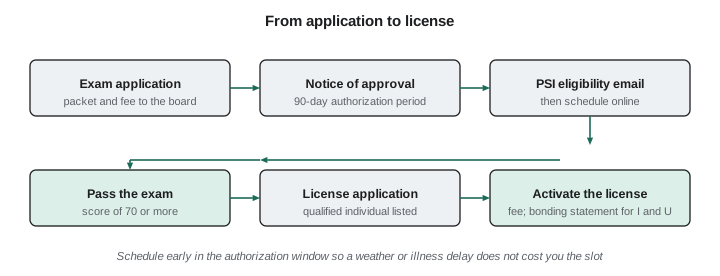
Step 1: Read the handbook and choose a classification
The board publishes an exam information handbook that explains eligibility, the application, the exam rules, the approved references and what happens after the exam. Reading it first saves time, because it tells you which forms you need and how the board wants experience documented. The next decision is the classification: limited, intermediate, unlimited, or one of the special restricted classifications. The classification you apply for determines the experience you must document, the exam you sit and the jobs your license will allow, so make the choice deliberately, as Lesson 2 described.
Step 2: Submit the application for examination
The application for examination is a packet: the application form, the experience documentation the board requires for the chosen classification, any other documents listed in the handbook, and the examination fee. The board's exam page listed the fee at 125 dollars when this course was written. Most delays come from missing or unclear experience statements, unsigned forms and fee problems, so Ray kept a checklist and had Keisha read every statement back to him before mailing. He also kept a scanned copy of the whole packet in the company's files, which saved time when the board's staff called with a question.
The board reviews the application and, if it is complete and the candidate qualifies, sends a notice of approval. If something is missing, the board asks for it, and the clock does not start until the application is approved. A candidate who does not qualify for the classification applied for may be told which classification they do qualify for.
Preparing the experience statements
Experience statements are where most applications slow down, so it pays to treat them like a small project. Start with a list of every employer since the start of your electrical career, with dates, the address of each company and the name of a supervisor who can sign for that period. Then estimate hours for each period and the kind of work: hands-on installation, maintenance, supervision, estimating, design or classroom training. The board's forms tell you how to present those hours and what proof can support them, such as pay stubs, W-2 forms or letters on company letterhead. Ask each supervisor early, give them a draft that matches the board's form, and make it easy for them to sign.
Keisha had worked for three employers. Haw River could sign for the last eight years in a day. Her first employer, a commercial contractor in Greensboro, had been sold, and the new owners had no records of her time. Ray suggested she find her former foreman, who had moved to a contractor in Winston-Salem, and she also pulled her old W-2 forms from her own files. Her apprenticeship records from the community college covered the first year. Between them, the documents told a consistent story, which is what the board wants to see.
| Document | What it shows | Where Keisha found it |
|---|---|---|
| Employer experience statements | Dates, hours and kind of work for each period | Haw River, former foreman, apprenticeship coordinator |
| W-2 forms or pay stubs | That the employment actually happened | Her own tax files |
| Apprenticeship or school records | Classroom and on-the-job training | Alamance Community College |
| Prior licenses or certificates | Any credentials held elsewhere | None for Keisha |
If a supervisor is unavailable, the board's handbook usually explains what substitutes it will accept. Never sign a statement for someone else or exaggerate hours; the board can deny or later revoke a license obtained with false information, and the qualified individual's honesty is part of what the license stands for.
Accommodations and rescheduling
Candidates who need testing accommodations because of a disability, or alternative arrangements for religious reasons, should ask early, because the request usually has to be approved before the exam can be scheduled with the accommodation in place. The handbook explains how to request one and what documentation is needed. Rescheduling and cancellation rules, including deadlines and any fees for late changes or missed appointments, are set by PSI and described in the handbook. A candidate who simply does not show up may lose the exam fee and have to reapply, so it is worth reading those rules before booking.
Step 3: The notice of approval and the authorization period
The notice of approval states the classification approved and the candidate's Exam Authorization Period, which the board's page described as a 90-day window to schedule and take the exam. The window matters: if a candidate does not test within it, they may have to reapply and pay again. Experienced candidates schedule early in the window so that a cancellation for illness, weather or a family emergency still leaves time to rebook.
Step 4: The PSI eligibility email and scheduling
The board uses PSI as its testing vendor. According to the board's page, PSI sends an eligibility email 48 to 72 hours after the authorization period begins, and candidates cannot schedule until they receive it. The email contains a test taker identification number used to book the exam on PSI's site for the board. If the email has not arrived within three business days after the start of the authorization period, the board asks candidates to call or email its office. Once the email arrives, the candidate chooses a test center, date and time from those available.
# Plan the booking inside a 90-day authorization period (illustrative dates)
from datetime import date, timedelta
start = date(2026, 2, 2)                 # authorization period begins
email_by = start + timedelta(days=3)     # eligibility email expected within about 3 days
window_end = start + timedelta(days=90)
target = start + timedelta(days=35)      # aim for about five weeks in
latest_safe = window_end - timedelta(days=21)
print("period starts:", start)
print("chase the email if not received by:", email_by)
print("target exam date:", target)
print("latest date to book with a 3-week cushion:", latest_safe)
print("window closes:", window_end)period starts: 2026-02-02 chase the email if not received by: 2026-02-05 target exam date: 2026-03-09 latest date to book with a 3-week cushion: 2026-04-12 window closes: 2026-05-03
Keisha's approval came through at the end of January, with an authorization period starting February 2. She booked a Saturday in early March at a test center in Greensboro, about five weeks in, which left a comfortable cushion before the window closed in early May.
Booking also sets the study calendar. Keisha had started reviewing in November, before she even applied, because the application and approval take weeks and the authorization window is short. Candidates who wait for the approval letter before opening a book often find themselves cramming in a few weeks for a six-hour exam that covers code, calculations, business and law. A better plan is to start studying while the application is being reviewed, use the approval letter to set a firm date, and spend the final weeks on timed practice. Lesson 12 lays out a full study plan, and the earlier lessons of this course point to the topics that show up most often.
Step 5: Test day
The board's page tells candidates to bring two forms of identification, one of which must be a valid, unexpired government-issued photo ID, and their approved reference books. Calculators and other necessities are provided at the test site. The exam is computer-based. The center checks identification, inspects the books for prohibited notes or loose papers, and assigns a workstation. The handbook lists exactly what is allowed in the books, such as tabs and highlighting, and what is not, such as handwritten notes and inserted pages. Lesson 4 covers the exam format and references in detail.
Step 6: Results, retakes and reviews
The board's page says the score is given immediately after the candidate finishes at PSI and is on file with the board the next business day. A minimum grade of 70 is required to pass. A candidate who fails may not retake the same classification until a waiting period has passed; the board's page described it as three months in one place and 90 days in another, so candidates should confirm the exact date with the board. A candidate may apply for a different classification immediately after a failed attempt if they meet its experience requirement, and anyone retaking must submit a new application and fee.
The board also offers an exam review for a failed exam. According to its page, a candidate may review a failed exam once, for a fee listed at 25 dollars, in a group session at the board's office that lasts about four hours and is held about once a month. A review does not change the score; it helps the candidate see which topics caused trouble. Candidates register for a review with the board's form.
Step 7: The license application and activation
Passing the exam qualifies the candidate as a qualified individual; it does not by itself create a license for the company. The licensee, which may be the individual or a business, then submits the license application listing the qualified individual and pays the annual license fee for the classification. Intermediate and unlimited licenses also require a statement of bonding ability before they are activated, and the board may ask for other documents, such as business registration details. The board then issues the license certificate, and it can issue a qualified individual patch and decorative certificates for small fees. Lesson 8 covers the business requirements.
At Haw River, the plan was for the company to apply for a new unlimited license listing Keisha as its qualified individual as soon as she passed, and to retire the intermediate license that listed Glenn. Ray had already called the company's surety agent about the statement of bonding ability, so that the license would not sit unused while the paperwork caught up.
Worked problem
Working out the retake date
A candidate named Darnell failed the unlimited exam on April 18. He meets the experience requirement for intermediate as well as unlimited. What are his options, and when is the earliest he could retake unlimited if the waiting period is three months?
Show solution
- The board allows an application for a different classification immediately if he meets its experience requirement, so he could apply for intermediate right away.
- For unlimited, he must wait out the waiting period after the failed exam date.
- Three months after April 18 is July 18.
- Either way, he must submit a new application and fee, and he could book a review of the failed exam first.
Answer: He could apply for intermediate at once, or retake unlimited from about July 18 with a new application, after confirming the waiting period with the board.
Common reasons for delay
The board's staff and experienced office managers see the same problems again and again: experience statements that do not show enough hours of the right kind, signatures missing from employer statements, applications sent with the wrong fee, candidates who miss the authorization window, and books with forbidden notes on test day. A few simple habits avoid most of them: read the handbook, use a checklist, keep copies of everything, book early in the window, and prepare the books well before test day.
Common mistakes
MistakeWaiting for the approval letter before gathering experience records.
InsteadCollect employer statements and pay records before you apply; they take the longest.
MistakeLetting the 90-day authorization period run out.
InsteadBook early in the window and leave a cushion for a cancellation.
MistakeAssuming a passing score makes the company licensed.
InsteadThe licensee must still apply for the license, list the qualified individual and pay the fee.
MistakeBringing reference books with handwritten notes.
InsteadFollow the handbook's rules on tabs and highlighting, or the books may be refused.
Summary and key terms
- The application for examination is a packet with experience documentation and a fee, listed at 125 dollars.
- The board's notice of approval sets a 90-day Exam Authorization Period.
- PSI sends an eligibility email with a test taker ID 48 to 72 hours after the period begins; candidates schedule after it arrives.
- Scores are given at the end of the exam; 70 is required to pass. Retakes require a waiting period and a new application, and a failed exam may be reviewed once.
- After passing, the licensee applies for the license, lists the qualified individual, pays the fee and, for intermediate and unlimited, provides a statement of bonding ability.
- The notice of approval
- The board's letter approving a candidate's classification and setting the authorization period.
- Exam Authorization Period
- The window, described as 90 days, in which an approved candidate must schedule and take the exam.
- PSI
- The testing vendor that delivers the board's computer-based exams.
- Exam review
- A one-time group session where a candidate who failed can review the exam.
- License application
- The separate application, after passing, that creates the license and lists the qualified individual.
Practice problems
Work each problem on paper first, then reveal the answer to check.
When can a candidate schedule the exam with PSI?
Show answer
After receiving PSI's eligibility email, which arrives 48 to 72 hours after the authorization period begins.
What identification must a candidate bring?
Show answer
Two forms of ID, one a valid, unexpired government-issued photo ID.
What score is required to pass?
Show answer
70.
What additional document is needed to activate an unlimited license?
Show answer
A statement of bonding ability.
Lesson quiz · 5 questions
Score 60% or more to complete this lesson.
Create a free account to save your progress, take quizzes and earn a certificate.