
MELU-308 · Lesson 11 of 12 · 22 min
Renewal and continuing education
▶ Video coming soon A video version of this lesson is on the way.
Glenn had a habit that Keisha found old-fashioned until she understood it: every year, on the first business day of the month before his license expired, he blocked out a morning to renew it, check his continuing education credits on the board's website and update the company's records. "I've seen two good contractors lose a month of work because a license lapsed over a holiday," he said. "A lapsed license means no permits. No permits means no work." This lesson covers how North Carolina electrical contractor licenses are renewed, the continuing education the board requires of qualified individuals, carry-forward and waivers, what happens when a license expires, and how to build a renewal routine that never misses.
The renewal cycle
According to the board's licensing page when this course was written, an electrical contractor license expires one year after the date it was issued, rather than on a single statewide date. The board sends a renewal notice about 60 days before expiration, by email if the licensee has provided an address and otherwise by mail. Renewals are completed through the board's online renewal and update system, which also lets licensees update their contact information. A renewal received after the license has expired carries an administrative fee listed at 25 dollars, in addition to the annual license fee for the classification.
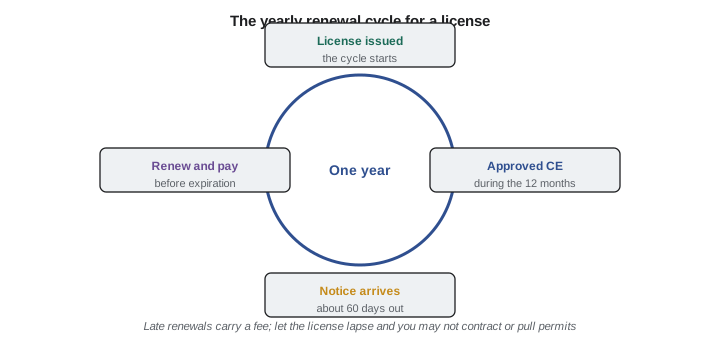
Because each license has its own anniversary date, a company with several licenses, such as an unlimited license and a special restricted license, may have different renewal dates for each. Haw River's intermediate license under Glenn renewed in April; Keisha's new unlimited license would renew on the anniversary of its issue date, probably in the spring. Ray put both dates on the company calendar with reminders at 90, 60 and 30 days.
Continuing education requirements
Section 87-44.1 of the General Statutes allows the board to require each listed qualified individual to complete continuing education as a condition of annual renewal. The statute caps the requirement at ten hours in any twelve-month period and says the hours must be completed during the twelve months before renewal, in courses the board has approved before the qualified individual enrolls. Courses offered by community colleges count if the board approves them. The number of hours the board actually requires, and any topic requirements, are set in the board's rules and published on its website; many approved providers market eight-hour renewal packages for North Carolina electrical contractors, which reflects what the board has commonly required, but candidates should confirm the current number for their classification.
Approved continuing education courses usually cover code changes and state amendments, interpretations, safety, licensing law and business topics. The board publishes a search tool for approved courses and sponsors, and sponsors report attendance so that credits appear in the qualified individual's record. The statute also requires attendance to be certified on a form the board provides, and the board's online system now handles much of that process.
Carry-forward and waivers
The statute allows a qualified individual to carry forward up to two additional years of the annual requirement. In practice, that means a qualified individual who takes extra approved hours in one year may be able to apply them to later years, within the limit, which helps someone who expects a busy year or wants to take a long code update course when it is offered. The board's rules explain how carry-forward is recorded and applied. The statute also allows the board to waive the requirement for certified illness or undue hardship under the procedures in its rules, which usually means a written request with supporting documentation before the deadline.
# Continuing education with carry-forward (illustrative: assumes an 8-hour annual requirement
# and carry-forward of up to two years' worth, as the statute allows; check the board's rules)
annual = 8
max_bank = 2 * annual
taken = {2025: 16, 2026: 0, 2027: 8, 2028: 4}
bank = 0
for year, hours in taken.items():
    available = hours + bank
    met = available >= annual
    bank = min(max(available - annual, 0), max_bank) if met else 0
print(f"{year}: took {hours:>2}, requirement met: {met}, banked after renewal: {bank}")2025: took 16, requirement met: True, banked after renewal: 8 2026: took 0, requirement met: True, banked after renewal: 0 2027: took 8, requirement met: True, banked after renewal: 0 2028: took 4, requirement met: False, banked after renewal: 0
In this illustration, sixteen hours taken in 2025 cover that year and bank eight hours, which cover 2026 even though no course was taken. In 2028, only four hours are available, so the requirement is not met and the qualified individual would need more hours before renewing. The real calculation follows the board's rules, but the pattern shows why tracking hours year by year matters.
What happens when a license expires
A license that is not renewed by its expiration date is no longer active. During that time the licensee may not engage in electrical contracting, and inspections departments should not issue new permits under the license. The board's rules allow a late renewal within a set period with the late fee; after a longer lapse, the rules may require reinstatement steps or, in some cases, a new application and examination. A lapse can also cause problems with ongoing jobs, because owners, general contractors and sureties often require proof of an active license. The safest course is never to let a license lapse.
Worked problem
A renewal that almost slipped
Haw River's unlimited license was issued on April 22. In late March, Ray notices that Keisha's continuing education record shows only five hours for the year, though she believes she took a full course in January. What should they do?
Show solution
- Check whether the January course was board-approved and whether the sponsor reported the attendance.
- If the course was approved but not reported, contact the sponsor and the board with the certificate of completion.
- If the hours are genuinely short, take an approved course before April 22, and before renewing.
- Renew online before the expiration date to avoid the late fee and any gap in the license.
Answer: Fix the missing credit or take the remaining hours, then renew before April 22.
Who carries the continuing education duty
The continuing education requirement attaches to the person, not the company. Each listed qualified individual must meet it, and a company's license renews only if its qualified individual is in good standing. A firm with two qualified individuals, one on its unlimited license and one on a special restricted license, needs both people's hours to be current. If a qualified individual leaves and a new one is listed, the new person's own record is what matters at the next renewal. Glenn pointed out to Keisha that this also works in reverse: her hours followed her, so if she ever moved to another company, her record would move with her.
Foremen, journeymen and apprentices are not covered by the board's continuing education rule, because the board licenses contractors rather than individual electricians. Some cities and some employers set their own training expectations for field staff, and many contractors send foremen to the same code update classes the qualified individual takes. Haw River paid for its three foremen to attend the code update course each year, on the theory that the person holding the meter on the job needed to know the amendments as well as the person whose name was on the license.
Choosing courses that are worth the time
Because the hours are required anyway, it pays to choose courses that solve real problems. A qualified individual whose company is moving into solar work can choose approved courses on photovoltaic systems and energy storage; one who is fighting repeated inspection failures on grounding can take a course that focuses on grounding and bonding. Courses that cover the state amendments and recent interpretations are especially valuable in North Carolina, because the adopted code edition and its amendments change on a schedule set by the Building Code Council and the Office of State Fire Marshal rather than on the national cycle.
Format matters too. The board approves sponsors and courses, and the approval states whether a course may be taken in a classroom, live online or in another format. A qualified individual should confirm that the format chosen is approved for credit, keep the certificate of completion, and save a copy in the company's license file. A certificate without a matching entry in the board's record is the most common source of last-minute renewal trouble.
Worked problem
Keisha's first-year plan
Keisha's unlimited license is issued in April. She wants to meet the annual requirement, assume eight hours for planning purposes, bank some extra hours, and focus on the energy storage jobs Haw River is starting to bid. How could she plan the year?
Show solution
- Confirm the current required hours and any topic requirements on the board's website.
- Choose an approved code update course on the state amendments for the core hours.
- Add an approved course on energy storage and photovoltaic systems for the extra hours, within the carry-forward limit.
- Check the board's record after each course and file the certificates with the company's license documents.
Answer: Take the core update plus an approved specialty course, confirm both appear in the record, and keep the extra hours banked.
Inactive status, reinstatement and starting over
Sometimes a qualified individual stops contracting for a while, because of retirement, a move or a job with a utility or a manufacturer. The board's rules address how a license that is not being used is treated, whether it can be kept in a status that preserves the right to return, and what is required to reactivate it, which may include catching up on continuing education. The rules also set how long an expired license can be renewed late before reinstatement or a new examination is required. Because these details are set by rule and can change, a qualified individual who plans to step away should read the current rules or call the board before letting the license lapse. Passing the exam is hard enough to do once.
Renewal and other states
North Carolina has reciprocal agreements with a number of states, and a qualified individual who holds licenses in more than one state has more than one renewal schedule and more than one continuing education rule to track. Hours approved in one state are not automatically approved in another. Contractors who work in South Carolina or Virginia as well as North Carolina should keep a separate column for each state in their license tracker, with its own renewal date, fee and hours requirement.
Keeping the license record clean
Renewal is also a good moment to make sure the board's records are correct: the licensee's name and address, the qualified individuals listed, and the classifications held. If the company has changed its entity, added a qualified individual or moved, the renewal is not the place to discover that the board's records are out of date. Lesson 7 covered the changes that must be reported when they happen; the renewal review is a backstop.
| When | Task |
|---|---|
| 90 days before | Check CE credits; schedule any remaining approved courses |
| About 60 days before | Watch for the board's renewal notice |
| 30 days before | Renew online and pay the fee; confirm the board's records |
| On renewal | Update the license number and dates on proposals, vehicles and permit accounts if needed |
| Anytime | Report changes in qualified individuals, name or address as they happen |
Staying current beyond the minimum
Continuing education is a minimum. The North Carolina Electrical Code could move to a new edition with little notice once its effective date is set, interpretations change how rules are applied, and safety practices evolve. Contractors who stay current read the Office of State Fire Marshal's code notices, attend inspector meetings and trade association events, take manufacturer training on new equipment such as energy storage and electric vehicle chargers, and make sure foremen get training too. Keisha planned to take more than the required hours in her first year as qualified individual, partly to bank them and partly because she was now the person whose name the board would look for when anything went wrong.
Common mistakes
MistakeAssuming all licenses renew on the same statewide date.
InsteadEach license expires one year after its issue date.
MistakeTaking a course that the board has not approved.
InsteadUse the board's course search and confirm approval before enrolling.
MistakeRenewing after expiration and continuing to pull permits as usual.
InsteadAn expired license is not active; renew on time and pay any late fee before contracting.
MistakeAssuming extra hours always carry forward without limit.
InsteadThe statute allows carry-forward of up to two additional years of the requirement.
Summary and key terms
- Licenses expire one year after issue; the board sends a notice about 60 days ahead, and late renewals carry a fee listed at 25 dollars.
- The board may require up to ten hours of approved continuing education per year for each qualified individual, completed in the 12 months before renewal.
- Up to two additional years of the requirement may be carried forward, and the board may waive the requirement for illness or hardship.
- An expired license is not active, so the licensee may not contract or obtain permits until it is renewed or reinstated.
- A simple renewal routine with reminders at 90, 60 and 30 days prevents lapses.
- Renewal
- Extending a license for another year by paying the fee and meeting continuing education requirements.
- Continuing education
- Board-approved courses a qualified individual completes as a condition of renewal.
- Carry-forward
- Using extra approved hours from one year toward later years, within the statute's limit.
- Waiver
- Board relief from the continuing education requirement for certified illness or undue hardship.
- Lapsed license
- A license that has expired and is not active.
Practice problems
Work each problem on paper first, then reveal the answer to check.
When does a North Carolina electrical contractor license expire?
Show answer
One year after the date it was issued.
What is the most continuing education the board may require per twelve-month period?
Show answer
Ten hours.
How many additional years of the requirement may be carried forward?
Show answer
Up to two additional years.
May a contractor pull a new permit while its license is expired?
Show answer
No; the license is not active until it is renewed or reinstated.
Lesson quiz · 5 questions
Score 60% or more to complete this lesson.
Create a free account to save your progress, take quizzes and earn a certificate.