
MELU-308 · Lesson 10 of 12 · 19 min
Workplace safety law and OSHA for electrical contractors
▶ Video coming soon A video version of this lesson is on the way.
In September, one of Haw River's journeymen took a fall from a six-foot stepladder while pulling wire in a ceiling at the bakery fit-out. He broke his wrist, spent an afternoon at the hospital's emergency department, and was back on light duty a week later. Keisha spent that evening with Ray working out what the company had to record, what it had to report and to whom, and what the workers' compensation carrier needed. "Safety is the part of the business you can't afford to learn by accident," Glenn said the next morning. This lesson covers North Carolina's occupational safety and health program, the standards that matter most to electrical contractors, injury recording and reporting, incident rates, inspections and citations, and practical programs that keep crews safe.
A state plan
North Carolina runs its own occupational safety and health program under a state plan approved by federal OSHA. The state law is the Occupational Safety and Health Act of North Carolina, in Chapter 95 of the General Statutes, and the program is run by the Occupational Safety and Health Division of the North Carolina Department of Labor, often called OSH NC or NCDOL OSH. State plans must be at least as effective as federal OSHA, and North Carolina generally adopts the federal standards, including the construction standards in 29 CFR Part 1926 and the general industry standards in 29 CFR Part 1910, sometimes with state additions. For most private employers in the state, it is the North Carolina program, not federal OSHA, that inspects worksites and issues citations, although federal OSHA keeps jurisdiction over some workplaces, such as certain federal facilities.
For an electrical contractor, the practical effect is that the familiar federal rules apply, enforced by state inspectors who may visit a construction site after a complaint, a serious accident, a referral or as part of a targeted program. The NCDOL also offers consultation services that help employers find and fix hazards without citations, which many small contractors use to prepare for growth or a new kind of work.
Standards that matter most to electrical contractors
Several groups of standards come up again and again on electrical work. The electrical subpart of the construction standards covers wiring and equipment used during construction, ground-fault protection for temporary power, and safe work practices near energized parts. The lockout and tagout standard and its construction counterparts require hazardous energy to be controlled before servicing equipment. Fall protection standards, together with the ladder and scaffold standards, address the falls that injure electricians every year. Excavation standards apply to trenches for underground conduit. Other common topics include hazard communication for chemicals, personal protective equipment, aerial lifts, fire prevention and silica dust from cutting concrete.
Electrical contractors also rely on NFPA 70E, the Standard for Electrical Safety in the Workplace, which describes how to establish an electrically safe work condition, perform shock and arc flash risk assessments, choose protective equipment and train qualified persons. OSHA standards set general duties and performance requirements; NFPA 70E is a consensus standard that employers widely use to meet them. Inspectors may cite an employer under the general duty requirements when a recognized hazard, such as arc flash, is not controlled.
| Topic | Typical requirement (summary) |
|---|---|
| Temporary power | Ground-fault protection or an assured grounding program for construction power |
| Energized work | De-energize where feasible; otherwise follow safe work practices and use appropriate protective equipment |
| Lockout and tagout | Control hazardous energy before servicing equipment |
| Ladders and falls | Proper ladder use; fall protection at the heights the standards require |
| Trenches | Protective systems for excavations at the depths the standards require |
Recording injuries
Employers that are covered by the recordkeeping rule must record work-related injuries and illnesses that meet the recording criteria on an injury and illness log, complete an incident report for each recordable case, and post an annual summary. In general terms, a case is recordable if it results in death, days away from work, restricted work or transfer to another job, medical treatment beyond first aid, loss of consciousness, or a significant diagnosed injury or illness. Some small employers and some low-hazard industries are partially exempt from keeping the log, but construction contractors with more than the threshold number of employees generally must keep it. The log is kept for each establishment, and records are retained for years as the rule requires.
The journeyman's broken wrist was clearly recordable: it was diagnosed as a fracture, treated beyond first aid, and led to restricted work. Ray entered it on the log within the time the rule allows and completed the incident report, and Keisha made a note to include it in the annual summary.
Reporting serious events
Separately from recording, employers must report the most serious events to the safety agency quickly. Under the federal rule that North Carolina's program follows, a work-related fatality must be reported within 8 hours, and an inpatient hospitalization, an amputation or the loss of an eye within 24 hours. A trip to the emergency department for treatment and release is not an inpatient hospitalization, which is why the bakery fall was recorded but not reported. Contractors should know the reporting phone line and online option for the state program and include them in their emergency plans.
Worked problem
Record or report?
Three events happen at Haw River in one month: (1) an apprentice gets a small cut that is cleaned and covered with a bandage on site; (2) a journeyman breaks a wrist, is treated in the emergency department and released, and works light duty for a week; (3) a foreman suffers an electrical shock, loses consciousness briefly and is admitted to the hospital overnight. What must the company do for each?
Show solution
- The cut was treated with first aid only, so it is not recordable.
- The broken wrist is recordable because of the diagnosed fracture, medical treatment and restricted work, but it is not reportable because the worker was not admitted.
- The shock is recordable because of the loss of consciousness and treatment, and it is reportable within 24 hours because of the inpatient hospitalization.
- All three should be investigated so the causes are fixed.
Answer: Nothing to record for the cut; record the wrist; record the shock and report it within 24 hours.
Incident rates
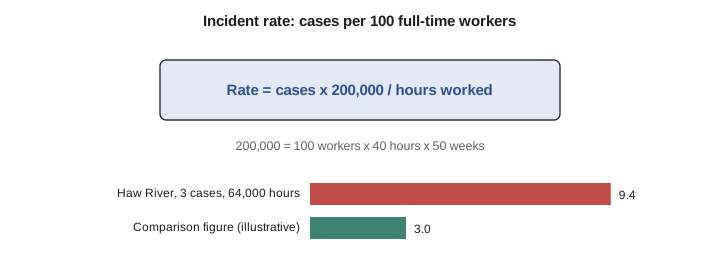
Owners, general contractors and insurers often ask for a contractor's incident rate, which compares recordable cases with hours worked. The standard formula multiplies the number of cases by 200,000 and divides by the total hours worked by all employees in the year. The 200,000 represents 100 full-time workers working 40 hours a week for 50 weeks, so the result is the number of cases per 100 full-time workers. A related figure, the days away, restricted or transferred rate, uses only the cases that caused lost or restricted time.
# Incident rates for Haw River's year (illustrative figures)
cases = 3                 # recordable cases
dart_cases = 2            # cases with days away, restriction or transfer
hours = 64000             # total hours worked by all employees
trir = cases * 200000 / hours
dart = dart_cases * 200000 / hours
print(f"total recordable incident rate: {trir:.2f}")
print(f"days away, restricted or transferred rate: {dart:.2f}")total recordable incident rate: 9.38 days away, restricted or transferred rate: 6.25
With three recordable cases in 64,000 hours, Haw River's rate came out at about 9.4, well above the comparison figure its largest general contractor customer used for prequalification. Glenn knew the number would come up when Keisha started bidding larger work, and that one more ladder fall could cost the company bids. That made safety a business issue as much as a moral one.
Rates are only as good as the data behind them. Hours worked should include all employees, including office staff if the rate is calculated for the whole company, and overtime hours count as hours worked. Cases must be recorded consistently, without leaving out borderline cases to make the number look better, which is itself a violation. A small company's rate can swing widely from one case, so customers often look at several years together, and contractors can explain an unusual year with the facts and the corrective actions they took.
Safety and the workers' compensation claim
Recording an injury for safety purposes and reporting it to the workers' compensation carrier are separate steps with separate rules. The North Carolina Industrial Commission's rules require employers to report qualifying injuries to the carrier and the Commission, and the carrier then manages medical care and wage benefits under Chapter 97. A good return-to-work program, offering suitable light duty while the worker heals, keeps the worker connected to the company and usually reduces the cost of the claim. Workers' compensation premiums are adjusted over time by an experience modification factor that compares the company's claims with what is expected for its size and trade, so a contractor's safety record shows up directly in its insurance costs and in the prequalification forms that ask for that factor.
Inspections and citations
State inspectors may arrive at a worksite unannounced. They usually present credentials, hold an opening conference, walk the site, interview workers, review records such as the injury log and written programs, and hold a closing conference. If they find violations, the agency may issue citations with proposed penalties and deadlines for correcting the hazards. Employers can request an informal conference, settle, or contest citations through the procedures in the state law. Retaliating against an employee for reporting a hazard or an injury is prohibited, and North Carolina has its own law protecting employees who report safety concerns or file workers' compensation claims.
Multi-employer worksites
Construction sites usually have several employers working side by side, and safety agencies apply a multi-employer approach: an employer can be cited not only for exposing its own workers to a hazard, but in some situations for creating a hazard, for being responsible for correcting it, or for controlling the site. An electrical contractor that leaves an open floor penetration after pulling conduit, or energizes a temporary panel with missing covers, can be responsible even if another trade's worker is the one exposed. The general contractor's site rules, safety meetings and permit-to-work systems help coordinate this, and the electrical contractor's foremen should take part rather than treating them as paperwork.
Heat and seasonal hazards
North Carolina summers are hot and humid, and electricians often work in attics, on roofs and in unconditioned buildings. Heat illness is a real hazard: crews need water, rest and shade, a plan for acclimatizing new workers, and supervisors who know the signs of heat exhaustion and heat stroke. Hurricanes and severe storms bring their own risks, including flooded equipment, damaged services and backfeed from portable generators that can injure line workers and electricians. Winter brings cold, slippery surfaces and temporary heaters on job sites. A good safety program adjusts with the seasons, and Keisha's summer toolbox talks always started with heat.
Building a safety program
Most effective safety programs for electrical contractors share a few elements: a written safety policy signed by the owner; training on the hazards crews actually face, with records; job hazard analysis before unusual work; a lockout and energized work policy that follows NFPA 70E; ladder and fall protection rules; regular toolbox talks; inspection of tools, cords and protective equipment; prompt reporting and investigation of injuries and near misses; and a return-to-work program for injured workers. After the bakery fall, Keisha added a short ladder inspection to every morning's start-up and replaced the oldest stepladders, and she asked the NCDOL consultation service to visit the medical office job.
Common mistakes
MistakeAssuming federal OSHA inspects most North Carolina construction sites.
InsteadNorth Carolina runs a state plan through the NCDOL OSH Division, which enforces safety standards for most private employers.
MistakeReporting every recordable injury to the agency.
InsteadRecord cases that meet the criteria; report only fatalities within 8 hours and inpatient hospitalizations, amputations and eye losses within 24 hours.
MistakeTreating an emergency room visit as an inpatient hospitalization.
InsteadTreatment and release is not inpatient admission.
MistakeWorking energized because shutting down is inconvenient.
InsteadDe-energize where feasible and follow a written energized work policy when it is not.
Summary and key terms
- North Carolina runs a state occupational safety and health plan through the NCDOL OSH Division, generally adopting the federal standards.
- Electrical contractors focus on electrical safety, lockout, falls and ladders, trenches and protective equipment, often using NFPA 70E.
- Recordable injuries go on the log; fatalities are reported within 8 hours and inpatient hospitalizations, amputations and eye losses within 24 hours.
- The incident rate is cases × 200,000 ÷ hours worked, or cases per 100 full-time workers.
- Inspections can lead to citations; consultation services and a written safety program help prevent both injuries and citations.
- State plan
- A state occupational safety and health program approved by federal OSHA.
- Recordable case
- A work-related injury or illness that meets the criteria for the log.
- Reportable event
- A fatality, inpatient hospitalization, amputation or eye loss that must be reported quickly.
- Incident rate
- Recordable cases per 100 full-time workers, calculated with the 200,000-hour base.
- NFPA 70E
- The consensus standard for electrical safety in the workplace.
Practice problems
Work each problem on paper first, then reveal the answer to check.
Which agency enforces workplace safety standards for most private employers in North Carolina?
Show answer
The Occupational Safety and Health Division of the North Carolina Department of Labor.
Within how many hours must a work-related inpatient hospitalization be reported?
Show answer
Within 24 hours.
A company had 2 recordable cases in 80,000 hours. What is its incident rate?
Show answer
2 × 200,000 ÷ 80,000 = 5.0.
Is a cut treated only with a bandage recordable?
Show answer
No; first aid only is not recordable.
Lesson quiz · 5 questions
Score 60% or more to complete this lesson.
Create a free account to save your progress, take quizzes and earn a certificate.