
MELU-308 · Lesson 7 of 12 · 19 min
Duties of the qualified individual
▶ Video coming soon A video version of this lesson is on the way.
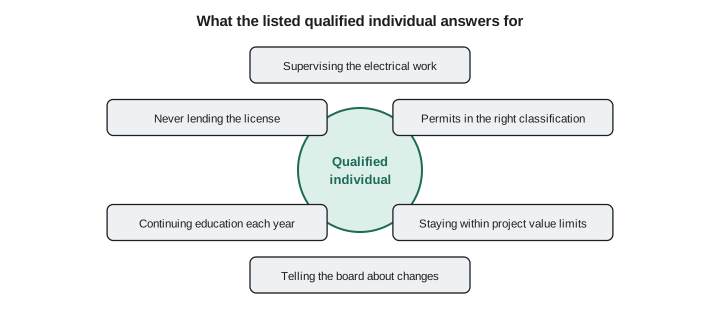
Glenn Tolliver had been Haw River's qualified individual for twenty-eight years, and he took the role seriously. The week after Keisha booked her exam, he walked her through the company's files: permits pulled under his name, a complaint the board had closed years ago, letters he had written to the board when the company changed its name, and continuing education certificates going back two decades. "When you're the qualified individual, every permit with our license number on it is yours," he said. "The board doesn't care who was on the ladder. It cares who was responsible." This lesson covers what it means to be listed as the qualified individual on a North Carolina electrical contractor license: the relationship with the licensee, supervision, permits and limits, changes the board must be told about, continuing education, and the grounds for discipline.
The relationship with the licensee
A license is issued to a licensee, which may be an individual or a business such as a corporation, limited liability company or partnership, on the basis of a qualified individual who passed the board's exam. The board's rules require the qualified individual to have a genuine connection to the licensee, such as being the owner, a partner, an officer or a regular employee, and to be in a position to supervise the electrical work. The rules also limit how many licensees one qualified individual may serve, so that a person cannot lend their exam result to several companies they have no real role in. The exact wording, including any exceptions for related companies, is in 21 NCAC 18B, and candidates should read it before the exam.
The board's license application asks for the qualified individual's name, signature, date of birth and Social Security number, and the board provides a form to add or remove a qualified individual. Those details make the point that the qualified individual is a specific, accountable person. A business may list more than one qualified individual, which some larger companies do so that the license does not depend on a single person.
Supervision
The qualified individual is responsible for supervising the electrical work done under the license. That does not mean standing next to every electrician, but it does mean having real authority over how the work is planned, staffed and checked: assigning qualified people, making sure crews have the code knowledge and drawings they need, reviewing problem jobs, responding to inspection rejections, and stopping unsafe or noncompliant work. In a small company the qualified individual may be on every job; in a larger one, the qualified individual sets the systems that keep the work under control, such as job reviews, inspection tracking and training.
Keisha planned to keep her role as field superintendent when she became the qualified individual, which suited the duty well. She set up a weekly review of every open permit, a list of inspection results by foreman, and a rule that no job over 50,000 dollars started without a pre-construction meeting she attended or approved. Those habits were not written in the rules, but they were the kind of evidence of supervision the board would expect if a complaint ever came in.
Permits and classification limits
Every permit pulled under the license carries the license number, so the qualified individual answers for it. The most basic duty is to pull permits only for work the company will actually perform and supervise, and only within the license's classification. A company with a limited license must not take or permit a project above the limited value or voltage, and a company with an intermediate license must not take a project above the intermediate value. If a project grows past the limit through change orders, the qualified individual must deal with it before the company works beyond its classification, as Lesson 2 described.
# Weekly open-permit review: flag permits that need the qualified individual's attention (illustrative)
permits = [
    {"job": "Bakery fit-out", "value": 85000, "days_open": 41, "last": "passed rough-in"},
    {"job": "Medical office", "value": 241000, "days_open": 96, "last": "rejected rough-in L1"},
    {"job": "Church hall", "value": 148000, "days_open": 160, "last": "no inspection in 75 days"},
    {"job": "House service", "value": 6800, "days_open": 12, "last": "final requested"},
]
LIMIT = None   # unlimited license, so no value limit; set 150000 to check an intermediate license
for p in permits:
    flags = []
    if LIMIT and p["value"] > LIMIT:
        flags.append("over license limit")
    if "rejected" in p["last"]:
        flags.append("correct and re-inspect")
    if "no inspection" in p["last"]:
        flags.append("risk of permit expiring")
print(f"{p['job']:<15} {', '.join(flags) or 'ok'}")Bakery fit-out ok Medical office correct and re-inspect Church hall risk of permit expiring House service ok
Never lending the license
The most serious misuse of a license is lending it: letting another person or company use the license number to pull permits or contract for work the licensee does not perform or supervise. North Carolina treats that as aiding unlicensed contracting, and it exposes the qualified individual and the licensee to discipline, including revocation. The same applies to a qualified individual who is listed on a company's license but has no real role, a situation sometimes called a paper qualifier. Glenn had once been offered a monthly fee to let a friend's company use his license; he refused, and he told Keisha the offer was the most dangerous phone call of his career.
Advertising and contracts
The license also shapes how the company presents itself. Contracts, bids and advertising should use the licensee's exact name as it appears on the license, and many contractors show the license number on vehicles, proposals and websites so owners can check it. Advertising electrical services without a license, or advertising a classification the company does not hold, can mislead the public. When a company changes its name or forms a new entity, it should not keep contracting under the old license name without telling the board. These are simple points, but they appear on exams and in complaints, because an owner who cannot find the contractor's name in the board's license search will often call the board.
Contracts are also where the classification limit becomes real. Before signing, the qualified individual or estimator should confirm that the contract value, plus any foreseeable change orders, fits the license, and that the scope does not reach into work requiring a license the company does not hold. Keisha added a line to Haw River's contract checklist that asked, in plain words, whether the license covered the whole job.
Telling the board about changes
The licensing law and the board's rules require the licensee to keep the board informed. Typical changes that must be reported include a change in the licensee's name, address or form of business; a change in the qualified individual, such as when one leaves the company; and other changes listed in the rules. When a qualified individual leaves, the licensee must notify the board and arrange for a replacement within the time the rules allow, or stop contracting under that license until it has one. A qualified individual who leaves a company should also notify the board, so that they are not listed as responsible for work they no longer supervise. Deadlines and procedures are in 21 NCAC 18B and the board's forms.
| Change | Who acts | Typical step |
|---|---|---|
| Qualified individual leaves | Licensee and the departing individual | Notify the board; add a replacement within the time the rules allow |
| Company changes its name or entity | Licensee | Notify the board; the license may need to be reissued or a new one applied for |
| Address or contact change | Licensee | Update the board's records |
| New qualified individual added | Licensee | File the board's form to add a qualified individual |
Continuing education
Section 87-44.1 of the General Statutes lets the board require each listed qualified individual to complete continuing education as a condition of the annual license renewal, up to a maximum of ten hours in a twelve-month period, in courses the board approves. The hours must be completed in the twelve months before renewal, attendance is certified on the board's form or system, and the statute allows a qualified individual to carry forward up to two additional years of the annual requirement. The board may waive the requirement for certified illness or undue hardship. Lesson 11 covers renewal and continuing education in detail.
Supervising subcontractors and specialty work
Many electrical contractors subcontract part of their work: low-voltage cabling, fire alarm, signs, or trenching and boring. The qualified individual should make sure each subcontractor holds the license its work requires, such as a fire alarm and low-voltage license or an electric sign license, and that the subcontract makes clear who pulls which permit. A licensee that pulls a permit covering a subcontractor's work remains responsible for it, so the qualified individual's supervision has to reach that work too. Ray's habit of printing the board's license search result for each subcontractor came from exactly this duty.
Supervision also includes the company's own apprentices and helpers. North Carolina does not license individual electricians, but the code requires competent installation, and the qualified individual decides who is ready to work alone, who needs a journey-level partner, and who needs more training. Many contractors pair new hires with experienced electricians, keep a simple skills record, and use community college and apprenticeship programs. These practices protect the public and the license, and they help the company keep good people.
Keeping records that show supervision
If a complaint ever reaches the board, the qualified individual will be asked how the work was supervised. Records answer that question better than memory: permit logs, inspection results, job meeting notes, correction photos, training records and the weekly reviews described earlier. Keisha kept a shared folder for each job and a single spreadsheet of open permits, and she reviewed both every Monday. It took about an hour a week and, as Glenn put it, was the cheapest insurance the company had.
Complaints, investigations and discipline
The board investigates complaints from owners, inspectors, other contractors and the public. The licensing law lists grounds for discipline, which include, in general terms, obtaining a license by fraud or misrepresentation, gross negligence, incompetence or misconduct in electrical contracting, willful violation of the code or the licensing law, aiding unlicensed contracting or lending a license, and failing to comply with board orders. After notice and an opportunity for a hearing, the board may reprimand a licensee or qualified individual, suspend or revoke a license, or take other action allowed by the statute, and it can ask a court to stop unlicensed activity. Many complaints are resolved informally, but the qualified individual should take every letter from the board seriously and respond on time.
Worked problem
A complaint from a homeowner
A homeowner complains to the board that a service upgrade Haw River installed under Keisha's license failed inspection twice and that the crew left without finishing. The permit shows the work was assigned to a foreman who has since left the company. What should Keisha do?
Show solution
- Respond to the board on time, in writing, with the facts and the permit and inspection records.
- Send a crew to complete the work and correct the inspection items, and document the final inspection.
- Explain the supervision steps the company uses and what it changed after the foreman left.
- She cannot shift responsibility to the departed foreman; as qualified individual she answers for the permit.
Answer: Finish and document the work, respond promptly and factually, and show the board the supervision the company provides.
Common mistakes
MistakeTreating the qualified individual role as a name on the license.
InsteadThe rules require a real connection to the licensee and real supervision of the work.
MistakePulling a permit for a friend's job as a favor.
InsteadThat is aiding unlicensed contracting and can cost the license.
MistakeForgetting to notify the board when the qualified individual leaves.
InsteadReport the change and arrange a replacement within the time the rules allow.
MistakeIgnoring a letter from the board because the complaint seems unfair.
InsteadRespond on time and in writing, with records.
Summary and key terms
- Each license rests on a listed qualified individual who must have a genuine role with the licensee and supervise its electrical work.
- The qualified individual answers for every permit under the license and must keep work within the classification's limits.
- Lending a license or serving as a paper qualifier is treated as aiding unlicensed contracting.
- Changes such as a departing qualified individual or a new business name must be reported to the board.
- The board may require up to ten hours of approved continuing education a year and can discipline licensees for the grounds in the statute.
- Licensee
- The individual or business to which the license is issued.
- Paper qualifier
- A listed qualified individual with no real role in supervising the work, which the rules do not allow.
- Aiding unlicensed contracting
- Helping an unlicensed person contract, for example by lending a license or pulling permits for them.
- Reprimand
- A formal disciplinary statement short of suspension or revocation.
- Revocation
- Cancellation of a license by the board.
Practice problems
Work each problem on paper first, then reveal the answer to check.
Who answers to the board for the work done under permits pulled with a license number?
Show answer
The licensee and its listed qualified individual.
What should a licensee do when its only qualified individual leaves?
Show answer
Notify the board and add a replacement within the time the rules allow, or stop contracting under the license.
What is the most continuing education the statute lets the board require in a twelve-month period?
Show answer
Ten hours.
Name two grounds for discipline under the licensing law.
Show answer
For example, obtaining a license by fraud, gross negligence or misconduct, willful code violations, or aiding unlicensed contracting.
Lesson quiz · 5 questions
Score 60% or more to complete this lesson.
Create a free account to save your progress, take quizzes and earn a certificate.