
MELU-308 · Lesson 12 of 12 · 27 min
Practice exam review and test-day strategy
▶ Video coming soon A video version of this lesson is on the way.
Three weeks before her exam date, Keisha took her first full timed practice test at the kitchen table on a Saturday morning: one hundred questions, six hours, her tabbed code book, the NFPA 72 standard, the business guide and the licensing law. She finished with forty minutes left and scored 66. "Good," Glenn said when she told him. "Now you know where the points are." This lesson pulls the course together. It reviews an eight-week study plan, walks through a mixed practice set that touches every earlier lesson, explains a two-pass method and a pacing plan for a six-hour open-book exam, and covers what to do the week before, the morning of, and the day after.
How the exam rewards preparation
Lesson 4 described the exam for the limited, intermediate and unlimited classifications: one hundred questions in six hours, computer-based at PSI, open book, with a passing score of 70. The open-book format changes what preparation means. Candidates do not need to memorize the code; they need to find things in it quickly and read what they find accurately. They also need enough command of the licensing law, the lien law and the business topics to answer without searching, because those questions can eat time when a candidate has to hunt for them in an unfamiliar book. A candidate who knows where every major article sits and has practiced common calculations until they are routine has time left over for the hard questions.
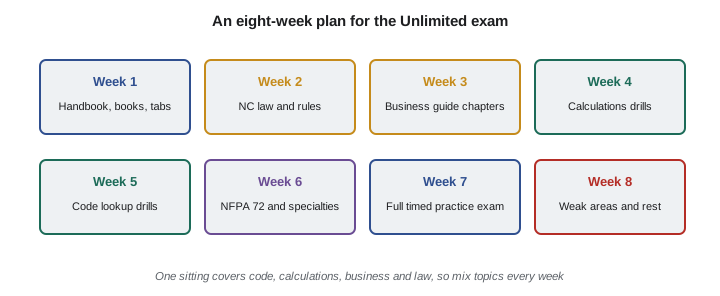
The eight-week plan
Keisha's plan, which this course has followed, ran for eight weeks before her March exam. Week one was setup: reading the board's candidate information, confirming the current reference list, buying the exact editions, and tabbing the books within the permitted rules. Week two covered North Carolina law: Article 4 of Chapter 87, the board's rules, classifications, qualified individual duties and penalties. Week three was the business guide: contracts, liens, bonds, insurance, payroll, taxes and safety recordkeeping. Week four was calculations: load calculations, conductor sizing and ampacity adjustment, box and conduit fill, voltage drop, motor circuits and service sizing. Week five was code lookup drills against a timer. Week six covered NFPA 72 for fire alarm questions. Week seven was full timed practice, and week eight went to weak areas.
The plan's order is deliberate. The law and business material is learned early because it is the part that can be answered from memory, which saves time on exam day. The calculation and lookup work comes in the middle, when the tabs are in place. Full timed practice comes late enough to measure real readiness and early enough to leave a week to fix what it reveals.
A mixed review set
The questions below sample each part of the course. Work through them with the references closed for the law and business items and open for the code items, and note how long each takes.
Worked problem
Mixed review: classification and value
A customer asks Haw River to bid an electrical package for a project with an estimated electrical value of 175,000 dollars. Using the limits on the board's licensing page when this course was written, which classifications could take it?
Show solution
- The limited classification was listed at 60,000 dollars, too low.
- The intermediate classification was listed at 150,000 dollars, also too low.
- The unlimited classification has no value limit.
- Remember that change orders count toward the project value.
Answer: Only an unlimited license could take the job, under the limits listed when this course was written.
Worked problem
Mixed review: experience hours
A candidate has 6,400 hours of creditable experience, including 5,600 hands-on. Under the statute's maximum experience requirements, which classification's experience requirement could he meet?
Show solution
- Limited needs no more than 3,000 hours, 2,000 hands-on: met.
- Intermediate needs no more than 5,750 hours, 5,000 hands-on: met.
- Unlimited needs no more than 9,000 hours, 8,000 hands-on: not met.
- The board's rules set how hours are credited and documented.
Answer: He could meet the experience requirement for intermediate, but not yet unlimited.
Worked problem
Mixed review: lien deadline
A supplier last delivered fixtures to a private office job on June 3. By what date must it file a claim of lien, and by what date must it start a suit to enforce it?
Show solution
- Count 120 days from June 3 for the claim: October 1.
- Count 180 days from June 3 for the suit: November 30.
- The supplier should already have served a notice to lien agent early in the job.
Answer: File the claim by October 1 and start suit by November 30.
Worked problem
Mixed review: safety records
A contractor's employees worked 64,000 hours last year and had three recordable injuries. What is its total recordable incident rate, and which of the year's events would have required a report to the safety agency rather than only a log entry?
Show solution
- Multiply cases by 200,000 and divide by hours: 3 times 200,000 divided by 64,000 is about 9.4.
- A work-related fatality must be reported within 8 hours.
- An inpatient hospitalization, amputation or loss of an eye must be reported within 24 hours.
- A fracture treated and released is recorded on the log but not reported.
Answer: The rate is about 9.4; only fatalities and the listed serious injuries need a report.
Worked problem
Mixed review: workers' compensation
Andre's shop has Andre, who is the sole owner, and two full-time employees. He plans to hire a third employee in May. What changes for workers' compensation?
Show solution
- The Industrial Commission's guidance requires coverage when a business regularly employs three or more people.
- With three regular employees, coverage is required; check how the owner is counted for the business's form.
- Occupational accident insurance is not a substitute for workers' compensation.
- Many general contractors require a certificate of coverage from every sub regardless of size.
Answer: Arrange workers' compensation coverage before the third employee starts.
# Practice pacing for a 100-question, 6-hour exam
from datetime import datetime, timedelta
start = datetime(2026, 3, 6, 8, 30)
minutes = 6 * 60
per_q = minutes / 100
print(f"average per question: {per_q:.1f} minutes")
for done in (25, 50, 75, 100):
    t = start + timedelta(minutes=done * per_q)
print(f"question {done:>3} by {t:%H:%M}")average per question: 3.6 minutes question 25 by 10:00 question 50 by 11:30 question 75 by 13:00 question 100 by 14:30
The two-pass method
On a long open-book exam, the biggest risk is spending twenty minutes on one hard question while easy questions wait at the end. The two-pass method avoids that. On the first pass, the candidate answers every question that can be answered quickly from memory or with a short lookup, and marks any question that needs a long search or a multi-step calculation. On the second pass, the candidate works through the marked questions in order of expected payoff. The computer-based format lets candidates mark and return to questions, and candidates should confirm how the marking feature works in the tutorial at the start of the session.
A useful rule for the first pass is two minutes: if a question is not answered or clearly on its way after two minutes, mark it and move on. The average available time is 3.6 minutes per question, so a first pass that averages two minutes on the questions it answers leaves a large block of time for the marked ones. Never leave a question blank at the end; an unanswered question is always wrong, and a guess has a chance.
| Checkpoint | Target |
|---|---|
| First hour | About 25 questions on the first pass |
| Three hours | First pass finished; marked questions listed |
| Five hours | Most marked questions done |
| Last 30 minutes | Every question answered; check flagged guesses |
Reading questions carefully
Many wrong answers on licensing exams come from misreading, not from not knowing. Read the last line of the question first to see what is being asked, then read the whole question. Watch for words such as minimum, maximum, except, not and shall, and for units such as feet versus inches or volts versus volt-amperes. When a question gives a lot of detail, some of it may be there only to distract. When two answers look right, the question usually turns on one specific word. For code questions, read the whole section, including exceptions, before choosing; an exception often changes the answer.
Using the references efficiently
Tabs help only if they are used. In practice sessions, keep a list of every lookup that took more than a minute and decide whether a new tab or a better index habit would fix it. Use the code index for unfamiliar terms and the table of contents for article-level navigation. Keep the business guide and the licensing law tabbed by topic, such as liens, bonds, workers' compensation, payroll and recordkeeping, so a business question is a quick look rather than a search. Confirm in the candidate information which tabbing and highlighting are allowed, because references that do not meet the rules can be refused at check-in.
The week before
In the final week, the goal is confidence, not new material. Take one last timed section to confirm pacing, review the error log from practice tests, and reread the summaries of the law and business lessons. Confirm the PSI appointment, the test center address and parking, the arrival time and the ID requirements: two forms of identification, one of them a valid government-issued photo ID, with names matching the registration. Check that the references are the exact editions on the board's list and that tabs meet the rules. Plan the drive, and for a morning appointment, plan to arrive early enough to check in calmly.
Test day
On test day, eat a real breakfast, bring water and a snack for the break if the center allows it, and leave the phone in the car or the locker the center provides. At check-in, staff will verify identification and inspect the references. Use the tutorial to learn the navigation and marking tools before the clock starts. Once the exam starts, follow the pacing plan, take a short break if the rules allow one, and keep moving. A hard run of questions is normal and says nothing about the final score.
Keisha's exam at the PSI center in Greensboro started at 8:30. She marked twenty-two questions on the first pass, finished it shortly after the three-hour mark, worked the marked questions until about 2:00, and spent the last twenty minutes checking her guesses. Her score report appeared on the screen when she submitted: 78.
If the score falls short
A candidate who does not pass sees the score immediately and can use it to plan. The board offers an exam review session for a fee, held as a group session at the board office, which lets candidates see the areas they missed. A retake requires a new application and fee and a waiting period that the board's examination page describes in terms of about three months, so candidates should confirm the current rule. A candidate may sit for a different classification without that wait. The best response to a failed attempt is the same as the best response to a weak practice score: find where the points were lost and work on those areas.
Darnell, a friend of Keisha's from her apprenticeship class, failed his first attempt at the intermediate exam by four points. His review showed that he had lost most of his points on box fill and motor calculations and on business questions about payroll records. He spent the waiting period on those three areas, took two more timed practice tests, and passed his second attempt with a 75.
After passing
Passing the exam is one step in licensing, not the last. The board's records show the passing score, and the company completes the remaining licensing steps described in earlier lessons, including the application for the license, the fee, the qualified individual listing and, for intermediate and unlimited, the statement of bonding ability. Insurance certificates, workers' compensation coverage and the license tracker all need updating. Keisha's first act as qualified individual was to sit down with Ray and update the company's license file, the permit accounts and the renewal calendar, which is where this course began.
Common mistakes
MistakeSpending a long time on one hard question early in the exam.
InsteadMark it and come back on the second pass.
MistakeLeaving questions blank at the end.
InsteadAnswer every question; a guess can earn a point and a blank cannot.
MistakeBringing the wrong edition of a reference.
InsteadUse the exact editions on the board's current reference list.
MistakeMissing the word except or not in a question.
InsteadRead the last line first, then the whole question.
Summary and key terms
- The exam for the limited, intermediate and unlimited classifications has 100 questions in six hours, about 3.6 minutes per question, and a passing score of 70.
- Learn the law and business material well enough to answer from memory, and practice code lookups and calculations against a timer.
- Use a two-pass method with a two-minute rule on the first pass and checkpoints at regular intervals.
- Confirm the appointment, ID and reference editions in the final week.
- If the score falls short, use the score report and review session to target weak areas before retaking.
- Two-pass method
- Answering quick questions first and returning to marked hard questions on a second pass.
- Checkpoint
- A planned time by which a set number of questions should be done.
- Error log
- A record of practice mistakes and their causes, used to guide review.
- Exam review
- A board session where a candidate who did not pass can see the areas missed.
- Reference list
- The board's list of exact editions candidates may bring into the exam.
Practice problems
Work each problem on paper first, then reveal the answer to check.
How many minutes per question are available on average on a 100-question, six-hour exam?
Show answer
3.6 minutes.
What should a candidate do with a question that is not on its way after two minutes on the first pass?
Show answer
Mark it and move on, returning on the second pass.
What identification is needed at check-in?
Show answer
Two forms, one a valid government-issued photo ID.
What should a candidate do after a failed attempt?
Show answer
Use the score report and review session to target weak areas, then reapply.
Lesson quiz · 5 questions
Score 60% or more to complete this lesson.
Create a free account to save your progress, take quizzes and earn a certificate.