
MELU-308 · Lesson 5 of 12 · 19 min
The NEC as adopted in North Carolina and state amendments
▶ Video coming soon A video version of this lesson is on the way.
Carla Whitt, a senior electrical inspector with the City of Burlington, had known Glenn Tolliver for twenty years and agreed to spend an hour with Keisha over coffee. "People think the code is the NEC," she said. "In this state, the code is the North Carolina Electrical Code. It's the NEC plus our amendments, adopted on a date the state sets, and it stays in force until the state says otherwise. If you don't know which edition and which amendments apply, you can't answer the question." This lesson covers how North Carolina adopts the NEC, which edition was in force when this course was written, how the state amendments work, how a job's governing edition is decided, and how to keep current.
Part of the State Building Code
North Carolina enforces a statewide building code, the North Carolina State Building Code, made up of volumes for building, residential, fire, plumbing, mechanical, fuel gas, energy, existing buildings and electrical work. The electrical volume is the North Carolina Electrical Code. The Building Code Council, a state body supported by the Office of State Fire Marshal, adopts each volume and its amendments through a rulemaking process with public hearings. Local inspections departments in counties and cities enforce the State Building Code; they generally do not write their own electrical codes, which gives contractors one set of technical rules across the state.
The Office of State Fire Marshal maintains a page for the State Electrical Code and its interpretations. That page lists the current edition, the amendments, the interpretations issued by the state's electrical staff and the status of future editions. It is the place to check before relying on a code edition for a job, and Carla told Keisha she bookmarked it on every inspector's tablet.
Which edition is in force
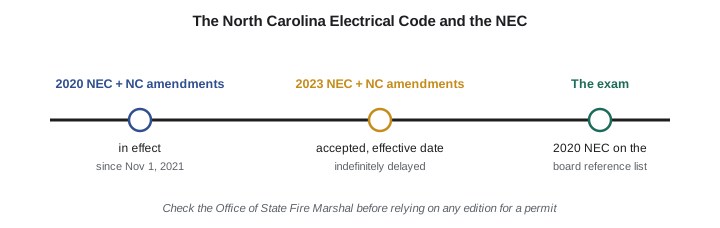
When this course was written, the Office of State Fire Marshal's page listed the 2020 NEC with state amendments as the current North Carolina Electrical Code, effective November 1, 2021. The 2023 NEC with state amendments had been accepted by the Building Code Council with an original adoption date of January 1, 2025, but its effective date was listed as indefinitely delayed. In practice, that meant North Carolina jobs were still being designed, permitted and inspected under the 2020 NEC as amended, years after the 2023 and even the 2026 NEC were published nationally.
This situation surprises contractors who move to North Carolina from states that adopt each new edition quickly, and it affects everything from GFCI and AFCI requirements to surge protection and service disconnect rules that changed in later editions. A rule that a manufacturer or a national magazine describes as new may not be required in North Carolina yet. Conversely, a rule that was removed or relaxed nationally may still apply here. The safe approach is always to start from the edition and amendments actually in force.
Delays like this one usually come from the rulemaking process itself: proposed amendments are debated, fiscal notes estimate the cost of new requirements, objections may send rules back for review, and the legislature can step in. None of that is on the exam, but it explains why a North Carolina contractor cannot assume the state will follow the national three-year cycle, and why the effective date on the state's page, not the year printed on the NEC's cover, is the date that matters for permits and inspections.
How the state amendments work
The North Carolina Electrical Code is the NEC as published by NFPA, adopted with a set of state amendments. The amendments change, delete or add specific sections. When this course was written, the state's page showed a compact original set of amendments for the 2020 code plus a separate list of additional amendments adopted after the code took effect, which is why a careful contractor checks both. Some amendments address administration and scope, such as how the code applies to one- and two-family dwellings; others change technical requirements. The state's page also lists formal interpretations of particular sections, which tell inspectors and contractors how the state reads them.
Reading an amendment takes discipline. First, find the section of the NEC it changes. Second, read the amendment's exact wording: does it replace the whole section, add an exception, delete a list item, or change one number? Third, check whether a later amendment or interpretation changed it again. Fourth, note the effective date. Carla kept a printed copy of the amendments tabbed into her NEC, with each amended section flagged in a different color, and recommended Keisha do the same for her working copy, but not for her exam copy unless the handbook allowed such inserts.
| Step | Question to ask |
|---|---|
| 1. Find the NEC section | Which section of the NEC does the amendment touch? |
| 2. Read the exact change | Does it replace, delete, add an exception or change a value? |
| 3. Check later changes | Did an additional amendment or interpretation modify it? |
| 4. Check the date | Was it in force on the job's permit date? |
Which edition governs a job
When a new edition takes effect, jobs already in progress do not instantly change. The general approach in North Carolina, as in most states, is that the code in effect when the permit is applied for or issued governs the job, and the State Building Code and the Building Code Council's adoption notices describe any transition period during which either edition may be used. A designer who started drawings under one edition needs to know when the next takes effect so that the permit application goes in under the intended edition. Because the 2023 edition's effective date was delayed indefinitely, North Carolina jobs permitted at the time this course was written fell under the 2020 code as amended.
# Which North Carolina Electrical Code edition applies? (illustrative logic)
from datetime import date
EDITIONS = [  # (effective date, edition label)
    (date(2021, 11, 1), "2020 NEC with NC amendments"),
    # The 2023 NEC with NC amendments was accepted, but its effective date was indefinitely delayed.
]
def edition_for(permit_date):
    current = None
    for eff, label in EDITIONS:
        if permit_date >= eff:
            current = label
    return current or "an earlier edition"
for d in (date(2021, 6, 15), date(2024, 3, 1), date(2026, 10, 5)):
print(d, "->", edition_for(d))2021-06-15 -> an earlier edition 2024-03-01 -> 2020 NEC with NC amendments 2026-10-05 -> 2020 NEC with NC amendments
The code above makes the point in a simple way: a permit in mid-2021 fell under the earlier code, and permits in 2024 and late 2026 fell under the 2020 code as amended, because no later edition had taken effect. When the state sets an effective date for the next edition, the list grows by one line and the transition rules decide which edition applies near the boundary.
The exam and the code in force
The board's reference list named the 2020 NEC when this course was written, which matched the code in force. That makes life simpler for candidates, but the exam is written to the NEC as published, not to every state amendment. Questions about installation rules usually expect the NEC answer, while questions about North Carolina administration, permits and licensing draw on the state's law and rules. If the board changes its reference list to a new edition, candidates must study the edition on the list in force on their exam date, even if the state code has not yet caught up, or the reverse.
Practical effects on North Carolina jobs
Using the 2020 code as amended affects several areas that changed in later editions. Examples that contractors commonly discuss include the reach of GFCI protection in dwellings and other occupancies, surge protection requirements for dwelling services, emergency disconnect requirements for one- and two-family dwellings, and the reorganization of some articles. A contractor bidding work in North Carolina should price the job to the code in force, while staying aware of what later editions require, because owners, engineers and manufacturers often ask for later-edition features voluntarily. When a specification calls for something stricter than the code, the specification governs the contract even if the inspector would accept less.
Worked problem
A later-edition rule on a North Carolina job
An engineer's drawings for a Mebane medical office call for a feature that the 2023 NEC requires but the 2020 NEC does not. The general contractor asks Keisha whether Haw River can leave it out to save money because the inspector will not require it. What should she say?
Show solution
- Under the North Carolina Electrical Code in force (2020 NEC as amended), the feature may not be required.
- But the drawings and specifications are part of the contract, and the engineer specified it.
- Leaving it out would be a change to the contract that needs the engineer's and owner's approval, usually through a change order or substitution request.
- The inspector enforces the code minimum; the contract can require more.
Answer: Install it as specified unless the engineer and owner approve a change in writing; the code is a minimum, and the contract governs extra requirements.
Other code volumes that touch electrical work
Electrical contractors in North Carolina also work under parts of the State Building Code outside the electrical volume. The building code governs fire-resistance-rated assemblies, so penetrations of rated walls and floors by conduit and cable must be firestopped with listed systems. The energy conservation code sets lighting power limits, lighting controls and some metering and receptacle control requirements for commercial buildings, which the electrical contractor usually installs even when an engineer designs them. The fire code and the building code decide when fire alarm systems are required, while NFPA 72 and the electrical code govern how they are installed. The residential code contains requirements for dwellings that interact with the electrical code, such as smoke alarm locations and interconnection. A contractor who knows only the electrical volume will miss requirements that inspectors from other disciplines check on the same job.
On the Mebane medical office, for example, the lighting design had to satisfy the energy code's lighting power and occupancy sensor requirements, the corridor walls were one-hour rated and needed firestopped penetrations, and the fire alarm was required by the building code for that occupancy. Keisha's estimate included each of these, and her pre-construction meeting agenda listed the inspectors who would check them.
Questions to bring to the inspections department
Good contractors use the inspections department as a resource before work is covered. Useful questions include: which edition and which amendments apply to this permit; whether a particular interpretation applies; what the department expects to see at each inspection; how it handles special inspections or engineer letters; and how to request a variance or alternate method if a design cannot meet a rule as written. Asking early, in writing when the answer matters, avoids failed inspections and disputes later.
Staying current
Keeping track of North Carolina code changes means watching a few sources: the Office of State Fire Marshal's code pages and notices, the Building Code Council's meeting agendas and rulemaking notices, the state's electrical interpretations, and continuing education courses, which the board requires each year and which often cover amendments and interpretations. Trade associations and local inspector meetings also share news. Carla's last piece of advice was simple: when a code question matters, call the inspections department before the work is covered, not after the inspection fails.
Common mistakes
MistakeAssuming the newest national NEC edition is enforced in North Carolina.
InsteadCheck the Office of State Fire Marshal's page; the 2020 NEC as amended was in force when this course was written.
MistakeReading the NEC without the state amendments.
InsteadThe North Carolina Electrical Code is the NEC plus amendments, including additional amendments adopted later.
MistakeLeaving out a specified item because the code does not require it.
InsteadThe contract can require more than the code; changes need approval.
MistakeUsing an amended rule on the exam when the question asks for the NEC rule.
InsteadRead the question; installation questions usually expect the NEC answer from the reference list edition.
Summary and key terms
- The North Carolina Electrical Code is part of the State Building Code, adopted by the Building Code Council with support from the Office of State Fire Marshal.
- When this course was written, the 2020 NEC with state amendments was in force, effective November 1, 2021.
- The 2023 NEC with amendments was accepted but its effective date was indefinitely delayed.
- State amendments change specific sections, and additional amendments and interpretations can follow.
- The code in force on the permit date governs a job, and the contract can require more than the code.
- North Carolina Electrical Code
- The NEC as adopted with state amendments as part of the State Building Code.
- Building Code Council
- The state body that adopts the State Building Code and its amendments.
- Office of State Fire Marshal
- The state office that supports the Building Code Council and publishes the code and interpretations.
- State amendment
- A change to a section of the NEC adopted for North Carolina.
- Interpretation
- A formal statement of how the state reads a code section.
Practice problems
Work each problem on paper first, then reveal the answer to check.
Which NEC edition was the basis of the North Carolina Electrical Code when this course was written, and since when?
Show answer
The 2020 NEC with state amendments, effective November 1, 2021.
What was the status of the 2023 NEC with North Carolina amendments?
Show answer
Accepted, but with its effective date indefinitely delayed.
Where should a contractor check the current edition and interpretations?
Show answer
The Office of State Fire Marshal's State Electrical Code page.
Who decides whether a job may omit an item the specifications require but the code does not?
Show answer
The engineer and owner, through a written change; the inspector only enforces the code minimum.
Lesson quiz · 5 questions
Score 60% or more to complete this lesson.
Create a free account to save your progress, take quizzes and earn a certificate.