
MELU-308 · Lesson 8 of 12 · 19 min
Contractor licensing, insurance and bonding
▶ Video coming soon A video version of this lesson is on the way.
Passing the exam would make Keisha a qualified individual. Making Haw River an unlimited contractor was a separate job, and it landed on Ray Delgado's desk. He made a list: the license application and fee, the statement of bonding ability, the company's registration with the state, its insurance certificates, its workers' compensation policy, and the bonds that public jobs like the Graham school addition would require. "The board licenses us," he said, "but the owner, the general contractor, the surety and the insurance company each have their own requirements, and any one of them can stop a job." This lesson covers the business side of the license: the license application and fees, the statement of bonding ability, business registration, insurance, workers' compensation and payment and performance bonds.
The license application and fees
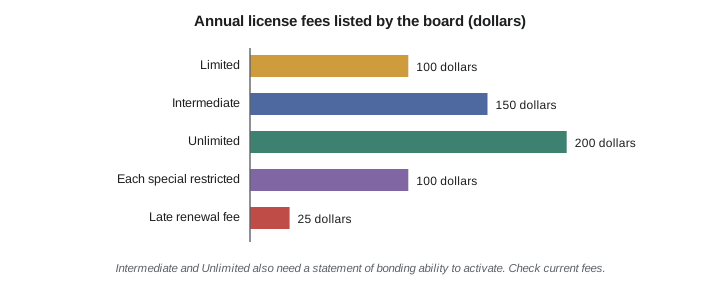
After the qualified individual passes the exam, the licensee applies for the license, lists the qualified individual and pays the annual fee for its classification. When this course was written, the board's licensing page listed annual fees of 100 dollars for limited, 150 dollars for intermediate, 200 dollars for unlimited and 100 dollars for each special restricted classification. Licenses expire one year after the date of issue, the board sends renewal notices about 60 days ahead, and renewals received after expiration carry an administrative fee listed at 25 dollars. Small fees also apply to duplicate certificates, decorative certificates and the qualified individual patch some contractors wear on their uniforms.
The statement of bonding ability
The board's licensing page said that a statement of bonding ability is required to activate intermediate and unlimited licenses. In general terms, it is a letter or form from a surety company stating that the contractor is able to obtain bonds, which shows the board that a company taking on larger projects has a relationship with a surety. It is not itself a bond protecting any particular owner, and it does not replace the payment and performance bonds a project may require. The board's forms explain what the statement must say and who may issue it.
Ray called Haw River's surety agent the week Keisha applied, explained the move to unlimited, and arranged the statement so it would be ready the day her passing score posted. The agent also asked for the company's latest financial statements and its work-in-progress schedule, because the surety would be underwriting larger bonds once Haw River started bidding jobs like the school addition.
Business registration and names
A licensee that is a corporation, limited liability company or limited partnership must be organized or registered with the North Carolina Secretary of State, and a business that operates under a name other than its legal name generally files an assumed business name certificate as state law requires. The license should be issued in the business's exact legal name, and contracts, bids and permits should use that name. When a contractor changes its entity, for example by converting a sole proprietorship to a corporation, it should check with the board whether the license can be updated or a new license is needed, and it should never assume an old license carries over automatically. Tax registrations with the North Carolina Department of Revenue and the state's unemployment insurance agency follow from having employees and doing business in the state.
General liability insurance
The board's licensing page did not list a general liability insurance requirement for electrical contractor licenses when this course was written. In practice, general liability insurance is close to universal for electrical contractors, because owners, general contractors, landlords and many local governments require certificates of insurance with specified limits before work starts. Contracts often require the contractor to name the owner or general contractor as an additional insured, to carry completed operations coverage for a period after the job, and to waive subrogation. A certificate of insurance is evidence that a policy exists; the policy and its endorsements decide what is actually covered.
# Track insurance certificates that expire during a job (illustrative dates)
from datetime import date
certs = [
    ("Haw River general liability", date(2026, 9, 30)),
    ("Haw River workers' compensation", date(2026, 7, 31)),
    ("Low-voltage sub general liability", date(2026, 6, 15)),
    ("Low-voltage sub workers' compensation", date(2027, 1, 31)),
]
job_end = date(2026, 8, 28)
for name, exp in certs:
    note = "renew before job ends" if exp < job_end else "covers the job"
print(f"{name:<38} expires {exp} {note}")Haw River general liability expires 2026-09-30 covers the job Haw River workers' compensation expires 2026-07-31 renew before job ends Low-voltage sub general liability expires 2026-06-15 renew before job ends Low-voltage sub workers' compensation expires 2027-01-31 covers the job
Workers' compensation
North Carolina's Workers' Compensation Act, in Chapter 97 of the General Statutes, is administered by the North Carolina Industrial Commission. According to the Commission, employers that regularly employ three or more employees must carry workers' compensation insurance or qualify as self-insured, and corporate executive officers count toward the three. A corporation with two officers and one other employee therefore needs coverage. Sole proprietors, partners and LLC members are not automatically counted, though they may elect to cover themselves. Occupational accident insurance is not a substitute for workers' compensation.
Construction adds another rule. Under section 97-19, a contractor that sublets work to a subcontractor without obtaining proof that the subcontractor carries workers' compensation can become liable for injuries to the subcontractor's employees as if it were their employer. That is why electrical contractors collect certificates of insurance from every subcontractor before work starts and keep them current, and why general contractors require the same from electrical contractors. Ray kept a spreadsheet of every subcontractor's certificates and would not release a first payment until the certificates were on file.
Worked problem
Does the company need coverage?
Keisha's friend Andre runs his shop as a corporation. He and his wife are the two officers, and he employs one electrician full time. His insurance agent offered him an occupational accident policy instead of workers' compensation. What should Andre do?
Show solution
- Corporate executive officers count toward the three-employee threshold.
- Two officers plus one employee makes three, so the corporation must carry workers' compensation.
- An occupational accident policy is not a substitute for workers' compensation.
- Andre should buy a workers' compensation policy, and he may ask whether the officers can exclude themselves under the policy's terms.
Answer: Andre's corporation needs workers' compensation coverage; the occupational accident policy does not satisfy the law.
Payment and performance bonds
Public construction in North Carolina often requires bonds. State law in Article 3 of Chapter 44A requires payment and performance bonds on public construction contracts above thresholds set in the statute, and the owner or general contractor may require them on private jobs too. A performance bond protects the owner if the contractor fails to perform the contract; a payment bond protects subcontractors and suppliers who are not paid, because they generally cannot place liens on public property. On the Graham school addition, the general contractor required Haw River to provide both bonds for its subcontract, which the surety issued once Haw River's unlimited license was active.
| Bond | Who it protects | Typical use |
|---|---|---|
| Bid bond | The owner, if the low bidder refuses to sign | Public bids |
| Performance bond | The owner (or general contractor), if the contractor fails to perform | Public jobs and larger private jobs |
| Payment bond | Subcontractors and suppliers, if they are not paid | Public jobs, where liens are not available |
| Statement of bonding ability | Shows the board the contractor can obtain bonds | Activating intermediate and unlimited licenses |
Building a surety relationship
Sureties decide whether to bond a contractor, and for how much, by looking at what underwriters often call the three Cs: character, capacity and capital. Character is the contractor's reputation, history of finishing jobs and paying suppliers, and the experience of its people. Capacity is whether the company has the crews, supervision and systems to perform the work it is bidding, often judged from a work-in-progress schedule that lists every open job, its contract value, its cost to date and its expected profit. Capital is the company's financial strength, usually shown in financial statements prepared or reviewed by an accountant. From these, the surety sets a single-job limit and an aggregate limit for all bonded work at once.
For Haw River, moving to unlimited meant bidding single jobs two or three times larger than before. The surety reviewed three years of financial statements, the work-in-progress schedule and Keisha's resume, and set a single-job limit comfortably above the school addition. Ray learned to send updated statements every year without being asked, because a surety that is surprised by a bad year can cut limits just when the company needs them.
# A simple work-in-progress check against a surety's aggregate limit (illustrative figures)
jobs = {"School addition": (310000, 0.10), "Medical office": (241000, 0.35), "Church hall": (148000, 0.80), "Bakery": (85000, 0.95)}
aggregate_limit = 900000
backlog = 0
for name, (value, done) in jobs.items():
    remaining = value * (1 - done)
    backlog += remaining
    print(f"{name:<16} contract {value:>8,}  remaining {remaining:>9,.0f}")
print(f"uncompleted backlog {backlog:,.0f} of an aggregate limit of {aggregate_limit:,}")School addition contract 310,000 remaining 279,000 Medical office contract 241,000 remaining 156,650 Church hall contract 148,000 remaining 29,600 Bakery contract 85,000 remaining 4,250 uncompleted backlog 469,500 of an aggregate limit of 900,000
Insurance requirements in contracts
Insurance requirements usually arrive in the contract, not the license. A typical general contractor subcontract lists required coverages and limits: commercial general liability, often with per-occurrence and aggregate limits; automobile liability for company vehicles; workers' compensation and employer's liability; and sometimes an umbrella or excess policy. It may also require additional insured endorsements, primary and noncontributory wording, waivers of subrogation and notice of cancellation. Before signing, the contractor should send the insurance section to its agent and confirm that its policies meet it, because adding endorsements after the fact can take time and money. Missing coverage discovered after an accident is far more expensive.
Taxes and payroll
Every contractor with employees must withhold and pay federal and state income taxes, pay Social Security and Medicare taxes, and register for state unemployment insurance. North Carolina also has sales and use tax rules for contractors that depend on whether a contract improves real property and on who buys the materials; contractors on real property contracts generally pay tax on the materials they buy rather than charging sales tax to the owner, but the rules have details and exceptions. The NASCLA business guide on the board's reference list covers these topics, and a contractor's accountant should confirm how they apply to each kind of job.
Payroll also brings record-keeping duties. Employers keep records of hours and wages, verify each new employee's eligibility to work, report new hires to the state, and file quarterly and annual returns. Federal wage and hour law requires overtime for nonexempt employees who work more than forty hours in a workweek, and public jobs funded with federal money may carry prevailing wage requirements with certified payroll reports. Misclassifying workers as independent contractors to avoid payroll taxes and workers' compensation is a common and costly mistake; the tests that agencies apply look at control over the work, not at what the paperwork calls the worker. Haw River's rule was simple: anyone who worked on its crews under its direction was an employee, with taxes withheld and workers' compensation in place.
Common mistakes
MistakeThinking the statement of bonding ability is the same as a payment bond.
InsteadThe statement shows bonding capacity to the board; project bonds protect particular owners and suppliers.
MistakeLeaving corporate officers out of the employee count.
InsteadExecutive officers count toward the three-employee workers' compensation threshold.
MistakeHiring a subcontractor without a current workers' compensation certificate.
InsteadSection 97-19 can make the upper-tier contractor liable for the subcontractor's injured workers.
MistakeAssuming a license carries over automatically when the business changes its entity.
InsteadCheck with the board; a new license or an update may be required.
Summary and key terms
- The licensee applies for the license after the exam and pays an annual fee by classification, listed at 100, 150 and 200 dollars for limited, intermediate and unlimited.
- A statement of bonding ability is required to activate intermediate and unlimited licenses.
- Businesses register with the Secretary of State and use their exact legal name on the license, contracts and permits.
- Employers with three or more regular employees, counting corporate officers, must carry workers' compensation, and section 97-19 makes certificates from subcontractors essential.
- Public jobs above statutory thresholds require payment and performance bonds.
- Statement of bonding ability
- A surety's statement that a contractor can obtain bonds, required to activate intermediate and unlimited licenses.
- Certificate of insurance
- A document showing that an insurance policy exists, with its limits and dates.
- Additional insured
- A party added to a contractor's liability policy, such as the owner or general contractor.
- Performance bond
- A bond protecting the owner if the contractor fails to perform.
- Payment bond
- A bond protecting unpaid subcontractors and suppliers.
Practice problems
Work each problem on paper first, then reveal the answer to check.
What annual fee did the board list for an unlimited license?
Show answer
200 dollars.
A corporation has three officers and no other employees. Must it carry workers' compensation?
Show answer
Yes; executive officers count, so it has three employees, although officers may be able to exclude themselves under the policy.
Why do contractors collect workers' compensation certificates from subcontractors?
Show answer
Because section 97-19 can make them liable for an uninsured subcontractor's injured employees.
Which bond protects unpaid suppliers on a public job?
Show answer
The payment bond.
Lesson quiz · 5 questions
Score 60% or more to complete this lesson.
Create a free account to save your progress, take quizzes and earn a certificate.