
MELU-308 · Lesson 6 of 12 · 19 min
Permits, inspections and the inspection authority
▶ Video coming soon A video version of this lesson is on the way.
The second half of Keisha's coffee with Carla Whitt turned to permits. "Your license gets you in the door," Carla said. "The permit is what lets you work on a particular building, and my inspections are how the city knows the work meets the code. If you skip either one, the license won't save you." This lesson covers who issues electrical permits in North Carolina, who may obtain them, the inspection stages on a typical job, how inspectors are certified, what happens when an inspection fails, and how power gets connected at the end. Local procedures vary, so the details here are typical rather than universal; each inspections department publishes its own permit and inspection procedures.
Who enforces the code
In North Carolina, the State Building Code is enforced mainly by local inspections departments run by counties and cities. State law, in the building code enforcement article of the land use statutes in Chapter 160D, authorizes local governments to create inspections departments, employ inspectors, issue permits, inspect work and order unsafe conditions corrected. A city usually enforces the code inside its limits, and the county outside them, although some local governments contract with each other or share departments. Certain state-owned buildings and other special cases are handled by state agencies rather than local departments, so the first step on any unusual job is to find out who the inspection authority is.
Keisha's jobs illustrated the pattern. The bakery fit-out in downtown Burlington was inspected by the City of Burlington. The church fellowship hall outside town limits was inspected by Alamance County. The Mebane medical office fell under the City of Mebane. A project for a state university campus would have had different arrangements. Each department had its own online permit portal, fee schedule and inspection request system, and Ray kept a one-page summary for each one the company worked with regularly.
Permits and who may get them
Electrical work generally requires a permit before it starts, with limited exceptions for minor repairs and replacements described in the State Building Code and local rules. A permit is issued for a specific address and scope of work. In North Carolina, local inspections departments issue electrical permits only to people who hold the appropriate license from the electrical contractors' board for the type and value of the work, or to people covered by an exemption, such as certain property owners doing work on their own residence under conditions set by the statute. The department checks the license and classification, so a limited licensee cannot obtain a permit for a job above the limited value or voltage, and a special restricted licensee cannot obtain one outside its scope.
The permit application typically asks for the address, owner, scope, value of the electrical work, service size and, for larger jobs, drawings for plan review. On commercial work, the department may require sealed electrical drawings from an engineer. Fees usually depend on the value, the service size or the number of circuits, and are set locally. Once issued, the permit must be available at the site, and work must start and continue within time limits the department sets; a permit for a job that stalls can expire and have to be renewed.
The owner exemption
The licensing statute allows certain property owners to do electrical work on their own property without a contractor's license, under conditions. In general terms, the exemption is aimed at an owner doing work personally on a residence they own and occupy, or will occupy, and not on property built for sale or rent. The owner still needs a permit, the work must meet the code and pass inspections, and the inspections department may require the owner to show they understand the requirements. The exemption does not let an owner hire an unlicensed person to do the work. Contractors sometimes meet owners who misunderstand the exemption, and exam questions test its limits.
Contractors who work across several jurisdictions often keep a simple matrix: for each department, the permit portal, the fee basis, the lead time for inspection requests, whether plan review is required for small commercial work, the cutoff time for next-day inspections, and the contact for questions. Ray's matrix for Burlington, Graham, Mebane, Alamance County and Guilford County fit on one page and saved the crews from guessing. When a new jurisdiction came up, he called the department before the bid was submitted, because a long plan review queue could change the schedule the company promised the owner.
Plan review
On commercial projects and larger residential projects, the inspections department reviews the electrical drawings before issuing the permit or before work above a certain stage. Plan reviewers check the service and feeder sizes, the load calculations, the panel schedules, fault current information, emergency and standby systems, and compliance with the energy code's lighting requirements. Comments must be resolved before the permit is issued or before the affected work proceeds. Haw River's estimators learned to read plan review comments carefully, because a comment that changes a feeder size or adds a disconnect changes the cost.
Inspection stages
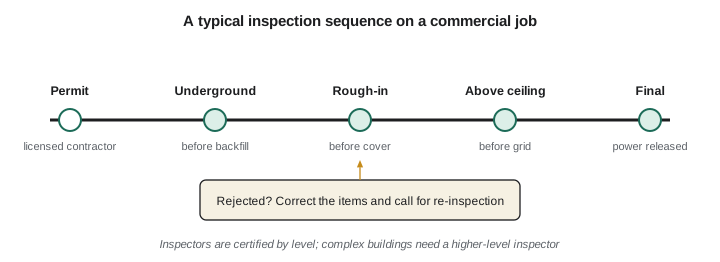
A typical commercial job has several electrical inspections: an underground or slab inspection before conduit is buried or concrete is poured; a rough-in inspection before walls are covered; an above-ceiling inspection before the ceiling grid is closed; service inspections; and a final inspection when the work is complete. Residential jobs typically have temporary service, rough-in and final inspections. The contractor requests each inspection through the department's system, usually a day or more in advance, and must not cover work before it passes.
# A simple inspection tracker for the Mebane medical office (illustrative)
inspections = [
    ("Underground", "2026-04-08", "passed"),
    ("Slab conduits", "2026-04-15", "passed"),
    ("Rough-in, level 1", "2026-06-02", "rejected"),
    ("Rough-in, level 1", "2026-06-05", "passed"),
    ("Above ceiling", "2026-07-21", "scheduled"),
    ("Final", None, "not yet requested"),
]
passed = sum(1 for _, _, s in inspections if s == "passed")
rejected = sum(1 for _, _, s in inspections if s == "rejected")
for name, day, status in inspections:
    print(f"{name:<20} {day or '-':<12} {status}")
print(f"passed {passed}, rejected {rejected}")Underground 2026-04-08 passed Slab conduits 2026-04-15 passed Rough-in, level 1 2026-06-02 rejected Rough-in, level 1 2026-06-05 passed Above ceiling 2026-07-21 scheduled Final - not yet requested passed 3, rejected 1
How inspectors are certified
North Carolina inspectors are certified by a state board for code officials, which issues certificates by trade and by level. Higher levels allow an inspector to inspect larger and more complex buildings, so a department sends an inspector with the right level to a hospital or a high-rise. Inspectors complete continuing education to keep their certificates. Contractors do not need to know the certification rules in detail, but it helps to understand that the inspector on a complex job has been certified for that kind of work, and that inspectors themselves work under the same State Building Code and interpretations as the contractor.
When an inspection fails
When an inspector finds violations, the inspection is rejected and the inspector lists the items to correct. The contractor corrects them and requests a re-inspection, which may carry a fee if the department charges for repeat visits. Disputes over an inspector's reading of the code can usually be taken to the inspector's supervisor or the department head first, and then through the appeal procedures the State Building Code and state law provide, which can reach the state's code officials and, for code interpretations, the state's electrical staff. Most disagreements are settled by a conversation and a code reference, which is why Carla always asked contractors to bring the section number, not just an opinion.
Worked problem
A rejected rough-in
On the medical office, the level 1 rough-in was rejected for three items: missing bonding bushings on a concentric-knockout enclosure, cables not secured within the required distance of boxes in two rooms, and a missing firestop at one rated wall. What should Keisha do?
Show solution
- Review each item against the code section the inspector cited, and confirm the correction needed.
- Assign the corrections to the crew with photos of each location.
- Have the firestop installed with a listed system appropriate to the wall and penetration.
- Request a re-inspection once all items are corrected, and pay any re-inspection fee.
- Brief the crew so the same items do not recur on level 2.
Answer: Correct all three items, document them, request a re-inspection, and use the lesson on the next floor.
Temporary power, final inspection and power release
Most jobs need temporary power during construction, which has its own permit or inspection and its own safety requirements. At the end, the final inspection checks the completed installation, labeling, panel directories, equipment installation and any required tests. Once the final inspection passes, the inspections department notifies the electric utility or issues a release so that the utility may connect permanent power. Utilities generally will not energize a new or rebuilt service without that release. On commercial projects, the building's certificate of occupancy depends on the final inspections of all trades, so a late electrical final can delay the owner's move-in.
Working with the electric utility
The utility is a separate party with its own rules. In much of North Carolina the serving utility is a large investor-owned company, while other areas are served by electric membership cooperatives or municipal electric systems. Each publishes service requirements that cover metering equipment, meter locations, clearances, service entrance arrangements, current transformer cabinets for larger services, and the steps to request a new service, an upgrade or a temporary disconnect for work. These requirements are not part of the electrical code, but inspectors expect meters and service equipment to suit the utility, and a utility can refuse to connect equipment that does not meet its standards. On a service upgrade, the contractor typically coordinates the outage with the utility, has the work inspected, and then the utility reconnects after the release.
Haw River had learned to send its service applications early. On the Graham school addition, the utility needed weeks to design a new pad-mounted transformer and set the conduit specifications for the primary, and the electrical schedule depended on that design. Keisha's job schedule listed the utility's milestones alongside the inspections, because a late transformer delays the final as surely as a failed inspection.
Service calls, repairs and replacements
Not every job is a new building. Service work, such as replacing a breaker, a failed receptacle, a water heater element circuit or a damaged panel, raises the question of when a permit is needed. The State Building Code and local rules allow some minor repairs and like-for-like replacements without a permit and require permits for others, such as service replacements, new circuits and panel changes. Because the line differs by situation, many contractors simply ask the department or pull a permit whenever in doubt. Unpermitted service changes are a common cause of failed home sales inspections and insurance disputes, and they reflect on the contractor whose name is on the van.
Records and responsibility
Good contractors keep permit and inspection records in the job file: the permit, plan review comments, inspection results, correction photos and the final release. These records help if a dispute arises, if an owner later asks for proof that work was permitted, or if the board investigates a complaint. Under the licensing law, the licensee and its qualified individual are responsible for the work done under their permits, so the records are also evidence that the company supervised the work it permitted.
Common mistakes
MistakeStarting work before the permit is issued.
InsteadWait for the permit, and post it at the site.
MistakeCovering work before the inspection passes.
InsteadNever cover work until it has passed; uncovering it later costs time and money.
MistakeTelling a homeowner the owner exemption lets them hire an unlicensed helper.
InsteadThe exemption covers the owner's own work under conditions; it does not authorize hiring unlicensed contractors.
MistakeArguing a rejection without a code reference.
InsteadBring the specific section and any state interpretation; most disputes end there.
Summary and key terms
- Local inspections departments in counties and cities enforce the State Building Code and issue electrical permits.
- Permits are issued to licensees with the right classification for the job, or to owners covered by the exemption.
- Typical inspections include underground, rough-in, above-ceiling, service and final, and work must not be covered before it passes.
- Inspectors are certified by trade and level; disputes go first to the department and then through appeal procedures.
- After the final inspection, the department releases the service so the utility can connect permanent power.
- Inspections department
- The local government office that issues permits and inspects work under the State Building Code.
- Permit
- Permission from the inspections department to perform specific electrical work at an address.
- Rough-in inspection
- An inspection of wiring before walls or ceilings are covered.
- Owner exemption
- The statutory exemption that lets certain owners do electrical work on their own residence under conditions.
- Power release
- The department's notice to the utility that a service may be energized.
Practice problems
Work each problem on paper first, then reveal the answer to check.
Who usually enforces the electrical code for a job inside city limits?
Show answer
The city's inspections department, unless it has arranged otherwise.
May a limited licensee obtain a permit for a 120,000-dollar job?
Show answer
No; the job is above the limited value listed by the board, so the department should refuse the permit.
What should happen before a new service is energized by the utility?
Show answer
The final or service inspection must pass and the department must release the service.
What is the first step in disputing an inspector's reading of the code?
Show answer
Discuss it with the inspector and supervisor, citing the specific code section and any state interpretation.
Lesson quiz · 5 questions
Score 60% or more to complete this lesson.
Create a free account to save your progress, take quizzes and earn a certificate.