
MELU-308 · Lesson 4 of 12 · 21 min
The exam format and the references allowed
▶ Video coming soon A video version of this lesson is on the way.
Two weeks after her application went in, Keisha spread four books across Haw River's conference table: a softbound NEC, a fire alarm code, a thick business and law guide with "North Carolina Electrical Edition" on the cover, and a printout of the licensing law and rules. "That's the whole exam," Ray said. "Everything they can ask is in one of those, and you're allowed to bring all four in with you." This lesson covers the format of the board's examinations, the references the board allows, how the questions are spread across code, calculations and business topics, and a pacing plan for a long open-book exam. The figures come from the board's examination page when this course was written; the current handbook controls.
The exams by classification
The board gives a different exam for each group of classifications. According to its examination page, the limited, intermediate and unlimited exams each have 100 multiple-choice questions and a time limit of six hours. The fire alarm and low-voltage exam has 50 questions in three hours. The other special restricted exams (single-family dwelling, plumbing heating and air conditioning, electric sign, elevator and groundwater pump) have 40 questions in three hours, and the swimming pool exam has 25 questions in one hour. All are computer-based, delivered at PSI test centers, and a score of 70 or more is required to pass.
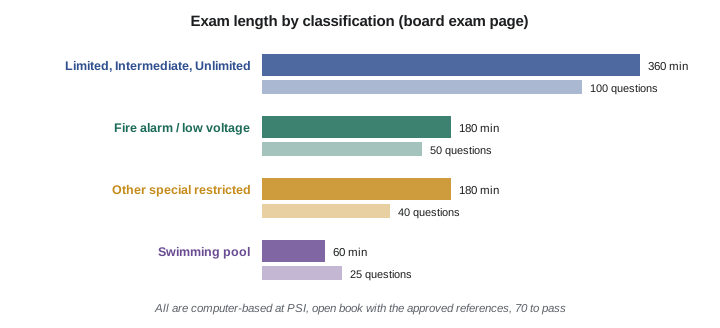
Note what the table does not say: the limited, intermediate and unlimited exams share the same length and format, but the content differs with the classification. A limited exam stays within the work a limited licensee may do, while the unlimited exam can reach into larger services, medium-voltage topics, complex load calculations and larger-project business questions. Prep providers describe the unlimited exam as the broadest, and Keisha planned for it accordingly.
The approved references
The board's examination page says the exam is open book, and candidates may refer to any part of the approved references. When this course was written, the page listed four references: the National Electrical Code, 2020 edition; NFPA 72, the National Fire Alarm and Signaling Code, 2013 edition; the NASCLA Contractors Guide to Business, Law and Project Management, North Carolina Electrical Edition; and the North Carolina electrical contractor licensing law, meaning Article 4 of Chapter 87 and the board's rules in 21 NCAC 18B. The handbook explains which formats are accepted and what marking is allowed, such as permanent tabs and highlighting, and what is not, such as handwritten notes or inserted pages.
| Reference | What it is used for on the exam |
|---|---|
| NEC, 2020 edition | Installation rules, tables and calculations |
| NFPA 72, 2013 edition | Fire alarm and signaling questions |
| NASCLA guide, NC Electrical Edition | Business, contracts, project management, tax, payroll, insurance, safety and NC-specific law |
| Article 4 of Chapter 87 and 21 NCAC 18B | Licensing law: classifications, limits, qualified individuals, renewal, discipline |
How the questions are spread
The board's handbook describes the content areas of each exam, sometimes with the approximate number of questions in each. For the main classifications, expect a large share of code questions, where the answer is a rule or table value you must find; a substantial group of calculations, such as load calculations, conductor sizing with adjustment and correction, voltage drop, motor circuits, conduit and box fill and transformer sizing; and a block of business, law and project management questions drawn from the NASCLA guide and the North Carolina licensing law. Fire alarm questions draw on NFPA 72. Because all of these share one sitting, the candidate has to switch between very different kinds of questions, which is harder than it sounds.
# Rough topic budget for a 100-question exam (illustrative split, not the board's official outline)
split = {"Code lookup": 45, "Calculations": 25, "Business and project management": 20, "NC law and rules": 6, "Fire alarm (NFPA 72)": 4}
assert sum(split.values()) == 100
minutes = 360 - 40   # reserve 40 minutes for review
for topic, n in split.items():
print(f"{topic:<33} {n:>3} questions about {n * minutes / 100:.0f} minutes")Code lookup 45 questions about 144 minutes Calculations 25 questions about 80 minutes Business and project management 20 questions about 64 minutes NC law and rules 6 questions about 19 minutes Fire alarm (NFPA 72) 4 questions about 13 minutes
The split in the code above is an illustration only; the handbook gives the real content outline, and it may change. The point is that a candidate who spends most of their study time on code lookup and neglects the business guide can lose twenty or more points that are easier to earn than the hardest calculations.
Calculations to have ready
Calculation questions reward practice more than any other kind. The master electrician core courses covered the methods; for this exam, the goal is to do them quickly and with the right reference open. Common types include dwelling and commercial load calculations, sizing conductors after applying temperature correction and adjustment for the number of current-carrying conductors, voltage drop over a run, motor branch circuit and feeder sizing using the motor tables, conduit fill and box fill, transformer primary and secondary currents, and service and feeder neutral loads. Each has a small set of steps and a few table lookups, and each has typical traps, such as forgetting the continuous load factor, using the wrong temperature column, or rounding a conductor size the wrong way.
Worked problem
A quick transformer current question
A question gives a 75 kVA, three-phase transformer with a 480-volt primary and a 208Y/120-volt secondary, and asks for the full-load secondary current. How should the candidate work it?
Show solution
- For a three-phase transformer, current equals kVA × 1,000 divided by (voltage × 1.732).
- Secondary current = 75,000 ÷ (208 × 1.732) = 75,000 ÷ 360.3 ≈ 208 amperes.
- Primary current, if asked, = 75,000 ÷ (480 × 1.732) ≈ 90 amperes.
- Check which side the question asks about before choosing an answer, since both values usually appear in the options.
Answer: About 208 amperes on the secondary (and about 90 amperes on the primary).
Questions like this are worth practicing until they take under two minutes, because they buy time for the longer load calculations later in the exam. The formula is general electrical theory, not a code table, so the candidate's own notes on the scratch paper are enough.
Fire alarm and specialty questions
Because NFPA 72 is on the reference list, candidates for the main classifications should expect a few fire alarm questions even if they rarely install fire alarm systems. These tend to cover definitions, the basic structure of the code, power supply and secondary power concepts, circuit and pathway classes, and inspection and testing ideas. A candidate who has never opened NFPA 72 should spend at least a couple of study sessions learning how it is organized and tabbing its main chapters, so that a lookup takes minutes rather than a quarter of an hour.
At the test center
Test centers follow standard security procedures: lockers for personal items, a check of identification and reference books, a seat assignment, and rules on breaks. Scratch paper or a whiteboard and a calculator are provided, and the computer interface usually lets candidates flag questions and return to them. A short tutorial at the start explains the controls. Candidates should eat beforehand, bring water if allowed, and arrive early so that the check-in does not cut into their nerves. Six hours is a long time to concentrate, so planned short breaks, if the rules allow them, can help.
Tabbing and organizing the books
In an open-book exam, the books are only as useful as the candidate's ability to find things fast. Most candidates put permanent tabs on the NEC articles and tables they use most, such as the definitions article, branch circuits, feeders, load calculations, services, overcurrent protection, grounding and bonding, wiring methods, conductor ampacity tables, conduit fill tables and annexes, motor tables, transformers and the special occupancy articles. In the NASCLA guide, they tab the chapters on contracts, liens, insurance, tax, payroll, safety and the North Carolina supplement. In the licensing law, they tab the classifications, qualified individual rules, renewal and discipline sections. The handbook's rules on tabs and markings must be followed exactly.
Keisha practiced with her tabbed books for weeks before the exam, timing herself on lookups. She learned that the index of the NEC was often faster than flipping to an article she half remembered, and that the business guide's index and chapter summaries let her answer many business questions in under a minute.
A pacing plan
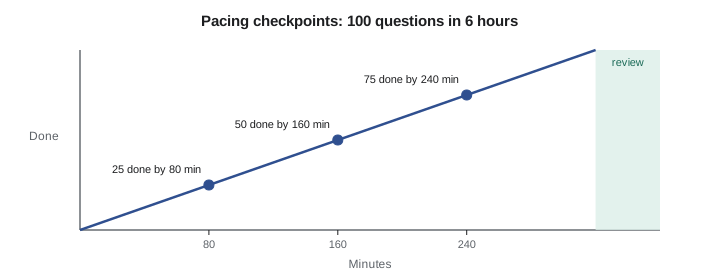
Six hours for 100 questions sounds generous, but long lookups and multi-step calculations eat time. A simple plan reserves the last 40 minutes for review and flagged questions, leaving 320 minutes for a first pass, or 3.2 minutes per question. Checkpoints keep the pace honest: about 25 questions done by 80 minutes, 50 by 160 and 75 by 240. On the first pass, answer what you can, flag anything that will take more than about four minutes, and move on. On the second pass, work the flagged questions in order of how confident you are that a lookup will settle them.
# Pacing checkpoints for 100 questions in 360 minutes with a 40-minute review reserve
total_q, total_min, reserve = 100, 360, 40
per_q = (total_min - reserve) / total_q
print(f"first-pass budget: {per_q:.1f} minutes per question")
for q in (25, 50, 75, 100):
print(f"question {q:>3} by minute {q * per_q:.0f}")first-pass budget: 3.2 minutes per question question 25 by minute 80 question 50 by minute 160 question 75 by minute 240 question 100 by minute 320
Reading the questions
Exam questions are written carefully, and small words matter. Watch for words like minimum, maximum, not, except, and the difference between dwelling unit and dwelling, or between continuous and noncontinuous load. When a question asks for a conductor size, check whether it asks for the minimum size allowed or a size that is merely acceptable. When it describes a job, check the voltage, the occupancy and whether the load is continuous. Calculator mistakes are common, so write the steps on the scratch material provided and check units. If two answers look right, the question usually hinges on a detail in the stem.
Wrong answers on licensing exams are rarely random. They are often the result of a common mistake: the value from the wrong column of a table, the number you get if you forget to apply a factor, the single-phase answer to a three-phase question, or a rule from the general article when the question is about a special occupancy that modifies it. When your answer matches one of the options, that is a good sign but not proof; ask which mistake each of the other options represents. Keisha found that habit caught several of her own errors in practice exams, especially on adjustment factors and motor questions.
Worked problem
A typical business question
A question asks: 'Under North Carolina law, a qualified individual must complete continuing education during which period before renewal?' Where should the candidate look, and how should they decide between close answers?
Show solution
- The topic is licensing law, so the North Carolina statute and board rules are the right reference.
- The continuing education section says the hours must be completed in the 12 months before renewal, in courses approved by the board.
- Answers that mention a two-year cycle or any course chosen by the candidate can be ruled out.
- The candidate should read the exact wording in the reference rather than relying on memory of another state's rule.
Answer: Look in the licensing law; the answer is the 12 months before renewal, in board-approved courses.
Common mistakes
MistakeBringing a newer NEC edition than the one on the reference list.
InsteadUse the edition the board lists; questions are written to it.
MistakeSpending most study time on calculations and skipping the business guide.
InsteadBusiness and law questions are a sizable share and often quicker to answer.
MistakeGetting stuck on one long calculation for fifteen minutes.
InsteadFlag it, move on and come back on the second pass.
MistakeUsing handwritten notes in the margins of the references.
InsteadFollow the handbook's marking rules exactly.
Summary and key terms
- The limited, intermediate and unlimited exams each have 100 questions in six hours; special restricted exams are shorter.
- All exams are computer-based at PSI, open book, and 70 is required to pass.
- The approved references listed were the 2020 NEC, NFPA 72 (2013), the NASCLA North Carolina Electrical Edition guide and the North Carolina licensing law and rules.
- Questions mix code lookups, calculations, business and project management, North Carolina law and fire alarm topics.
- A pacing plan of about 3.2 minutes per question with a 40-minute review reserve keeps the exam under control.
- Open book
- An exam where approved references may be used during the test.
- Reference list
- The board's list of books and editions allowed in the exam.
- NASCLA guide
- The Contractors Guide to Business, Law and Project Management, North Carolina Electrical Edition.
- First pass
- Working through every question once, answering quick ones and flagging slow ones.
- Flag
- To mark a question for review later in the exam.
Practice problems
Work each problem on paper first, then reveal the answer to check.
How many questions and how much time does the unlimited exam have?
Show answer
100 questions in six hours.
Which NFPA standard appears on the reference list, and which edition?
Show answer
NFPA 72, 2013 edition.
With a 40-minute review reserve, how many minutes per question are available on the first pass of a 100-question, six-hour exam?
Show answer
(360 − 40) ÷ 100 = 3.2 minutes.
Where would you look up the single-project value limit for an intermediate license during the exam?
Show answer
In the North Carolina licensing law and board rules.
Lesson quiz · 5 questions
Score 60% or more to complete this lesson.
Create a free account to save your progress, take quizzes and earn a certificate.