
MELU-308 · Lesson 2 of 12 · 19 min
Eligibility for the Electrical Contractor License
▶ Video coming soon A video version of this lesson is on the way.
Before Keisha could book an exam, she had to choose a classification and show that she met its requirements. Glenn assumed she would apply for unlimited, but Ray Delgado, who handled the company's paperwork, pointed out that the application would ask her to document her experience hour by hour, and that the unlimited classification asked for the most. "Get your old pay stubs and letters together now," he told her. "The board doesn't take your word for it." This lesson covers the classifications in detail, the project value and voltage limits, what counts as a single project, and the experience the board requires for each classification.
The three main classifications
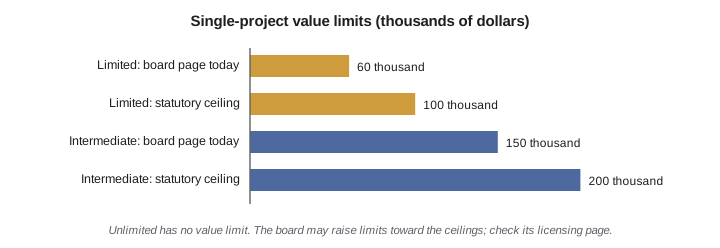
Section 87-43.3 of the General Statutes sets out three main classifications. A limited license allows a single electrical contracting project up to a value set by the board, and it is restricted to equipment and installations rated below a voltage limit. An intermediate license allows a single project up to a higher value set by the board. An unlimited license allows any electrical contracting project regardless of value. The statute also gives the board power to adjust the limited and intermediate value limits, up to ceilings written in the statute, no more than once every three years, based on a cost index for electrical projects in the state.
That structure creates two sets of numbers that candidates often confuse. The statute, as amended in 2022 and 2024, sets ceilings: the board may set the limited value at up to 100,000 dollars and the intermediate value at up to 200,000 dollars, and the limited voltage limit is 1,000 volts in the current statute. The board's licensing page, at the time this course was written, listed the limited license at 60,000 dollars and 600 volts and the intermediate license at 150,000 dollars. The board may raise its figures toward the statutory ceilings over time, and its website may lag behind a rule change. For a real bid, and for the exam, use the figures in the current board rules and the current exam handbook, and confirm them with the board if they disagree.
What counts as a single project
The value limits apply to a single electrical contracting project, and the board's rules explain how to measure one. In general terms, the value is the total contract price for the electrical work on the project, including labor, materials, equipment and any change orders, not just the part the contractor earns as profit. A contractor may not split one project into several contracts to stay under its limit; the board looks at the work as a whole. If the value of a project grows through change orders until it exceeds the license's limit, the contractor can find itself working beyond its classification, so contractors near their limit watch change orders carefully.
Questions about single projects often describe a building with several phases, an owner who wants separate contracts for the service and the branch circuits, or a job that grows during construction. The safe approach is to ask what the owner is actually buying: if it is one building or one connected scope of electrical work, treat it as one project and compare its full electrical value with the limit. Haw River had once turned down a request from a developer to write a 180,000-dollar strip-center package as two 90,000-dollar contracts so that it would fit under Glenn's intermediate license; Glenn told Keisha it was the easiest no he had ever said.
# Does a growing project stay within the license limit? (illustrative)
limit = 150000          # intermediate value from the board page today
base = 128500
change_orders = [6200, 4800, 7400, 3900]
total = base
for n, co in enumerate(change_orders, 1):
    total += co
    status = "within limit" if total <= limit else "OVER LIMIT"
print(f"after change order {n}: {total:,} ({status})")after change order 1: 134,700 (within limit) after change order 2: 139,500 (within limit) after change order 3: 146,900 (within limit) after change order 4: 150,800 (OVER LIMIT)
In this example the project starts comfortably under the intermediate limit but passes it after the third change order. A contractor in that position should talk to the owner and the board before taking on the extra work, because the license limit applies to the whole project, not just the original contract.
The voltage limit on limited licenses
The limited classification is also restricted by voltage: the licensee may work only on equipment and installations rated below the limit in the statute and rules. The board's page listed 600 volts when this course was written, while the statute's current wording allows up to 1,000 volts. The practical effect is that a limited licensee cannot take a medium-voltage job, such as a 4,160-volt motor feed or a primary service, regardless of its value. Intermediate and unlimited licenses do not carry the same voltage restriction in the statute, although the work must still be done under the code and by qualified people.
Special restricted classifications
The statute lets the board create special restricted classifications, each covering one phase of electrical contracting or electrical work that is incidental to another business. The board's licensing page lists seven of them: residential dwelling (SP-SFD), fire alarm and low voltage (SP-FA/LV), plumbing, heating and air conditioning (SP-PH), swimming pool (SP-SP), groundwater pump (SP-WP), electric sign (SP-ES) and elevator (SP-EL). Each has its own scope in Section .0800 of the board's rules and its own shorter exam. A special restricted licensee may work only within that scope. For example, a fire alarm and low-voltage licensee may not install a 120-volt branch circuit to feed a fire alarm panel unless the scope allows it, and a heating and air conditioning contractor with an SP-PH license may do the electrical connections for its equipment but not wire the rest of a building.
| Code | Phase of work (summary) |
|---|---|
| SP-SFD | Electrical work on single-family detached residential dwellings |
| SP-FA/LV | Fire alarm and low-voltage systems |
| SP-PH | Electrical work for plumbing, heating and air conditioning equipment |
| SP-SP | Electrical work for swimming pools |
| SP-WP | Electrical work for groundwater pumps |
| SP-ES | Electric signs |
| SP-EL | Elevators |
Experience requirements
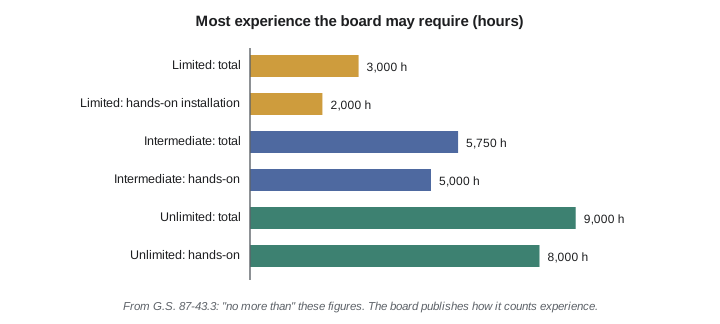
Each main classification requires electrical experience before the exam. The statute sets the most the board may require: for limited, no more than 3,000 hours of experience, at least 2,000 of which must be primary hands-on installation experience under the NEC; for intermediate, no more than 5,750 hours, at least 5,000 of them hands-on; and for unlimited, no more than 9,000 hours, at least 8,000 of them hands-on. The board's rules and application forms explain exactly how it counts experience, including whether and how education, engineering work, supervision or military experience can count, and which types of work count as primary installation experience.
Experience is documented on the board's forms, usually with statements from employers or supervisors describing the work and the hours, and the board may ask for more proof such as payroll records or tax forms. Experience in another state can count if it is the right kind of work. A candidate who does not yet meet the unlimited requirement can apply for a classification they do qualify for, and the board's exam page says a candidate who fails one classification may apply for another immediately if they meet its experience requirement.
Worked problem
Counting Keisha's hours
Keisha worked 2,080 hours a year for most of her eleven years. Her first year was mostly helper work in a classroom-and-job program; years two through eight were commercial installation; and the last three years were split about half and half between running crews in the field and estimating in the office. Roughly how much primary hands-on installation experience can she show, and does she clear the unlimited ceilings?
Show solution
- Years two through eight are seven years of installation: 7 × 2,080 = 14,560 hours.
- Half of the last three years in the field adds about 1.5 × 2,080 = 3,120 hours, if the board counts that crew leadership as hands-on work.
- Even counting only the seven installation years, 14,560 hours is far above 8,000 hands-on and 9,000 total.
- She should still document each employer and period on the board's forms, because the board decides what counts.
Answer: Keisha has well over 9,000 hours, most of them hands-on installation, so she clears the unlimited ceilings; the forms just need to show it.
Choosing a classification as a business decision
The classification is not only about what a candidate can qualify for; it is a business decision about which jobs the company wants to bid and what it is willing to carry. An unlimited license removes the ceiling on project value, but it costs more each year, requires a statement of bonding ability, and invites the company into larger jobs that bring larger risks: bigger crews, longer payment cycles, payment and performance bonds, retainage, and owners and general contractors with sophisticated contracts. A limited license costs less and suits a small shop that does service work and small fit-outs, but it caps growth and rules out medium-voltage work entirely.
Glenn and Keisha talked this through before she applied. Haw River's work in the last three years had included about forty jobs under 60,000 dollars, a dozen between 60,000 and 150,000 dollars, and the two bids over 150,000 dollars that they had to pass on. The company had the crew size and the bonding relationship to handle the larger work, and its general contractor customers were asking for it. Unlimited was the right choice. A different shop might reasonably stay at limited or intermediate for years, and some companies hold a main license plus a special restricted license, for example an intermediate license and a fire alarm and low-voltage license, to cover a specialty side business.
# Haw River's last three years of work, grouped by the board page limits
jobs = [42000, 18500, 9600, 55800, 61200, 74300, 98500, 133000, 148000, 152000, 241000, 310000, 27400, 6800]
bands = {"up to 60,000": 0, "60,001 to 150,000": 0, "over 150,000": 0}
for v in jobs:
    if v <= 60000:
        bands["up to 60,000"] += 1
    elif v <= 150000:
        bands["60,001 to 150,000"] += 1
    else:
        bands["over 150,000"] += 1
for band, n in bands.items():
print(f"{band:>18}: {n} jobs") up to 60,000: 6 jobs
60,001 to 150,000: 5 jobs
over 150,000: 3 jobsOut-of-state and military applicants
Experience gained in another state counts if it is the kind of work the board recognizes and it is documented the same way. A contractor licensed in a state with a reciprocity arrangement may be able to use that route instead of the full exam, as Lesson 1 mentioned. The board also has a military license application for service members, veterans and military spouses, which reflects a broader North Carolina law that gives credit for military training and out-of-state licenses in many occupations. The details of each route are on the board's website, and candidates should read them before choosing a path.
Other conditions
Besides experience, applicants must complete the board's application, pay the fee, and meet any other conditions in the statute and rules, such as age and the information the board requires about the applicant's background. The license itself has additional requirements before it becomes active, such as a statement of bonding ability for intermediate and unlimited licenses, which Lesson 8 covers. Candidates with a past disciplinary action or criminal record should ask the board how it reviews those before paying for an exam.
Common mistakes
MistakeUsing the statutory ceiling as if it were the board's current limit.
InsteadThe statute sets the most the board may allow; the board's rules and handbook set the figure in force.
MistakeSplitting one project into several contracts to fit under a value limit.
InsteadThe board looks at the whole project; splitting does not change the classification required.
MistakeIgnoring change orders on a job near the license limit.
InsteadChange orders count toward the project value and can push a job over the limit.
MistakeCounting office or estimating time as hands-on installation without checking.
InsteadThe board's rules define primary installation experience; document each kind of work honestly.
Summary and key terms
- The limited, intermediate and unlimited classifications differ in single-project value and, for limited, voltage.
- The statute sets ceilings for the value limits and lets the board adjust within them; the board's page listed 60,000 and 150,000 dollars when this course was written.
- A single project is measured by its whole electrical value, including change orders, and may not be split to fit a limit.
- Seven special restricted classifications each cover one phase of electrical work.
- The statute caps required experience at 3,000, 5,750 and 9,000 hours, with 2,000, 5,000 and 8,000 hands-on, and the board's forms document it.
- Value limit
- The highest value of a single project a limited or intermediate licensee may take on.
- Statutory ceiling
- The maximum value limit the statute allows the board to set.
- Single project
- One connected scope of electrical work, measured by its full value.
- Primary installation experience
- Hands-on electrical installation work under the NEC, as the board defines it.
- Statement of bonding ability
- A document required to activate intermediate and unlimited licenses.
Practice problems
Work each problem on paper first, then reveal the answer to check.
Which classification may take a 4,160-volt motor feed project worth 40,000 dollars?
Show answer
Not a limited license, because of the voltage limit; an intermediate or unlimited license could, subject to value.
A developer offers two contracts of 90,000 dollars each for one strip-center package. What does an intermediate licensee need to consider?
Show answer
The board treats it as one project of 180,000 dollars, which is above the intermediate limit listed today, so an unlimited license is required.
What are the statutory experience ceilings for the unlimited classification?
Show answer
No more than 9,000 hours, at least 8,000 of them primary hands-on installation.
Which special restricted classification covers electric signs?
Show answer
SP-ES.
Lesson quiz · 5 questions
Score 60% or more to complete this lesson.
Create a free account to save your progress, take quizzes and earn a certificate.