
MELU-308 · Lesson 1 of 12 · 19 min
How electrical licensing works in North Carolina
▶ Video coming soon A video version of this lesson is on the way.
Glenn Tolliver started Haw River Electric in Burlington in 1998 with a used bucket truck, two helpers and an intermediate electrical contractor license. Twenty-eight years later the company employs eighteen electricians and apprentices, runs four service vans, and does a steady mix of retail fit-outs, church additions, small industrial jobs and service upgrades across Alamance, Guilford and Orange counties. On a cold Tuesday in January, Glenn called his field superintendent, Keisha Monroe, into the office and slid two bid invitations across the desk. One was a middle-school classroom addition in Graham with an electrical package of about 310,000 dollars. The other was a medical office building in Mebane at about 240,000 dollars. "We can't bid either one," he said. "My license is intermediate, and both jobs are over the limit. I'm sixty-six and I don't want to sit another exam. If this company is going to grow after me, it needs an unlimited license with you as the qualified individual."
Keisha had eleven years in the trade: an apprenticeship that started at Alamance Community College, six years wiring commercial and light industrial jobs, and the last three years running Haw River's crews and estimating mid-size jobs. She had already worked through the master electrician core courses on the National Electrical Code, load calculations, conductors and overcurrent protection, grounding and bonding, motors and transformers, special occupancies, and the business and law of contracting. This course applies that preparation to North Carolina: who licenses electrical contractors, how the license classifications and project value limits work, how to qualify and book the exam, what the exam covers, which code edition applies, how permits and inspections work, and the North Carolina law on contracts, liens, workers' compensation, workplace safety and renewal.
The board
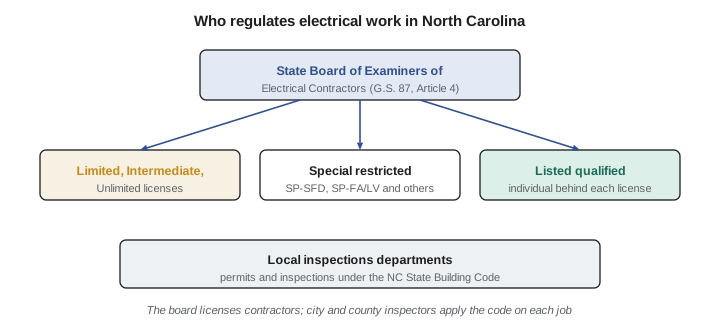
North Carolina licenses electrical contractors through the State Board of Examiners of Electrical Contractors, usually shortened to the board or NCBEEC. The board is created by Article 4 of Chapter 87 of the General Statutes, which also defines electrical contracting, sets out the license classifications, lists exemptions and gives the board its powers to examine applicants, issue and renew licenses, set continuing education requirements and discipline licensees. The board's detailed rules are in 21 NCAC 18B. Its office is in Garner, near Raleigh, and it handles applications, license records, renewals, continuing education records and complaints.
Most other construction trades in North Carolina have their own boards. General contractors are licensed by the Licensing Board for General Contractors, and plumbing, heating and fire sprinkler contractors by their own board. Each has its own statute, rules, classifications and exams. This matters in practice and on the exam: a rule about general contractor license limits, for example, does not apply to electrical contractors, even though the two systems look similar. When you read a North Carolina construction law article or a prep book, check which board and which article of Chapter 87 it is talking about.
Who needs a license
In North Carolina, the license is a contractor license. The statute defines electrical contracting broadly as engaging in the business of installing, maintaining, altering or repairing electrical wiring and equipment, and it requires anyone in that business to hold a license from the board unless an exemption applies. The board's rules and the statute list exemptions, such as certain work by a property owner on their own residence, some work by utilities on their own systems, and maintenance work by regular employees on their employer's premises in some circumstances. The exemptions are narrow and have conditions, so a contractor should read the exact wording before relying on one, and the exam often asks whether a described situation falls inside or outside an exemption.
There is no statewide journeyman or master electrician license for individual workers in North Carolina, unlike in many states. The electricians who work for a licensed contractor do not hold a state license of their own; the contractor's license, and the qualified individual listed on it, carry the responsibility for their work. Some electricians hold certificates from apprenticeship programs or community colleges, and many employers track those, but the state license sits with the business and its qualified individual. Keisha herself had never needed a state card to work; she needed one now because she would be the person whose name stood behind the company's license.
The qualified individual
Every electrical contractor license is issued on the strength of a person who passed the board's examination and is listed on the license as its qualified individual. The license application asks for that person's name, signature, date of birth and Social Security number, and the board's form for adding or removing a qualified individual shows that the listing can change over time. The board's rules require the qualified individual to have a genuine role with the licensee, and they treat that person as responsible for supervising the electrical work done under the license. Lesson 7 covers the qualified individual's duties in detail.
At Haw River, Glenn was both the owner and the listed qualified individual on the intermediate license. The plan was for Keisha to pass the unlimited examination, then be listed as the qualified individual on an unlimited license for the company, while Glenn stayed on as owner and gradually stepped back. That separation of ownership and qualification is common in North Carolina, and the law cares mainly that the qualified individual has real authority over the electrical work.
Classifications at a glance
The statute creates three main classifications: limited, intermediate and unlimited. They differ in the value of a single project the licensee may take on and in the experience the board may require before the exam. An unlimited license allows any electrical contracting project regardless of value. The limited and intermediate licenses each have a single-project value limit set by the board within a ceiling in the statute, and the limited license is also restricted to installations below a voltage limit. The statute also lets the board create special restricted classifications for a specific phase of electrical work, such as single-family dwellings, fire alarm and low voltage, signs, elevators, swimming pools and groundwater pumps. Lesson 2 covers the classifications and their current limits.
| Classification | What it allows (summary) | Typical holder |
|---|---|---|
| Limited | Single projects up to the board's limited value, with a voltage limit | Small residential and light commercial shops |
| Intermediate | Single projects up to the board's intermediate value | Mid-size commercial contractors |
| Unlimited | Any project regardless of value | Contractors bidding large commercial and industrial work |
| Special restricted | One phase of electrical work only | Sign, elevator, pool, fire alarm and similar specialists |
Unlicensed contracting
Doing electrical contracting without the required license, or beyond the limits of the license held, is unlawful in North Carolina, and the statute provides criminal penalties and lets the board seek court orders to stop it. An unlicensed contractor may also have trouble enforcing a contract or a lien. Licensed contractors face discipline if they help an unlicensed person, for example by pulling a permit for work they will not supervise, or by letting another company use their license. After every busy season Glenn told the same story about a homeowner in Mebane who paid a cash crew to add a subpanel, failed the inspection the crew never called for, and then paid Haw River to do the work over.
# Can this license take this job? (simplified study aid using the board page limits)
LIMITS = {"Limited": 60000, "Intermediate": 150000, "Unlimited": None}
jobs = [
    ("Middle-school addition, Graham", 310000),
    ("Medical office, Mebane", 240000),
    ("Bakery fit-out, Burlington", 85000),
    ("Church fellowship hall, Elon", 148000),
]
for name, value in jobs:
    ok = [lic for lic, cap in LIMITS.items() if cap is None or value <= cap]
print(f"{name}: {value:,} -> {', '.join(ok)}")Middle-school addition, Graham: 310,000 -> Unlimited Medical office, Mebane: 240,000 -> Unlimited Bakery fit-out, Burlington: 85,000 -> Intermediate, Unlimited Church fellowship hall, Elon: 148,000 -> Intermediate, Unlimited
The output shows why Glenn could not bid the two jobs: both are over the intermediate limit, so only an unlimited licensee may contract for them, while the bakery and the fellowship hall fit within the intermediate limit. Real limit questions can turn on what counts as a single project and what is included in its value, which Lesson 2 covers.
Worked problem
Choosing the right license
Keisha's friend Andre runs a three-person shop in Burlington. He does service changes and rewires on houses, plus occasional small restaurant fit-outs around 50,000 dollars. Which classification fits his business, and what would change if he started bidding 90,000-dollar fit-outs?
Show solution
- Andre's house work alone would fit a special restricted single-family dwelling license, but restaurants are outside that scope.
- Small commercial jobs under the limited value limit, at low voltage, fit a limited license.
- A 90,000-dollar fit-out is above the limited value listed on the board's page today.
- An intermediate license would cover single projects up to the intermediate value, so it would cover the larger fit-outs.
Answer: A limited license fits today; regular 90,000-dollar fit-outs point to an intermediate license, unless the board has raised the limited value by then.
Reciprocity and the board's other services
Contractors who already hold a license in another state sometimes ask whether they can skip the North Carolina exam. The board's website lists reciprocity arrangements with a number of states, including Alabama, Florida, Georgia, Mississippi, Ohio, South Carolina, Tennessee, Texas, Virginia and West Virginia. Each arrangement has its own terms, such as how long the out-of-state license must have been held, which classification it maps to, and whether a North Carolina laws and rules component is still required. The board also accepts certain NASCLA accredited examinations in place of parts of its own testing for some classifications. Because the details differ by state and change over time, a contractor coming from another state should read the board's reciprocity page for their state and confirm with the board before assuming anything.
The board also offers a laws and rules class that walks through Article 4 of Chapter 87 and 21 NCAC 18B, runs a public license search so owners, general contractors and inspectors can confirm that a contractor is licensed in the right classification, and keeps an online record of each qualified individual's continuing education credits. Ray Delgado, Haw River's office manager, used the license search every time the company hired a sub-tier contractor for low-voltage or sign work, and printed the result into the job file.
Where the rules live
North Carolina electrical contractors work under several layers of law, and the exam expects candidates to know which layer answers which question. Statutes passed by the General Assembly set the framework: Article 4 of Chapter 87 for electrical licensing, Chapter 44A for liens, Chapter 97 for workers' compensation and Chapter 143 for the State Building Code and the state's occupational safety and health program. Board rules in 21 NCAC 18B fill in details such as how experience is counted, how the qualified individual must relate to the licensee, how value limits apply, fees and continuing education. The North Carolina State Building Code, including the North Carolina Electrical Code, governs the technical work. Local inspections departments issue permits and perform inspections. When a question comes up on a job or the exam, start by asking which layer it belongs to.
Common mistakes
MistakeAssuming a general contractor board rule also applies to electrical contractors.
InsteadCheck which board and which article of Chapter 87 the rule comes from.
MistakeThinking each electrician on a crew needs a state license.
InsteadNorth Carolina licenses the contracting business through its listed qualified individual; workers do not hold individual state licenses.
MistakeBidding a job above the license's single-project limit and planning to fix it later.
InsteadContracting above the limit is unlicensed contracting for that job; only a license in the right classification may contract for it.
MistakePulling a permit for a friend's job you will not supervise.
InsteadThat can be aiding unlicensed contracting and exposes your license to discipline.
Summary and key terms
- The State Board of Examiners of Electrical Contractors licenses electrical contractors under Article 4 of Chapter 87, with rules in 21 NCAC 18B.
- The license belongs to the contracting business and is backed by a listed qualified individual who passed the exam.
- There is no statewide journeyman or master license for individual electricians.
- The main classifications are limited, intermediate and unlimited, plus special restricted classifications for single phases of work.
- Contracting without a license, or above a license's limits, is unlawful and can cost the right to collect.
- NCBEEC
- The State Board of Examiners of Electrical Contractors, which licenses and disciplines electrical contractors in North Carolina.
- Qualified individual
- The person who passed the board's exam and is listed on a license as responsible for its electrical work.
- Unlimited license
- The classification that allows electrical contracting projects of any value.
- Special restricted license
- A classification limited to one phase of electrical work, such as signs or elevators.
- 21 NCAC 18B
- The board's rules in the North Carolina Administrative Code.
Practice problems
Work each problem on paper first, then reveal the answer to check.
Which article of Chapter 87 governs electrical contractor licensing?
Show answer
Article 4.
Does a journeyman electrician working for Haw River need a state license of their own?
Show answer
No. North Carolina licenses the contracting business through its qualified individual.
Why couldn't Haw River bid the 310,000-dollar school addition?
Show answer
Its license was intermediate, and the job's value was above the intermediate single-project limit.
Name two layers of law that apply to an electrical contractor besides Chapter 87.
Show answer
For example, Chapter 44A (liens), Chapter 97 (workers' compensation), the State Building Code or the state's occupational safety and health law.
Lesson quiz · 5 questions
Score 60% or more to complete this lesson.
Create a free account to save your progress, take quizzes and earn a certificate.