
MELU-307 · Lesson 9 of 12 · 18 min
Contracts and mechanics' liens in New York
▶ Video coming soon A video version of this lesson is on the way.
Electrical contractors get paid by finishing work and sending invoices, but they protect their right to be paid with contracts and, when necessary, with liens. New York's Lien Law gives contractors, subcontractors, laborers and suppliers who improve real property a way to secure payment by filing a notice of lien against the property. It also creates trust obligations for money paid for improvements. This lesson covers the contract basics a master needs, the main lien rules for private improvements, the trust fund provisions, and a few related rules, using Halsey Street's jobs as examples. It is general information to support exam study and good business habits, not legal advice; when real money is at stake, consult a New York construction lawyer.
The lien deadlines here were checked against summaries of the Lien Law published by construction payment and legal sources in November 2026. Statutes change and courts interpret them, so read the current Lien Law sections before relying on any deadline.
Contract basics
Every job should start with a written contract, even a small one. A good electrical contract identifies the parties and the property, describes the scope of work and what is excluded, references the drawings and specifications, states the price and how it is paid, sets the schedule, explains how changes are priced and approved, addresses permits, inspections and utility coordination, allocates responsibility for concealed conditions, states insurance requirements, and says how disputes are resolved. For residential work, local home improvement laws in the city and on Long Island can add required terms, such as cancellation rights and specific disclosures, when they apply.
Change orders deserve particular care. On the Jackson Heights co-op riser job, the board asked Halsey Street to add new hallway lighting halfway through. Teresa wrote a change order describing the added work, the price and the schedule impact, and had the board's managing agent sign it before her crew started. If the board had refused to pay later, the signed change order would have been the evidence of the agreement, and the added work would have been part of the value covered by a lien.
Who can file a lien
Under the Lien Law, a contractor, subcontractor, laborer or material supplier who performs labor or furnishes materials for the improvement of real property with the consent or at the request of the owner, or of the owner's agent, contractor or subcontractor, may have a lien for the agreed price or the value of the work. An electrical contractor working directly for an owner, a subcontractor working for a general contractor, and an electrical supply house selling to a subcontractor can all have lien rights. The lien attaches to the owner's interest in the property, and the amount that can be recovered from the owner is generally limited by what the owner still owes under the contract when the lien is filed, which is one reason prompt filing matters.
When to file
For a private improvement, a notice of lien generally must be filed within eight months after the last item of work was performed or the last materials were furnished. For a single-family dwelling, the deadline is shorter: generally four months after the last work or materials. The Lien Law defines the single-family exception narrowly in some respects; for example, it does not include a dwelling unit in a filed subdivision that the developer owns for purposes other than a personal residence when the lien is filed. New York does not require a preliminary notice or a notice of intent before filing a lien on a private improvement, which differs from many other states. The notice of lien is filed with the county clerk where the property is located, and the Lien Law requires service of a copy on the owner within the time the statute sets.
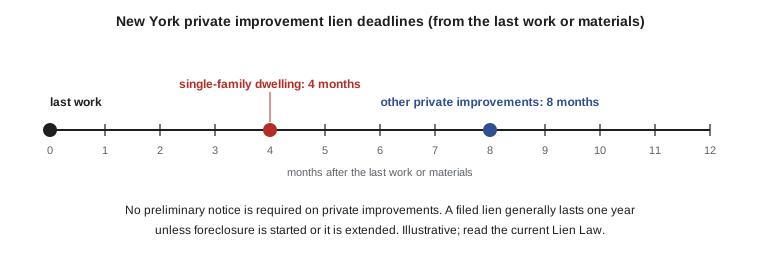
The calculator below finds both deadlines from the last day of work. It counts months on the calendar, which is how most practitioners read the statute, but if a deadline is close, do not rely on a calculator; file early.
from datetime import date

def add_months(d, months):
    y, m = divmod(d.month - 1 + months, 12)
    return date(d.year + y, m + 1, min(d.day, 28))

last_work = date(2026, 6, 18)   # illustrative last day of work
print("Single-family dwelling deadline (4 months):", add_months(last_work, 4))
print("Other private improvement deadline (8 months):", add_months(last_work, 8))
print("Trivial punch-list visits may not extend the last day of work; file early.")Single-family dwelling deadline (4 months): 2026-10-18 Other private improvement deadline (8 months): 2027-02-18 Trivial punch-list visits may not extend the last day of work; file early.
The note in the code matters. Courts have held that minor corrective or warranty work done after the job is complete does not necessarily extend the lien deadline. If Teresa returns to the Park Slope brownstone months later to replace a faulty dimmer, that visit may not restart the clock. The safe practice is to calculate the deadline from the last substantial contract work and file well before it.
How long a lien lasts
A filed lien on a private improvement does not last forever. Generally, it remains effective for one year from filing unless, within that year, the lienor starts an action to foreclose it or obtains an extension as the statute allows, and the rules on extensions differ for some types of property. A lienor who files and then does nothing will find the lien expired. An owner can also discharge a lien by bonding it or depositing money with the court, which moves the claim from the property to the bond or deposit. These procedures are technical, and a contractor facing them needs a lawyer.
| Rule | General New York position | Practical step |
|---|---|---|
| Filing deadline, single-family dwelling | Generally four months after last work or materials | Track the last substantial work date |
| Filing deadline, other private improvements | Generally eight months after last work or materials | File early; do not wait for the deadline |
| Preliminary notice | Not required before filing on private improvements | Keep good records anyway |
| Lien duration | Generally one year unless foreclosure is started or the lien is extended | Calendar the expiration the day you file |
| Exaggerated liens | A willfully exaggerated lien can be void and expose the lienor to liability | Claim only what is owed |
Do not exaggerate
The Lien Law penalizes willful exaggeration. A lien that a court finds was willfully exaggerated can be declared void, and the lienor can be liable for damages, which can include the cost of discharging the lien and attorney's fees, along with an amount related to the exaggeration. Honest mistakes and good-faith disputes about value are treated differently from deliberate inflation, but the safe practice is the same: claim only the amount actually owed for work actually performed, and keep the records that prove it. Teresa's rule is that every lien amount must match an invoice and a signed change order.
Trust funds under Article 3-A
Article 3-A of the Lien Law makes money paid to an owner, contractor or subcontractor for an improvement a trust fund for the people who performed the work and furnished the materials. In general terms, a contractor that receives payment on a project holds that money in trust to pay its subcontractors, suppliers and workers, and to pay certain related costs such as payroll taxes and insurance premiums for the project, before using the money for other purposes. Diverting trust funds can lead to civil liability and, in some cases, criminal liability for the people responsible. For an electrical contractor, the practical consequences are to keep good books showing what was received for each project and what was paid out, and to pay suppliers and workers on a project from that project's money.
Article 3-A also gives subcontractors and suppliers rights to information about trust funds and remedies when funds are diverted, which can be valuable when a general contractor fails to pay. These remedies interact with lien rights in complex ways, so a contractor with a serious unpaid claim should get legal advice early.
Public improvements
Public work has its own rules. On public improvements, a lien does not attach to public property; instead, the Lien Law allows a notice of lien to be filed with the public body's financial officer against the money due to the contractor, under deadlines and procedures specific to public work. Public contracts in New York also commonly require payment bonds that protect subcontractors and suppliers, with their own notice and claim deadlines. Halsey Street does not do public work yet, but Teresa notes that if it starts, the lien and bond rules for public jobs are different enough to need their own study.
Prompt payment and retainage
New York has a prompt payment law for certain private construction contracts, found in the General Business Law, which sets payment timelines and dispute procedures for qualifying projects, and the state has also legislated limits on retainage on some private projects. Whether these laws apply depends on the size and type of the project and on dates in the statute, so check the current text before relying on them. Public owners have their own prompt payment rules. In practice, the contract usually sets payment terms and retainage, and the master should read those clauses closely before signing.
Before you file: collection steps that often work
A lien is a serious step, and many payment problems resolve before it is needed. Teresa's collection routine starts the day an invoice goes out. She sends invoices promptly with the backup the contract requires, follows up by phone a few days after the payment due date, and then writes a short, polite letter that states the amount, the invoices it covers and the date by which payment is expected. If the customer disputes part of the amount, she asks for the dispute in writing and offers to meet. Often the problem is a missing lien waiver, a misrouted invoice or a question about a change order, all of which can be fixed in a day.
When those steps fail, the lien deadline drives the decision. Teresa calculates it the day the last substantial work is done and puts a reminder on the calendar two months before it. If payment has not arrived by then, she talks with the company's lawyer about filing. Waiting until the last week risks missing the deadline over a holiday, a clerk's office closure or a slow signature, and a missed deadline cannot be fixed.
Lien waivers and releases
Owners and general contractors often ask for waivers or releases of lien rights in exchange for payments. New York law limits some advance waivers; in particular, a contract provision that waives lien rights before work is performed is generally not enforceable under the Lien Law, while releases given for payments actually received are common and enforceable according to their terms. Read every release form before signing: a release that covers more than the payment received, or that releases claims for unpaid change orders, can cost the company money. Teresa signs releases only for the amounts actually received and lists any open change orders as excluded.
Common mistakes
MistakeWaiting for the deadline before filing a lien.
InsteadFile early; the amount recoverable from the owner can shrink as the owner pays others.
MistakeCounting a small warranty visit as the last day of work.
InsteadMinor corrective work may not extend the deadline; count from the last substantial contract work.
MistakeAssuming New York requires a preliminary notice before a private lien.
InsteadNo preliminary notice is required for private improvements.
MistakeInflating the lien amount to gain leverage.
InsteadWillful exaggeration can void the lien and create liability.
MistakeUsing project payments for other purposes before paying suppliers and workers.
InsteadArticle 3-A treats project payments as trust funds for those who performed the work.
Summary and key terms
- Contracts, written change orders and good records are the first protection for payment.
- Contractors, subcontractors, laborers and suppliers who improve private property may file a notice of lien with the county clerk.
- Deadlines are generally four months for a single-family dwelling and eight months for other private improvements, from the last work or materials.
- No preliminary notice is required on private improvements; a filed lien generally lasts one year unless extended or enforced.
- Willful exaggeration can void a lien, and Article 3-A makes project payments trust funds.
- Public improvements and prompt payment rules follow their own statutes; check current law and get advice.
- Lien notice (notice of lien)
- The document filed with the county clerk to claim a lien on improved real property.
- Lienor
- The person or company claiming a lien.
- Single-family dwelling exception
- The shorter four-month filing period for liens on single-family dwellings.
- Willful exaggeration
- Deliberately inflating a lien claim, which can void the lien and create liability.
- Trust fund
- Under Article 3-A, money received for an improvement that must be used to pay those who performed the work.
- Discharge
- Removal of a lien from the property, for example by bond or deposit.
Practice problems
Work each problem on paper first, then reveal the answer to check.
Halsey Street's last substantial work on a commercial fit-out was May 10. Roughly when is the lien deadline?
Show answer
Generally eight months later, about January 10, but file well before then.
What is the general deadline for a lien on a single-family house?
Show answer
Four months after the last work or materials.
Must Teresa send a preliminary notice before filing a lien on a private job?
Show answer
No; New York does not require one for private improvements.
What happens to a lien if nothing is done for a year?
Show answer
It generally expires unless foreclosure was started or it was extended as the statute allows.
Why should Teresa pay a project's suppliers from that project's payments?
Show answer
Because Article 3-A makes those payments trust funds for the people who performed the work and furnished materials.
Lesson quiz · 5 questions
Score 60% or more to complete this lesson.
Create a free account to save your progress, take quizzes and earn a certificate.