
MELU-307 · Lesson 6 of 12 · 19 min
Permits, inspections and the inspection authority
▶ Video coming soon A video version of this lesson is on the way.
A license gives a master electrician the right to do electrical work; a permit gives the master the right to do a particular job. In New York City, almost all electrical work requires a permit filed by a licensed electrician through the Department of Buildings' online system, DOB NOW, and the department's own electrical inspectors inspect the work. Outside the city, permits and inspections are handled by local code enforcement offices and, very often, by electrical inspection agencies the municipality has approved. This lesson follows a job through the city's system, from filing to sign-off, and then compares how a Long Island town handles the same steps.
The details here come from the department's DOB NOW: Build electrical filing guidance as checked in November 2026. The department changes fees, forms and procedures from time to time, so check the current guidance before filing.
Filing in DOB NOW
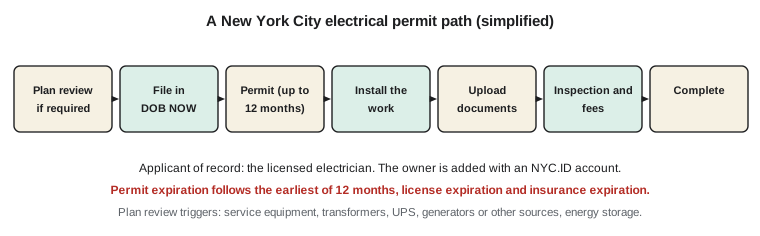
In the city, electrical work is filed in DOB NOW: Build. Each electrical filing is tied to a licensed electrician, who is listed as the applicant of record. The applicant of record is responsible for the filing and the work it covers. The department's guidance notes that only the applicant of record can submit some requests, such as an after-hours variance request to work outside normal hours, and that another licensed electrician can take over a job by submitting a supersede request. The property owner must have an NYC.ID account and must be added to the filing; the owner cannot be added as a delegated associate. Filing representatives and delegated associates, such as an office manager, can be added to help prepare filings.
At Halsey Street, Mei Chen prepares most filings as a filing representative, but Sal, as the licensed master, is the applicant of record. Once Teresa is licensed and an officer of the company, she will be applicant of record on her own jobs. Being applicant of record is not a formality: it is the license holder's name on the permit, and it carries responsibility for what is installed under it.
The permit and its life
When the department issues a work permit, it is valid for up to 12 months and must be renewed individually if the work takes longer; the department lists a 130 dollar renewal fee. The permit's expiration also follows the earliest of the insurance expiration and license expiration dates on file, so a lapse in the license holder's insurance or license can shorten the permit's life. A permit that has been expired for more than 12 months after issuance is placed in abandoned status and must be reinstated before work continues. After a supersede, the department does not renew the old permit; its expiration is set to the earliest of the insurance, license or one-year dates.
These rules tie the permit to the license holder's standing. Mei keeps a spreadsheet of every open permit with its expiration date and the expiration dates of Sal's license and the company's insurance policies, and she renews the insurance certificates on file before they lapse. The small program below shows the rule: a permit's expiration is the earliest of the three dates.
from datetime import date

def permit_expires(issued, license_exp, insurance_exp):
    one_year = date(issued.year + 1, issued.month, min(issued.day, 28))
    return min(one_year, license_exp, insurance_exp)

issued = date(2026, 10, 5)
print("Expires:", permit_expires(issued, license_exp=date(2027, 3, 31), insurance_exp=date(2027, 1, 15)))
print("Renew the insurance certificate before then, or the permit expires early.")Expires: 2027-01-15 Renew the insurance certificate before then, or the permit expires early.
Plan review before the permit
As Lesson 5 explained, some electrical scopes need electrical plan review before the permit proceeds: work that includes service equipment, transformers, uninterruptible power supplies, generators or other power sources, or energy storage systems. That review is submitted outside DOB NOW, and the filing cannot move forward until the plans are approved. For the Ditmars Boulevard bakery, with its new 400 A service, Halsey Street engages an engineer to prepare signed and sealed drawings, submits them for electrical plan review, and files the work in DOB NOW once the review is complete.
Inspections
When the work is ready, the applicant of record requests an inspection through DOB NOW. Any required documents must be uploaded before the inspection can be requested. The department's guidance adds that for older filings with unpaid parts fees, outstanding fees must be paid when the inspection is requested, and that electronic check payments take about ten days to clear, so a request paid that way does not go through until the payment clears. The department's electrical inspectors then inspect the work against the code that applies to the filing.
A failed inspection is a normal part of construction, not a disaster. The inspector notes what does not comply, the contractor corrects it, and the contractor requests another inspection. If the scope of the job changes, the department's guidance describes a post-approval amendment, with a listed fee of 130 dollars, to update the filing. Once the job passes inspection and all fees, including parts fees, are paid, the filing's status changes to complete. If a job is canceled, the applicant of record requests a withdrawal inspection, which must reach a pass-final status before the filing is canceled.
| Event | What DOB's guidance says | Practical step |
|---|---|---|
| Permit issued | Valid up to 12 months; renew individually | Track expiration with license and insurance dates |
| Inspection request | Required documents uploaded first | Upload test results and certificates before requesting |
| Payment by electronic check | Takes about ten days to clear | Pay early or use another method |
| Scope change after approval | Post-approval amendment, 130 dollars listed | Amend before installing the changed scope |
| Job canceled | Withdrawal inspection must pass | Request withdrawal; do not just abandon the filing |
| Job finished | Complete after passing inspection and paying all fees | Close out promptly; give the owner records |
Working hours and variances
New York City limits construction work outside normal weekday hours. Work at night or on weekends generally needs an after-hours variance, and for electrical filings only the applicant of record can request it. The bakery job's service changeover must happen at night, when the bakery is closed and the utility can de-energize the service, so Teresa plans the variance request into the schedule well in advance. Noise rules from the city's environmental agency can apply too, and the building owner's own rules may be stricter than the city's.
Utility coordination
Inspections and the utility are linked. For new and upgraded services, the utility generally requires evidence that the installation passed inspection before it energizes or re-energizes the service, and it has its own application and scheduling process. A master planning a service change coordinates three calendars: the department's plan review and inspection, the utility's application and outage scheduling, and the customer's operations. Lesson 5 described how starting the utility application early saved the bakery job a month.
Violations and stop-work orders
Inspectors can do more than fail an inspection. When the department finds work done without a required permit, work that departs from the permit, or conditions that are hazardous, it can issue violations and, where safety requires, order work to stop. A violation can lead to penalties and must be corrected and resolved through the department's processes; a stop-work order means no further work on the affected scope until the department lifts it. The department can also refer license holders for discipline when the conduct warrants, which Lesson 7 discusses. The specific penalties, hearing procedures and forms are set in the city's codes and rules and change from time to time, so check them when they arise rather than relying on memory.
Most violations against electrical contractors trace back to a few habits: starting work before the permit is issued, letting the scope drift beyond what was filed, failing to request inspections, and leaving filings open for years after the work is done. Each habit is easy to fix with office discipline. Mei's open-permit spreadsheet, a rule that no crew starts work without a copy of the permit, and a weekly review of filings awaiting inspection keep Halsey Street out of trouble.
Closing out a job
A job is not finished when the last cover plate goes on. It is finished when the filing is complete and the customer has the records. For a city job, close-out means passing the final inspection, paying any outstanding fees, confirming the filing shows complete in DOB NOW, and giving the owner copies of the permit, the inspection results and any test reports or equipment documentation. For the bakery, that includes the panel schedules, the grounding test results the engineer asked for, and the manuals for the new equipment. Teresa also photographs the inside of each panel before the covers go on and keeps the photos in the job file, which has saved Halsey Street more than one argument about what was installed.
Close-out also matters for future work. When a building owner sells or refinances, or when another contractor files work later, open filings and unresolved violations surface and cause delays. A contractor known for leaving filings open does not keep good customers for long.
Outside the city
On Long Island and upstate, the local building or code enforcement department usually issues the electrical permit, sometimes as part of the building permit, and the inspection is often performed by an electrical inspection agency that the municipality has approved. The electrician or owner contacts the agency, pays the agency's fee, and schedules rough and final inspections. When the work passes, the agency issues a certificate of compliance, and the municipality and the utility rely on it. Each town lists its approved agencies and its own filing requirements.
Andre's town requires him, once he is licensed, to file for an electrical permit with the town building department, show his town license and insurance certificate, and then arrange inspections with one of the town's approved agencies. He keeps copies of every certificate, because the town's certificate of occupancy for a project depends on them, and because a homeowner selling a house years later may need them.
What inspectors look for
Inspectors in every jurisdiction look for the same broad things: work that matches the permit and the approved plans, installation that complies with the applicable code, and the documents the code or the department requires, such as test results for certain systems. They also look for workmanship: secure supports, proper terminations, labeled panels and clean, accessible equipment. A master who walks the job before calling for inspection, with the permit and the plans in hand, catches most problems before the inspector does. Teresa's walk-through checklist for the bakery includes panel directories, working clearances, grounding and bonding connections, GFCI protection in the kitchen and wet areas, and support and protection of cables.
Minor work and emergencies
Candidates often ask whether every small electrical task needs a permit. Codes and rules generally exempt some minor work, such as replacing a device with an identical one, from permit requirements, while requiring permits for new circuits, services, and most alterations; the exact boundaries differ between the city and other jurisdictions and change with rules and bulletins. Emergencies also happen: a failed service or a fire-damaged panel may need immediate repair before a filing can be completed. The city's rules provide for emergency work with a filing to follow within a set time, and local codes elsewhere have their own emergency provisions. Because the details vary, the safe habit is to check the current rule before relying on an exemption, and to document emergency work and file promptly.
Teresa keeps a short list from the department's current guidance taped inside her truck's door: what counts as minor work that does not need a filing, what must be filed, and how emergency work is handled. When a customer asks for something small, she checks the list rather than guessing.
Common mistakes
MistakeLetting an office manager be the responsible party for an electrical filing.
InsteadA licensed electrician is the applicant of record; filing representatives only help prepare filings.
MistakeAssuming a permit always lasts twelve months.
InsteadIts expiration follows the earliest of twelve months, the license expiration and the insurance expiration.
MistakeRequesting an inspection before uploading required documents.
InsteadDocuments must be uploaded before an inspection can be requested.
MistakeAbandoning a canceled job's filing.
InsteadRequest a withdrawal inspection; it must pass before the filing is canceled.
MistakeAssuming DOB inspects electrical work on Long Island.
InsteadOutside the city, local departments and their approved inspection agencies handle inspections.
Summary and key terms
- City electrical work is filed in DOB NOW: Build with a licensed electrician as applicant of record and the owner added.
- Permits are valid up to 12 months, renew individually, and expire early if the license or insurance on file expires first.
- Plan review is required for service equipment, transformers, UPS, generators or other power sources, and energy storage.
- Inspections are requested after documents are uploaded; jobs are complete after passing and paying all fees.
- Scope changes use a post-approval amendment; canceled jobs need a passing withdrawal inspection.
- Outside the city, local departments issue permits and approved agencies often inspect and certify the work.
- Applicant of record
- The licensed electrician responsible for a DOB NOW electrical filing.
- Supersede
- A request by another licensed electrician to take over responsibility for a filing.
- Post-approval amendment
- A change to an approved filing to reflect a change in scope.
- Withdrawal inspection
- An inspection required to cancel a filing, which must reach pass-final status.
- After-hours variance
- Permission to perform construction work outside normal hours.
- Certificate of compliance
- A document issued after an inspection agency approves electrical work, relied on by towns and utilities.
Practice problems
Work each problem on paper first, then reveal the answer to check.
Who is the applicant of record on a city electrical filing?
Show answer
The licensed electrician responsible for the filing and the work.
A permit was issued March 1; the company's insurance on file expires June 30. When does the permit expire if not updated?
Show answer
June 30, the earliest of the dates.
What must happen before an inspection can be requested?
Show answer
Required documents must be uploaded.
The owner cancels the job. What does the applicant of record do?
Show answer
Request a withdrawal inspection, which must reach pass-final before the filing is canceled.
Who typically inspects electrical work in Andre's Long Island town?
Show answer
An electrical inspection agency approved by the town.
Lesson quiz · 5 questions
Score 60% or more to complete this lesson.
Create a free account to save your progress, take quizzes and earn a certificate.