
MELU-307 · Lesson 3 of 12 · 19 min
Applying, approval and booking the exam
▶ Video coming soon A video version of this lesson is on the way.
In most states, a master candidate applies, waits for the board to approve the application, and then books an exam. New York City runs the process in a different order. The Department of Buildings lets a candidate take the written exam and the practical exam first, and reviews the candidate's background, experience and fitness afterward. The candidate who passes both exams then has a limited time to file the background application, and only after that review does the department issue the license. Teresa likes the order because it lets her find out whether she can pass before she spends weeks gathering notarized documents, but it also means that passing the exams is not the end of the road. This lesson walks through each stage, the fees and the deadlines that connect them.
The dates and fees here come from the department's page on obtaining a master and special electrician license and from the exam administrator's information, as checked in November 2026. Check them again before you file.
The sequence at a glance
The New York City sequence has five stages. First, the candidate submits an exam application and pays the written exam fee. Second, the candidate takes and passes the written exam. Third, the candidate takes and passes the practical exam, which is available only after passing the written exam. Fourth, the candidate files the background application with the supporting documents described below, and the department reviews it. Fifth, after approval, the candidate sets up or confirms the business that the license will operate through and picks up the license.
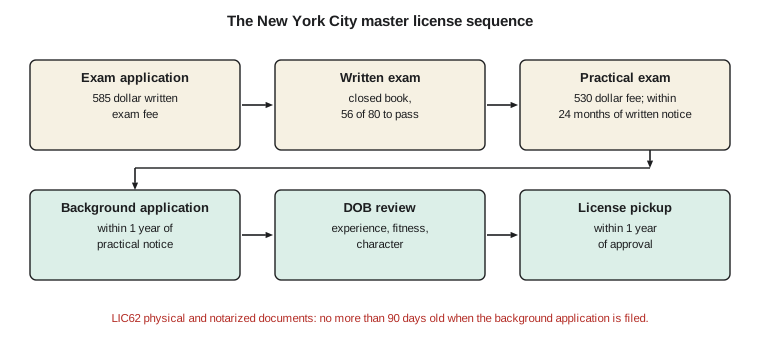
Stage one: the exam application
The candidate applies to take the exam through the department's online systems and pays the written exam fee, which the department lists as 585 dollars, by electronic check or credit card through the DOB NOW public portal. Once the application is accepted, the exam administrator emails scheduling instructions, typically within two to three weeks. The city contracts with an outside testing organization, currently CPS HR Consulting, to develop and give its licensing exams, and the administrator's website for New York City Department of Buildings exams describes the content outline and the appeal process.
Exams are given at multiple locations across New York State, not only in the city. A candidate who lives in Westchester or on Long Island may be able to test closer to home. Teresa books an early weekday morning slot at a center in Manhattan, takes the day off, and tells Sal so the bakery job can run without her.
Stage two: the written exam
The written exam is a closed-book, multiple-choice test on the city's electrical code, rules and regulations. Results are given at the test site, so Teresa will know before she leaves whether she passed. Lesson 4 covers its format, length and content areas in detail. A candidate who fails may apply to take it again, paying the fee again, and the administrator offers an appeal process for candidates who fail narrowly, which Lesson 4 also describes.
Stage three: the practical exam
Only a candidate who has passed the written exam may take the practical exam. The fee is 530 dollars. The candidate has 24 months from the written exam notification to pass the practical; if the window closes, the written exam must be passed again. Official practical exam results are mailed, usually about three to four weeks after testing. The practical tests hands-on and plan-reading skills, and Lesson 4 describes its parts.
The 24-month window is generous, but it is not a reason to wait. The practical exam rewards the skills Teresa uses every day, and they are freshest while she is studying. She plans to take the practical within six months of passing the written exam, which leaves her time for one retake inside the window if she needs it.
Stage four: the background application
After passing the practical exam, the candidate has one year from the practical exam notification to submit the background application. The application is filed through DOB NOW: Licensing, and the documents are uploaded as PDF files. The department's list includes the passing exam score report, the LIC62 physical examination form, the Experience Verification Forms, the Social Security earnings history for the years claimed, a government-issued photo identification and the candidate's Social Security card.
Two time limits apply to the documents themselves. The LIC62 physical examination form must be completed by a physician within 90 days before submission and must carry the physician's stamp. And the documents that require notarization must be signed and notarized within 90 days of submission. A candidate who collects everything early and then waits five months to file will find some of it stale. Teresa schedules her physical and her notary visits for the same two weeks, after her earnings history arrives and her experience forms are back.
| Item | Deadline or rule | Source of the rule |
|---|---|---|
| Written exam fee | 585 dollars, paid through DOB NOW | DOB license page |
| Practical exam fee | 530 dollars | DOB license page |
| Pass the practical | Within 24 months of written exam notification | DOB license page |
| Background application | Within one year of practical exam notification | DOB license page |
| LIC62 physical | Completed within 90 days before submission | DOB license page |
| Notarized documents | Signed and notarized within 90 days of submission | DOB license page |
| Request reconsideration of a denial | Within 60 days of the denial notice | DOB license page |
| Pick up the license card | Within one year of approval | DOB license page |
The department then conducts a background investigation to assess fitness and good moral character. It may ask questions, request more documents or call the candidate in. If it denies the application, the candidate may request reconsideration within 60 days of the denial notice, and the request must include all supporting documents. A careful first filing is the best way to avoid a denial in the first place.
Stage five: the business and the license
A master license in New York City is tied to a business. The department requires the applicant to be an officer, partner or sole proprietor of a business with a place of business in the city that complies with zoning, which in practice means a location in a district where the use is allowed. The business must carry general liability, workers' compensation and disability insurance, and it must show a telephone bill in the business's name for the approved location. The firm name must include the word Electric or Electrical. Lesson 8 covers these requirements in more detail.
After approval, the candidate has one year to pick up the license card; if it is not picked up, the department closes the application as a denial. Teresa and Sal plan the business side in parallel with her exams: she will become an officer of Halsey Street Electric Corp., and the company's existing insurance and its office on 31st Street, which is in a commercial district, will support her license. If Teresa were starting a new company instead, the business setup would be the slowest part of stage five.
Keeping the timeline under control
Because each stage starts a new clock, Teresa keeps a simple calendar. The code below takes the dates of her written and practical notifications and calculates the outer limits for the practical exam and the background application. It uses illustrative dates; your own notification letters are the official start dates.
from datetime import date

def add_months(d, months):
    y, m = divmod(d.month - 1 + months, 12)
    return date(d.year + y, m + 1, min(d.day, 28))

written_notice = date(2027, 2, 10)     # illustrative
practical_notice = date(2027, 8, 4)    # illustrative
print("Pass the practical by:", add_months(written_notice, 24))
print("File the background application by:", add_months(practical_notice, 12))
print("Physical exam no earlier than 90 days before you file; plan it in the last two months.")Pass the practical by: 2029-02-10 File the background application by: 2028-08-04 Physical exam no earlier than 90 days before you file; plan it in the last two months.
The calculator uses the 28th as the latest day of a month to stay on the safe side of short months. Use the dates on your official notices, and file well before the outer limit; a deadline that lands on a busy week at work is easy to miss.
Setting up your accounts and records
Much of the process runs online, so a little setup saves trouble later. Teresa creates her NYC.ID account for the department's online systems with a personal email address she will keep for years, not her work address at Halsey Street, because every exam notice, scheduling message and request for documents goes to that address. She also creates a folder on her computer with one subfolder per stage, and she scans every notice, receipt and form the day she receives it. When the background application asks for her passing exam score report, it is already a PDF in the right folder.
The department and the exam administrator also want consistent names and addresses. A candidate who uses a nickname on one form, a middle initial on another and a former name on a third invites delays while the reviewer confirms that the documents belong to the same person. Teresa uses her full legal name exactly as it appears on her identification, and she lists the same mailing address everywhere. If your name has changed, keep the legal record of the change with your file.
What the background reviewer looks for
The background review is where the department connects the paper to the person. The reviewer checks that the experience on the verification forms adds up to the route claimed, that each supervisor held a license for the period signed for, that the employers on the forms match the employers in the Social Security earnings history, and that the dates make sense together. A form that claims full-time work for one employer during months when the earnings history shows wages from a different, non-electrical employer will draw questions. So will a supervisor whose license was not active for part of the period signed for.
The reviewer also considers fitness and character. The physical examination form addresses fitness. Character questions on the application ask about past license discipline, criminal history and similar matters, and the department weighs any history against the duties of a master. A candidate with something to explain should explain it plainly in writing, with documents, on the first filing. The department has the authority to deny an application, and the reconsideration process is slower and harder than getting it right the first time.
Special electrician candidates
Candidates for the Special Electrician license follow a similar path of exams and background review, but the license is tied to the building or buildings of the employer who will employ the special electrician rather than to the candidate's own business. A hospital or university facilities department that wants an in-house special electrician typically supports the application with documents about the premises and the employment. If you are pursuing the special license, read the department's checklist for it rather than assuming the master checklist applies line for line.
Outside the city
Long Island and upstate jurisdictions usually follow the more familiar order: application and review first, then the exam. A town examining board on Long Island typically meets on a published schedule, reviews applications, interviews candidates or checks references, and then sets an exam date. The Town of North Hempstead's code, for example, has applicants file with its examining board of electricians and sets fees for each examination attempt, with a fee forfeited on failure. Rochester's Electrical Examining Board publishes a schedule of meetings with exam dates and application deadlines. Suffolk County's licensing office has its own forms and exam calendar.
Andre's town board meets monthly. He files his application, references and insurance quote, waits for the board to review them, and receives an exam date about two months later. The lesson for any candidate outside the city is to get the calendar early, because missing a board's filing deadline can cost a month or more.
Common mistakes
MistakeWaiting for DOB to approve eligibility before taking the city exams.
InsteadIn the city, candidates pass the written and practical exams first, then file the background application.
MistakeGetting the physical exam months before filing.
InsteadThe LIC62 form must be completed within 90 days before submission.
MistakeLetting the practical exam window lapse.
InsteadThe practical must be passed within 24 months of the written exam notification.
MistakeTreating passing the practical as receiving the license.
InsteadThe background application, review and business requirements still follow.
MistakeAssuming Long Island boards use the city's order.
InsteadMost local boards review the application first and then schedule the exam.
Summary and key terms
- New York City candidates take the written exam, then the practical, then file the background application.
- The written exam fee is 585 dollars and the practical exam fee is 530 dollars, paid through DOB NOW.
- The practical must be passed within 24 months of written exam notification.
- The background application must be filed within one year of practical exam notification.
- The physical exam form and notarized documents must be no more than 90 days old when filed.
- A denial can be reconsidered if requested within 60 days; the license card must be picked up within a year of approval.
- Background application
- The filing, after both exams, in which DOB reviews experience, fitness and character.
- LIC62
- The department's physical examination form, completed by a physician within 90 days before filing.
- CPS HR Consulting
- The testing organization that gives New York City's licensing exams under contract with DOB.
- DOB NOW: Licensing
- The department's online system for license applications and renewals.
- Reconsideration
- A request that DOB review a denied application again, filed within 60 days with supporting documents.
- Notification date
- The date on an official exam result notice, which starts the next window.
Practice problems
Work each problem on paper first, then reveal the answer to check.
What is the order of the New York City master process?
Show answer
Exam application, written exam, practical exam, background application and review, then license pickup.
Teresa's written exam notice is dated March 1, 2027. By when must she pass the practical?
Show answer
Within 24 months, so by about March 1, 2029.
How recent must the physical examination form be?
Show answer
Completed within 90 days before the background application is submitted.
What can a candidate do after a denial?
Show answer
Request reconsideration within 60 days of the denial notice, with all supporting documents.
How does Andre's town process typically differ?
Show answer
The board reviews his application first and then schedules the exam on its published calendar.
Lesson quiz · 5 questions
Score 60% or more to complete this lesson.
Create a free account to save your progress, take quizzes and earn a certificate.