
MELU-307 · Lesson 10 of 12 · 18 min
Workplace safety law and OSHA for electrical contractors
▶ Video coming soon A video version of this lesson is on the way.
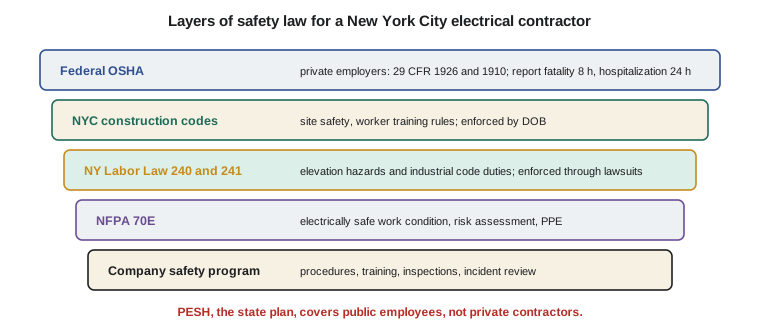
Electrical work is dangerous, and a master electrician in New York works under several overlapping layers of safety law. Federal OSHA standards apply to private employers throughout the state. New York's own public employee safety program covers state and local government workers. New York City adds construction site safety requirements in its building code and its local laws, including worker safety training requirements. New York's Labor Law places strong duties on owners and contractors for work at heights. And the electrical safety practices in NFPA 70E tie all of this to the specific hazards of shock and arc flash. This lesson gives a master the map: who enforces what, what the key duties are, and how Teresa builds a safety program for Halsey Street.
This lesson summarizes general requirements without reproducing standards. Federal OSHA rules are in Title 29 of the Code of Federal Regulations, and the city's requirements are in its building code and rules. Several details here are from memory and are worded generally; check the current text of each rule before relying on it.
Who enforces what
Federal OSHA covers private-sector employers in New York, including electrical contractors. New York operates a state plan, called Public Employee Safety and Health or PESH, that covers state and local government employees but not private employers, so Halsey Street answers to federal OSHA for workplace safety. Inside New York City, the Department of Buildings enforces the construction codes, including site safety provisions, and can issue violations and stop-work orders for unsafe construction conditions. The Labor Law creates duties that are enforced largely through injury lawsuits. Each layer has different inspectors and different consequences, and a single unsafe condition can violate more than one of them.
Federal OSHA basics
OSHA's construction standards in 29 CFR Part 1926 apply to construction work, and its general industry standards in Part 1910 apply to other work, such as maintenance in an operating building. Subpart K of Part 1926 covers electrical safety in construction, including ground-fault protection for temporary power, and other subparts cover ladders, scaffolds, fall protection and excavation. The general industry rules include the control of hazardous energy, commonly called lockout and tagout, and electrical safety-related work practices. OSHA also has a general duty clause that requires employers to keep the workplace free of recognized serious hazards even where no specific standard applies.
Recordkeeping and reporting rules apply too. Employers covered by the recordkeeping rule keep a log of recordable injuries and illnesses, prepare an annual summary and post it, and keep the records for the required period; some smaller employers and some industries are partially exempt. Every employer, regardless of size, must report a work-related fatality to OSHA within eight hours, and an in-patient hospitalization, an amputation or the loss of an eye within twenty-four hours. These deadlines are among the most frequently tested safety facts.
| Event | Report to OSHA within |
|---|---|
| Work-related fatality | 8 hours |
| In-patient hospitalization of an employee | 24 hours |
| Amputation | 24 hours |
| Loss of an eye | 24 hours |
Electrical safety practices and NFPA 70E
The safest electrical work is done with the equipment de-energized and verified dead. OSHA's rules and the consensus standard NFPA 70E both start from that principle: work on energized parts only when de-energizing creates a greater hazard or is not feasible, and then only with a justified, documented plan, qualified workers, appropriate protective equipment and safe work practices. NFPA 70E describes how to establish an electrically safe work condition, assess shock and arc flash risk, set approach boundaries and select protective equipment. OSHA does not adopt NFPA 70E word for word, but it treats the standard as evidence of recognized practice, and a contractor that follows it is well placed to meet OSHA's requirements.
Teresa's rule at Halsey Street is that panels are de-energized and locked out for work unless there is a written justification signed by her or Sal. On the bakery service changeover, that means coordinating a utility outage, locking and tagging the service disconnect, testing for absence of voltage with a meter verified on a known source before and after, and only then letting the crew work. The night shift adds lighting and fatigue hazards, so she schedules a short safety briefing at the start of the shift.
New York City site safety and worker training
New York City's building code has a chapter on safeguards during construction, covering site safety plans and managers on larger jobs, protection of the public, and many other requirements. The city has also required site safety training for workers on many construction sites, with workers carrying training cards issued after approved courses, under a local law passed after a series of fatal accidents. Which workers need which level of training, and on which sites, is set in the law and the department's rules and has changed over time, so a contractor should check the current requirements before staffing a job. Halsey Street keeps a training matrix showing each employee's OSHA and site safety training and expiration dates, and Teresa checks it before assigning crews to larger buildings.
The Labor Law and work at heights
New York's Labor Law includes provisions that are especially important on construction sites. Section 240, often called the scaffold law, places duties on owners and contractors to provide proper protection for workers exposed to elevation-related hazards, such as falls from ladders and scaffolds and falling objects, and courts have long applied it strictly, so that a failure to provide proper protection that causes an injury can make the owner and contractor liable even if the worker was also careless. Section 241 imposes duties tied to the state's industrial code rules for construction. These provisions are enforced mainly through lawsuits by injured workers, and they drive the insurance costs and contract terms that owners and general contractors impose on subcontractors.
For an electrical contractor, the practical message is that ladder and scaffold safety is not just an OSHA compliance issue; it is a major legal and insurance risk. Teresa replaces worn ladders immediately, trains new workers on ladder setup, uses scaffolds or lifts for high work rather than stretching ladders, and makes sure guardrails or personal fall protection are used where required.
Temporary power and ground-fault protection
Construction sites run on temporary power, and temporary power causes a large share of construction electrical injuries. OSHA's construction electrical rules require employers to protect workers from ground faults on temporary wiring, either with ground-fault circuit interrupters on the receptacle outlets workers use or with an assured equipment grounding conductor program that inspects and tests cords and tools on a schedule. The electrical code also has requirements for temporary installations. On a city job, the electrical contractor often installs and maintains the temporary power for all trades, which makes it responsible for a hazard that other trades' workers are exposed to.
Teresa's temporary power checklist for the co-op riser job includes GFCI protection on every temporary receptacle, cords inspected and tagged weekly, damaged cords removed from service immediately, temporary lighting with guards and secure supports, and panels closed and labeled. She also reminds the general contractor that other trades must not tap into temporary panels on their own.
Incident investigation
When something goes wrong, the response has two goals: take care of the injured person and prevent the next incident. Immediate steps are first aid and emergency services, securing the scene, and making any required reports to OSHA, the insurer and, where required, the city. Then comes an investigation that asks what happened, why it happened, and what will change. Good investigations look for system causes, such as a missing procedure, inadequate training, wrong equipment or schedule pressure, rather than stopping at the person who made the last mistake. Teresa uses a one-page form that records the facts, the causes and the corrective actions, with a name and a date for each action, and she reviews open actions at every monthly safety meeting.
Near misses and job hazard analysis
Two more tools make a safety program work before injuries happen. A near-miss report records an event that could have hurt someone but did not, such as a ladder that slipped while unoccupied or a circuit that tested live when the crew expected it dead. Near misses are free lessons, and a crew that reports them is a crew that is paying attention. A job hazard analysis breaks a task into steps, lists the hazards at each step and records the controls that will be used. Teresa asks her foremen to write a short hazard analysis for any unusual task, such as the bakery's night service changeover, and to review it with the crew before work starts.
Building a safety program
A written safety program turns these rules into habits. Teresa's program for Halsey Street includes a policy statement signed by the owners, assigned responsibilities, hazard assessment for each job, lockout and tagout procedures, an energized work permit process, personal protective equipment selection and inspection, ladder and fall protection rules, training and recordkeeping, incident reporting and investigation, and regular job-site inspections. The program is short enough that people read it and specific enough that they can follow it.
The calculator below shows a measure many customers ask about: the total recordable incident rate, calculated as the number of recordable cases times 200,000 divided by the hours worked. The 200,000 represents 100 full-time workers for a year. Lower is better, and many general contractors set a maximum rate for subcontractors.
# Total recordable incident rate (illustrative numbers)
recordable_cases = 2
hours_worked = 24_000   # twelve workers, about 2,000 hours each
rate = recordable_cases * 200_000 / hours_worked
print(f"Total recordable incident rate: {rate:.2f} cases per 100 full-time workers")Total recordable incident rate: 16.67 cases per 100 full-time workers
With two recordable cases in 24,000 hours, the rate is about 16.67, which would be high for most general contractors' requirements. The point of the calculation is not the number itself but what drives it: each recordable injury matters, and a small company's rate can swing a lot with one case.
Heat, cold and other site conditions
New York construction runs through hot summers and cold winters. Federal OSHA had proposed a heat injury and illness prevention standard but, as of this writing, had not issued a final rule, so heat hazards are addressed through the general duty clause, guidance and company programs. Cold-weather work brings slips on ice, cold stress and the hazards of temporary heaters. Teresa's program covers both: water, rest and shade breaks and a buddy system in heat waves, and in winter, salt and sand for walkways, warm-up breaks and rules for the safe placement and ventilation of temporary heat. Site conditions like these are not electrical hazards, but they injure electricians every year.
Health hazards deserve attention too. Electricians drill and cut concrete and masonry, which can create silica dust covered by OSHA's construction silica standard, and they work around lead paint in older buildings, which is common in the city's prewar housing stock. Brownstone renovations in Brooklyn often involve both. Teresa uses tools with dust collection or water, follows the required work practices for older painted surfaces, and trains crews on these hazards before they start renovation work.
Outside the city
Outside New York City, federal OSHA rules and the Labor Law apply in the same way, but the city's construction code site safety and training requirements do not, unless a local law adds similar rules. Andre's Long Island employer follows OSHA's construction standards and its own safety program, and large customers impose their own site rules. Some municipalities and owners require specific safety training as a condition of working on their sites. As always, check the local rules and the contract.
Common mistakes
MistakeAssuming New York's state plan covers private contractors.
InsteadPESH covers public employees; federal OSHA covers private employers in New York.
MistakeWaiting until the next business day to report a fatality.
InsteadA work-related fatality must be reported to OSHA within eight hours.
MistakeTreating NFPA 70E as optional because OSHA does not adopt it word for word.
InsteadOSHA treats it as recognized practice; following it helps meet OSHA duties.
MistakeViewing ladder safety as only an OSHA issue.
InsteadThe Labor Law's height-related duties create major legal and insurance risk.
MistakeAssuming city site safety training rules apply on Long Island.
InsteadThose requirements come from city law; outside the city, check local rules and contracts.
Summary and key terms
- Federal OSHA covers private employers in New York; PESH covers public employees.
- Construction standards are in 29 CFR Part 1926; general industry standards, including lockout and tagout, are in Part 1910.
- Report fatalities within eight hours and in-patient hospitalizations, amputations and eye losses within twenty-four hours.
- NFPA 70E guides electrical safe work practices, starting with establishing an electrically safe work condition.
- New York City adds construction site safety and worker training requirements; the Labor Law imposes strict height-related duties.
- A written safety program and training records turn the rules into daily practice.
- PESH
- New York's Public Employee Safety and Health program, covering state and local government employees.
- Lockout and tagout
- Procedures for controlling hazardous energy so equipment cannot be energized during work.
- Electrically safe work condition
- A state in which conductors and parts are disconnected, locked out, tested and verified de-energized.
- Scaffold law
- The common name for New York Labor Law section 240, covering elevation-related hazards.
- Recordable case
- A work-related injury or illness that must be entered in the OSHA log.
- Incident rate
- Recordable cases times 200,000 divided by hours worked.
Practice problems
Work each problem on paper first, then reveal the answer to check.
Which agency covers safety for Halsey Street's private employees?
Show answer
Federal OSHA.
Within how many hours must an employee amputation be reported to OSHA?
Show answer
Twenty-four hours.
A company had 3 recordable cases in 60,000 hours. What is its incident rate?
Show answer
3 times 200,000 divided by 60,000, which is 10.
What is the first step NFPA 70E emphasizes before electrical work?
Show answer
Establishing an electrically safe work condition: de-energize, lock out, test and verify.
Why do contractors in New York take ladder safety especially seriously?
Show answer
Because the Labor Law's height-related duties can make owners and contractors liable for elevation-related injuries.
Lesson quiz · 5 questions
Score 60% or more to complete this lesson.
Create a free account to save your progress, take quizzes and earn a certificate.