
MELU-307 · Lesson 1 of 12 · 19 min
How electrical licensing works in New York
▶ Video coming soon A video version of this lesson is on the way.
Teresa Bianchi has spent eleven years in the electrical trade, the last six as a foreman for Halsey Street Electric, a twelve-person shop in Astoria, Queens. She started as a helper on a job in Jersey City, moved into a four-year apprenticeship program registered with the New York State Department of Labor, and now runs the company's larger jobs: a bakery fit-out on Ditmars Boulevard, a riser upgrade in a six-story co-op in Jackson Heights, and a steady stream of brownstone renovations in Brooklyn. Sal Russo, who founded Halsey Street and whose New York City Master Electrician license is the reason the company can pull permits at all, is sixty-six and wants to retire. He wants Teresa to become a licensed master electrician and buy into the business. Teresa wants that too, but the first thing she learned when she started reading is that New York does not work the way most states do.
This is the New York course in the HSM University master electrician exam prep series. The core courses, MELU-101 through MELU-107, teach the National Electrical Code skills every master exam tests: navigating the code, load calculations, conductors and overcurrent protection, grounding and bonding, motors and transformers, special occupancies, and business and law. This course adds what is specific to New York, which is mostly a story about local licensing: who licenses electricians in New York City, on Long Island and upstate, who qualifies for the New York City Master Electrician license, how its unusual exam sequence works, which electrical code applies where, how permits and inspections work in the city, what a license holder is responsible for, insurance, New York lien law, workplace safety law, renewal, and a final practice review.
Two cautions apply throughout. First, licensing rules change, and in New York they change at the local level as well as the state level. The facts in this course were checked against the New York City Department of Buildings website, the city's exam administrator, the New York State Workers' Compensation Board and other sources in November 2026, and the lessons say so where a fact came from a secondary source. Before you apply, pay a fee or schedule an exam, check the current official pages. Second, the National Electrical Code and the New York City Electrical Code are published standards. This course cites article and section numbers and explains them in plain words, but it never reproduces their text, tables or figures.
No statewide license
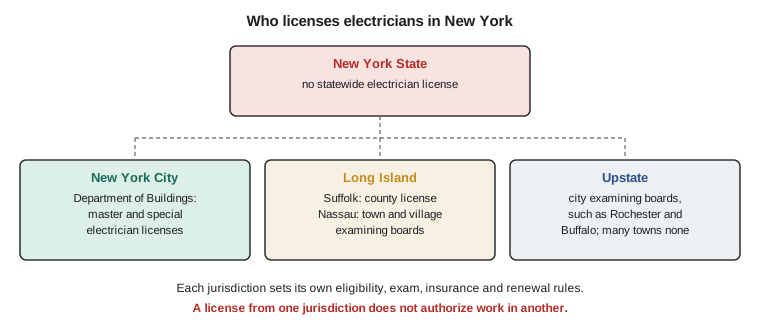
Most states issue an electrician license that is good everywhere in the state. New York does not. There is no New York State master electrician license and no state journeyman license. The state sets the building and fire code that applies outside New York City, and it regulates some related matters, such as workers' compensation and the lien law, but it leaves the licensing of electricians to local governments. Cities, towns, villages and counties decide for themselves whether to license electricians, what the license is called, who qualifies, how the exam works and how often the license is renewed.
The result is a patchwork. New York City licenses master electricians and special electricians through its Department of Buildings, under the city's Administrative Code. On Long Island, Suffolk County licenses electricians at the county level, while in Nassau County licensing is mostly handled by the individual towns and villages, each with its own examining board. Upstate, cities such as Buffalo, Rochester, Syracuse, Albany and Binghamton run their own electrical examining boards or licensing offices, and many smaller towns have no electrician license at all. An electrician who moves from Queens to Hempstead, or from Rochester to Buffalo, usually has to apply again under the new jurisdiction's rules, even though the work is the same.
That is why this course is called New York Local Master Electrician Licenses Exam Prep. It uses the New York City Master Electrician license as its main example, because it is the largest program in the state and the one Teresa needs, and it uses Long Island and upstate examples to show how other jurisdictions differ. If you plan to work outside the city, read the local law for your town or city closely; the details matter.
The New York City system
In New York City, the licensing law for electricians sits in Title 27 of the Administrative Code, in the chapter on electrical work, and the Department of Buildings, usually called DOB, runs the program. The department sets the eligibility rules, contracts with an outside testing organization to give the exams, reviews each applicant's background and fitness, issues the license and the seal that goes with it, and handles renewals and discipline. The Administrative Code section the department points applicants to for qualifications is 27-3010(a). The department also publishes rules in Title 1 of the Rules of the City of New York that add procedural detail.
The city issues two main electrician licenses. The Master Electrician license authorizes an individual to perform electrical work in or on any building in the city, through a business that the master owns or controls. The Special Electrician license is narrower: it authorizes an individual to perform electrical work in a particular building or set of buildings for the owner or tenant who employs the special electrician, such as the in-house electrician for a hospital, a university or a large property manager. Both licenses require experience, both exams and a background review, but only the master license lets a business sell electrical work to the public across the city.
Pay attention to what the city does not license. There is no New York City journeyman license and no apprentice registration with DOB. The people who pull the wire on a city job, whether union members of IBEW Local 3 or employees of a non-union shop, work under the supervision of the licensed master whose company holds the permit. Their experience counts toward their own future master license if it is documented properly, which is why Lesson 2 spends so much time on the Experience Verification Form.
| License | Who issues it | General scope |
|---|---|---|
| Master Electrician | New York City Department of Buildings | Electrical work in or on any building in the city, through the master's own business |
| Special Electrician | New York City Department of Buildings | Electrical work in specific buildings for the owner or tenant who employs the license holder |
| County master or electrician license | Suffolk County | Electrical work within the county, under county law |
| Town or village master license | Nassau towns and villages, such as North Hempstead | Electrical work within that town or village |
| City master license | Upstate city examining boards, such as Rochester and Buffalo | Electrical work within that city |
The New York City Electrical Code
New York City writes its own electrical code. The current code, the 2025 New York City Electrical Code, took full effect on December 21, 2025. It is built on the 2020 edition of NFPA 70, the National Electrical Code, with a set of city amendments that change, add or delete requirements to fit the city's buildings, utilities and practices. Before that, the city's code was based on the 2008 NEC, so the jump to the 2025 code brought a dozen years of national changes into the city at once. Lesson 5 explains the code in more detail, including how filings made on or after June 29, 2026 must name the code year they are reviewed under.
This matters for exam preparation in a way that surprises candidates from other states. The city's written master exam is closed book, and its questions are built on the city's electrical code and rules, not just the national code. A candidate who studies only the latest NEC, or who relies on looking things up during the exam, is preparing for the wrong test. Lesson 4 describes the exam in detail.
Outside the city
Outside New York City, building construction is governed by the New York State Uniform Fire Prevention and Building Code, usually called the Uniform Code, which is administered by the Department of State and enforced by local code enforcement officials. The Uniform Code references the National Electrical Code for electrical installations. The state has updated the referenced edition over time, and the 2025 update of the Uniform Code moved the electrical reference to the 2023 NEC; confirm the effective date and any state modifications before you rely on it. Local governments may also adopt their own electrical ordinances, which often add licensing, permit and inspection rules.
Inspection outside the city often looks different too. Many towns and villages rely on electrical inspection agencies that the municipality has approved, rather than employing their own electrical inspectors. The electrician or owner arranges an inspection with an approved agency, and the utility generally looks for the inspection certificate before it connects or reconnects service. Lesson 6 compares this with the city's system, in which DOB itself inspects electrical work filed in DOB NOW.
Teresa's plan and her study partner
Teresa is not studying alone. Her friend Andre Baptiste, who grew up in Hempstead and has spent nine years working for a Long Island contractor, wants to hold a master license in a Nassau County town so that he can start his own shop near home. Their paths share most of the technical study, because both exams test electrical theory and code knowledge, but the licensing steps, the exam format and the local rules are different. Throughout this course, when a lesson needs a Long Island or upstate example, Andre's town or a contractor Teresa met at a trade show in Rochester provides it. Those examples are illustrations; your own town's law controls.
Teresa's planning starts with time. Sal wants to retire in about three years. The city's process has more steps than most, because the written exam, the practical exam and the background review happen in sequence, and each has its own waiting period. The calculator below lays out her plan in months; change the numbers to fit your own situation.
# Teresa's planning check (illustrative numbers)
months_until_sal_retires = 36
steps = {
    "collect experience forms and earnings records": 2,
    "exam application accepted and written exam scheduled": 1,
    "study and pass the written exam": 4,
    "study and pass the practical exam": 4,
    "background application and DOB review": 4,
    "set up the business and insurance, pick up the license": 2,
}
needed = sum(steps.values())
for step, months in steps.items():
    print(f"{step}: {months} months")
print(f"Total: {needed} months; margin before retirement: {months_until_sal_retires - needed} months")collect experience forms and earnings records: 2 months exam application accepted and written exam scheduled: 1 months study and pass the written exam: 4 months study and pass the practical exam: 4 months background application and DOB review: 4 months set up the business and insurance, pick up the license: 2 months Total: 17 months; margin before retirement: 19 months
How this course is organized
The lessons follow the path a candidate actually walks. Lesson 2 covers eligibility and Lesson 3 the application, exam scheduling and background review. Lesson 4 describes the written and practical exams. Lesson 5 explains code adoption in the city and elsewhere in the state, and Lesson 6 permits and inspections. Lesson 7 covers the license holder's duties, Lesson 8 business requirements, insurance and bonding, and Lesson 9 contracts and mechanics' liens. Lesson 10 covers workplace safety law and OSHA, Lesson 11 renewal and working in other jurisdictions, and Lesson 12 a practice review with test-day strategy. Every lesson ends with a quiz that mixes multiple choice, true or false, number, ordering and matching questions, and the course ends with a final exam.
Common mistakes
MistakeAssuming New York State issues a master electrician license.
InsteadNew York has no statewide electrician license; cities, towns, villages and counties license locally.
MistakeTreating a New York City master license as good on Long Island or upstate.
InsteadEach jurisdiction issues its own license; check the local law before working outside the city.
MistakeBelieving New York City has a journeyman license.
InsteadThe city licenses masters and special electricians; workers perform electrical work under a licensed master's supervision.
MistakeStudying only the newest NEC for the city exam.
InsteadThe city's code is the 2025 NYC Electrical Code, built on the 2020 NEC with city amendments.
MistakeAssuming the special electrician license allows contracting with the public.
InsteadA special electrician works in specific buildings for the employer named; contracting with the public requires the master license.
Summary and key terms
- New York has no statewide electrician license; licensing is local.
- In New York City, the Department of Buildings licenses master and special electricians under Administrative Code Title 27.
- Suffolk County licenses at the county level; in Nassau, towns and villages license; upstate cities run their own boards.
- The 2025 New York City Electrical Code, built on the 2020 NEC with city amendments, took full effect on December 21, 2025.
- Outside the city, the state Uniform Code references the NEC, and many municipalities rely on approved electrical inspection agencies.
- Always confirm current requirements with the licensing jurisdiction before acting.
- DOB
- The New York City Department of Buildings, which licenses master and special electricians and enforces the city's construction codes.
- Master Electrician
- A New York City license authorizing electrical work in or on any building through the license holder's own business.
- Special Electrician
- A New York City license authorizing electrical work in specific buildings for the owner or tenant who employs the license holder.
- Uniform Code
- The New York State Uniform Fire Prevention and Building Code, which governs construction outside New York City.
- Electrical inspection agency
- An organization approved by a municipality to inspect electrical installations on its behalf.
- Examining board
- A local board that examines applicants and recommends or issues electrician licenses in its jurisdiction.
Practice problems
Work each problem on paper first, then reveal the answer to check.
Does New York State issue a master electrician license?
Show answer
No. Licensing is done by local governments: New York City, counties such as Suffolk, towns and villages, and cities.
What is the difference between a New York City master and special electrician?
Show answer
A master may perform electrical work in any building through the master's own business; a special electrician works only in specific buildings for the employer named.
On which edition of the NEC is the 2025 New York City Electrical Code built?
Show answer
The 2020 NEC, with New York City amendments.
Who often inspects electrical work in Long Island and upstate towns?
Show answer
Electrical inspection agencies approved by the municipality, rather than municipal employees.
Why must Andre read his town's law even though he studies the same technical material as Teresa?
Show answer
Because the licensing steps, exam and local rules differ by jurisdiction.
Lesson quiz · 5 questions
Score 60% or more to complete this lesson.
Create a free account to save your progress, take quizzes and earn a certificate.