
MELU-307 · Lesson 8 of 12 · 19 min
Contractor licensing, insurance and bonding
▶ Video coming soon A video version of this lesson is on the way.
In many states, an electrical contractor needs a separate business license from the state in addition to the master's personal license. New York City folds the two together: the master license can only be used through a business that meets the Department of Buildings' requirements, so setting up that business is part of getting licensed. Outside the city, towns and counties combine personal and business requirements in their own ways. On top of the licensing rules sit state laws that apply to every employer, such as workers' compensation, disability and paid family leave coverage, and requirements that apply to particular kinds of work, such as home improvement licensing and bonds on public work. This lesson sorts out what applies, and why.
The New York City business requirements here come from the department's master license page, and the coverage rules for disability and paid family leave come from the New York State Workers' Compensation Board, both checked in November 2026. Specific insurance amounts that the department requires are set in its insurance guidelines, which this lesson does not reproduce; check the current guidelines before you buy coverage.
The New York City business requirements
The department requires that the master electrician applicant be an officer, partner or sole proprietor of a business. The department's page lists the documents needed for each business structure, including corporations, limited liability companies, partnerships, sole proprietorships and out-of-state businesses. The business must have a place of business in New York City that complies with the Zoning Resolution, which in practice means a location in a district where the use is permitted. It must have a telephone bill in the business's name for the approved location; if the service is voice over internet or mobile, the department also asks for a utility bill in the business's name or a notarized lease stating that utilities are included. And the firm name must include the word Electric or Electrical.
Each requirement has a purpose. The ownership role ties the license holder to the business so the license holder can control it. The place of business gives the department and the public a real address where the business can be found. The telephone requirement confirms that the business actually operates at that address. And the firm-name rule tells the public that the business is an electrical contractor. When Teresa reviews Halsey Street's paperwork with Sal, she finds that the company's phone bill lists the old suite number from before a move down the hall, and they get it corrected before her background application.
Insurance the department requires
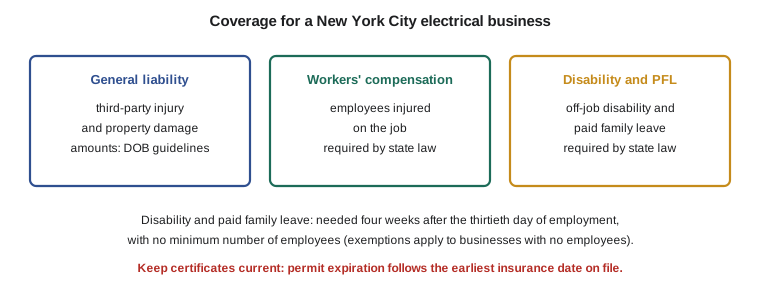
The department requires electrical businesses to carry general liability insurance, workers' compensation insurance and disability insurance. General liability covers claims by third parties for bodily injury and property damage arising from the business's operations, such as a customer's ceiling damaged by a fire that starts in faulty work, or a pedestrian injured by equipment on a sidewalk. Workers' compensation covers employees injured on the job. Disability coverage, which in New York is paired with paid family leave, provides benefits to employees who are disabled off the job or who take family leave. The department's insurance guidelines specify the required minimums and how proof is submitted; insurance certificates must stay current, because, as Lesson 6 explained, a permit's expiration follows the earliest insurance expiration on file.
Many customers require more than the minimum. A large property manager may require higher general liability limits, an umbrella policy, additional insured status for the owner and the manager, and waivers of subrogation. Those are contract terms, not licensing requirements, but a master who signs the contract must comply. Teresa reads every insurance clause before Halsey Street signs, and she sends the clause to the company's insurance broker before agreeing to it.
Workers' compensation in New York
New York's Workers' Compensation Law requires most employers to provide workers' compensation coverage for their employees, through a private insurer, the State Insurance Fund or approved self-insurance. The Workers' Compensation Board notes that under the law, most individuals who provide services to a for-profit business are considered employees, so a contractor cannot avoid coverage by calling its workers independent contractors. The law also has rules for when a general contractor becomes responsible for an uninsured subcontractor's workers, which is one reason general contractors ask electrical subcontractors for certificates of insurance before they start. Penalties for failing to carry required coverage can be severe; check the current law for the details.
Disability and paid family leave
New York requires employers to provide disability benefits and paid family leave coverage. According to the Workers' Compensation Board, a for-profit employer must have this coverage in place four weeks after the thirtieth day of employment of an employee, and there is no minimum number of employees: part-time, temporary, seasonal and other workers count. The Board lists exemptions for businesses with no employees: partnerships, limited liability companies and sole proprietors with no employees are not required to carry the coverage, though members and partners may cover themselves voluntarily, and a corporation with only one or two officers who own all the stock and hold all the offices, with no other employees, is not required to carry it. A corporation with more than two officers or shareholders, or whose officers do not own all the shares, must carry it.
The calculator below applies the Board's timing rule to a new hire. It counts thirty days of employment and then adds four weeks to find the date by which coverage must be in place. It is a planning aid; the Board's rules control.
from datetime import date, timedelta

def coverage_due(first_day):
    thirtieth_day = first_day + timedelta(days=29)
    return thirtieth_day + timedelta(weeks=4)

hire = date(2026, 9, 1)
print("First day of work:", hire)
print("Thirtieth day of employment:", hire + timedelta(days=29))
print("Disability and paid family leave coverage needed by:", coverage_due(hire))First day of work: 2026-09-01 Thirtieth day of employment: 2026-09-30 Disability and paid family leave coverage needed by: 2026-10-28
For the department's purposes, the practical question is simple: the department requires disability insurance for the electrical business, and the state requires it once the business has employees. A master starting a one-person business should check both the department's guidelines and the Board's exemptions before deciding what to buy.
| Coverage | Who requires it | Key point |
|---|---|---|
| General liability | DOB, and most customer contracts | Minimums set in DOB's insurance guidelines; contracts often require more |
| Workers' compensation | State law and DOB | Most service providers are employees under the law |
| Disability and paid family leave | State law and DOB | Needed four weeks after the thirtieth day of employment; no minimum headcount |
| Commercial auto | State law for vehicles, and contracts | Covers company vehicles |
| Umbrella or excess | Contracts | Raises limits above the primary policies |
Home improvement licensing
Electrical work in homes can bring another license into play. New York City requires home improvement contractors working on residential property to be licensed by the city's consumer protection agency, and Nassau and Suffolk counties have their own home improvement licensing offices. Whether a licensed master electrician doing purely electrical work needs a home improvement license, or is exempt for that work, depends on the local law and the scope of the job, especially when the electrical contractor also does carpentry, drywall or other general renovation. A master who takes on whole-kitchen renovations, not just the wiring, should check the home improvement rules carefully, and Andre makes a note to ask his county's consumer affairs office before he offers renovation packages.
Payroll and employment basics
Hiring employees brings obligations beyond insurance. A New York employer withholds and pays federal and state income and payroll taxes, registers with the state for unemployment insurance, follows federal and state wage and hour laws, including overtime and pay-frequency rules, and keeps payroll records. Public work adds prevailing wage requirements, with their own certified payroll records. The details change and are best handled with a payroll service and an accountant, but a master should understand the basics, because the business that holds the license is the employer, and failures can lead to penalties, back pay and trouble on public jobs. The core course MELU-107 covers federal employment basics in more depth.
Bonds
Surety bonds come up in three ways. First, some local licensing jurisdictions require a license bond or similar security as a condition of the license or of permits; check the local law. Second, public owners commonly require performance and payment bonds on public construction contracts, and public work in New York has its own bonding statutes and thresholds. Third, private owners and general contractors sometimes require subcontract bonds on large jobs. A bond is not insurance for the contractor; it is a guarantee to the owner or to suppliers and workers, and the surety expects to be repaid if it has to pay a claim. Getting bonded depends on the contractor's finances, experience and character, so a growing contractor should build a relationship with a surety broker early.
Halsey Street has never bid public work, but the Jackson Heights co-op board asked for a performance bond on the riser job because of its size. Sal's broker obtained it based on the company's financial statements and track record, and Teresa learned how much paperwork a first bond requires.
Business structure
The department accepts several business structures. A sole proprietorship is simplest but leaves the owner personally liable for business debts. A corporation or limited liability company can limit the owners' personal liability for business debts, though not for their own wrongful acts, and requires filings with the state and ongoing compliance. Partnerships share control and liability among partners. Tax treatment, insurance cost and future plans, such as bringing in a partner or selling the business, all affect the choice. The department's renewal rules require that a business entity used for the license be active with the state's corporation records, so a lapsed corporation can block a renewal. Teresa and Sal keep Halsey Street's corporation, and they talk with their accountant and a lawyer about how to transfer the stock over time.
Certificates of insurance in practice
Insurance shows up in daily work as certificates. The department needs proof of coverage on file, general contractors and owners ask for certificates before a subcontractor starts, and town codes on Long Island, such as North Hempstead's, require a certificate naming the town before work begins. A certificate summarizes the policies, limits and dates; it does not itself change the policy, so if a contract requires additional insured status or a waiver of subrogation, the policy must actually include an endorsement that provides it. Teresa keeps a standing list with the company's broker of every party that needs certificates, and she asks for renewals a month before the policies expire, so that no permit expires early and no general contractor stops a crew at the gate.
Claims are the other side of insurance. When an accident happens, a prompt report to the insurer, a written record of what happened, and photographs protect both the injured person and the company. Workers' compensation claims have their own reporting rules and forms with the Workers' Compensation Board; liability claims usually require prompt notice under the policy. A master who delays reporting can lose coverage the company has paid for.
Common mistakes
MistakeAssuming a sole master can skip disability coverage because the business is small.
InsteadThere is no minimum headcount; coverage is needed four weeks after the thirtieth day of employment of an employee.
MistakeTreating workers as independent contractors to avoid workers' compensation.
InsteadUnder the law, most people providing services to a for-profit business are employees.
MistakeForgetting the firm-name rule.
InsteadThe firm name must include Electric or Electrical.
MistakeConfusing a performance bond with insurance.
InsteadA bond guarantees performance or payment to others; the surety expects repayment.
MistakeAssuming the master license covers all home renovation work.
InsteadHome improvement licensing may apply to renovation work; check city or county rules.
Summary and key terms
- A New York City master must be an officer, partner or sole proprietor of a business with an approved place of business in the city.
- The business needs a telephone in its name at the approved location and a firm name including Electric or Electrical.
- DOB requires general liability, workers' compensation and disability insurance, with minimums in its insurance guidelines.
- State law requires disability and paid family leave coverage four weeks after the thirtieth day of employment, with no minimum headcount.
- Home improvement licensing may apply to renovation work in the city and on Long Island.
- Bonds guarantee performance or payment and are common on public and large private jobs.
- General liability insurance
- Coverage for third-party bodily injury and property damage from business operations.
- Disability benefits
- New York's required coverage for employees disabled off the job, paired with paid family leave.
- Paid family leave
- New York's required coverage that provides benefits while employees take family leave.
- Performance bond
- A surety's guarantee that the contractor will perform the contract.
- Payment bond
- A surety's guarantee that the contractor will pay subcontractors, suppliers and workers.
- Home improvement contractor license
- A local license for contractors performing residential home improvement work.
Practice problems
Work each problem on paper first, then reveal the answer to check.
Which three types of insurance does DOB require for electrical businesses?
Show answer
General liability, workers' compensation and disability.
An employee starts work on October 1. By when must disability and paid family leave coverage be in place?
Show answer
Four weeks after the thirtieth day of employment, which is October 30 plus four weeks, November 27.
Is a one-officer corporation with no employees required to carry disability and paid family leave coverage?
Show answer
No, under the Board's exemption for corporations with one or two officers who own all the stock and hold all offices, with no other employees.
Why did Teresa get Halsey Street's phone bill corrected?
Show answer
Because DOB requires a telephone bill in the business's name for the approved location.
What is the difference between a bond and insurance?
Show answer
A bond guarantees performance or payment to others and the surety expects repayment; insurance protects the insured against covered losses.
Lesson quiz · 5 questions
Score 60% or more to complete this lesson.
Create a free account to save your progress, take quizzes and earn a certificate.