
MELU-307 · Lesson 7 of 12 · 19 min
Duties and responsibilities of the Local Master Electrician Licenses holder
▶ Video coming soon A video version of this lesson is on the way.
Passing the exams and the background review makes Teresa a licensed master electrician. What she does with the license afterward determines whether she keeps it. A New York City master license is personal: it belongs to the individual, not the company, and the individual answers for how it is used. It is also tied to a business that meets the department's requirements. This lesson covers what the license allows, what the license holder must do, what the license holder must not do, how discipline works in general terms, and how responsibilities differ for a Long Island town license.
The duties described here are drawn from the department's license requirements and general principles of licensing law. The specific rules are in Title 27 of the Administrative Code and Title 1 of the Rules of the City of New York, and the department enforces them; read those sources for exact language.
What the license allows
The Master Electrician license authorizes the holder to perform electrical work in or on any building in the city. In practice, the holder does that through the business he or she owns or controls, filing permits as applicant of record, employing and supervising electrical workers, and standing behind the installations. The license does not authorize work that needs a different license, such as certain fire alarm, elevator, plumbing or fire suppression work, which have their own licensing rules. It also does not authorize the holder to lend the license to another company.
The Special Electrician license, by contrast, authorizes work only in the building or buildings of the employer named. A special electrician at a hospital cannot moonlight as a contractor in Queens on the strength of that license.
The business requirements as continuing duties
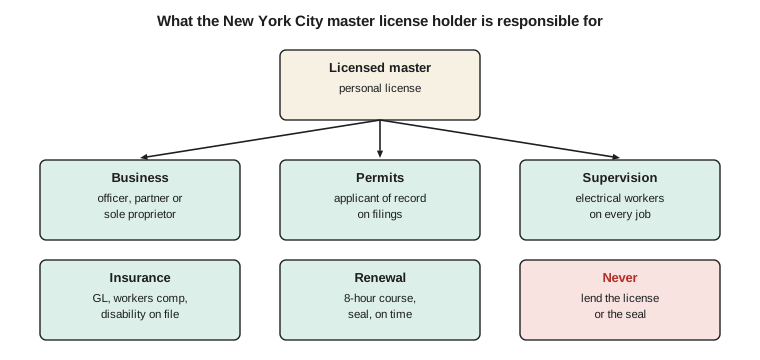
The department's business requirements are not just conditions for the first license; they describe how the license must operate. The master must be an officer, partner or sole proprietor of the business. The business must have a place of business in the city that complies with zoning, which means a location in a district where the use is allowed. The business must carry general liability, workers' compensation and disability insurance. It must have a telephone in its name at the approved location. Its name must include the word Electric or Electrical. Lesson 8 covers insurance and business structure in more detail.
These requirements keep the license connected to a real, accountable business. If Teresa later leaves Halsey Street to start her own company, she must set up a new business that meets the requirements, and the department's renewal rules, discussed in Lesson 11, check that the business entity is active with the state and is the same entity the department has on file. A master cannot keep a license alive by pointing to a business that no longer exists.
Permits and supervision
As Lesson 6 explained, the license holder is applicant of record on the company's filings. That role carries the responsibility for the work installed under the permit, including work done by employees. The license holder must make sure the work is supervised by competent people, installed to the code that applies, inspected when required, and closed out properly. Supervision does not mean standing over every apprentice, but it does mean knowing what each crew is doing, checking the work, and correcting problems before the inspector finds them.
Teresa thinks of supervision in three layers. The daily layer is her foremen and their crews: who is on which job, with what drawings and which permit. The weekly layer is quality: she walks each active job once a week with a checklist and the permit. The monthly layer is administration: open permits, expirations, inspection requests and close-outs. When something goes wrong, the department will look at whether the license holder had a system and followed it.
The seal
New York City issues a seal to each master electrician, and the renewal fee includes a seal fee. The seal identifies the license holder on documents and correspondence; the department's late-renewal procedure, for example, requires an affidavit on the license holder's letterhead bearing the department-issued seal. The seal belongs to the license holder personally and should be kept under the holder's control, never left with an office worker or another company to use.
What the license holder must not do
Licensing law in every jurisdiction prohibits the same basic misconduct, and New York City is no exception. A master must not allow another person or company to use the license to obtain permits for work the master does not control, which is often called lending or renting the license. A master must not file false or misleading information with the department, including on permit filings, inspection requests and certifications. A master must not perform or permit work without required permits, or depart from approved plans without amending the filing. And a master must not obtain a license or renewal through misrepresentation.
Lending a license deserves special emphasis because it is tempting. A contractor without a master may offer a licensed master a monthly fee to file permits in the master's name while the contractor does the work with its own crews. The arrangement exposes the master to discipline for work the master never saw, to liability for defects, and to the loss of the license. The department treats it seriously. Sal tells Teresa about a master he knew who lost his license this way, and she adds the story to her flash cards.
| Must do | Must not do |
|---|---|
| Own or be an officer or partner of the business that uses the license | Lend or rent the license to another company |
| Be applicant of record and supervise work under the company's permits | File false or misleading information with the department |
| Keep insurance, the place of business and the telephone requirement current | Work without required permits or beyond the approved scope |
| Renew on time with the required course | Let others use the department-issued seal |
| Keep records of jobs, permits and inspections | Obtain the license or renewal through misrepresentation |
Discipline
The department can investigate complaints and refer license holders for discipline. Depending on the conduct, outcomes in licensing systems like the city's can include warnings, fines, suspension or revocation of the license, and restrictions on filing. Formal proceedings in the city are generally heard through the city's administrative hearing system, where the license holder can present evidence and be represented. The specific grounds, penalties and procedures are in the city's laws and rules; the exam is more likely to ask what kind of conduct leads to discipline than to ask for a penalty amount.
The practical lessons are simple. Answer the department promptly and honestly. Keep records that show what you did and when. Correct violations quickly. And get advice from a lawyer who knows licensing matters if a formal proceeding begins.
Records that protect the license
Good records are a master's best defense. For each job, Teresa keeps the contract and change orders, the DOB filing and permit, plan review approvals, inspection results, test reports, photographs of concealed work, and close-out documents. For the company, she keeps the license, insurance certificates, the business entity's state registration, the place-of-business documents and the telephone bill. For each employee, she keeps training records and safety certifications. The small program below shows the kind of weekly check she runs on open filings.
from datetime import date

today = date(2026, 11, 9)
filings = [
    ("Ditmars bakery", date(2027, 1, 15), "inspection requested"),
    ("Jackson Heights riser", date(2026, 11, 30), "work in progress"),
    ("Park Slope brownstone", date(2026, 12, 20), "passed, fees unpaid"),
]
for name, expires, status in filings:
    days = (expires - today).days
    flag = "RENEW SOON" if days < 30 else "ok"
print(f"{name}: expires in {days} days ({status}) {flag}")Ditmars bakery: expires in 67 days (inspection requested) ok Jackson Heights riser: expires in 21 days (work in progress) RENEW SOON Park Slope brownstone: expires in 41 days (passed, fees unpaid) ok
Changes the department needs to know about
A licensed master's circumstances change: a new business address, a new corporation, a partner leaving, a change of name, a move from one company to another. Licensing systems generally require the license holder to keep the department's records current, and the city's requirements on place of business, telephone, insurance and business entity make this especially important, because each of those facts is part of what the department approved. A master who moves the shop to a new location should confirm that the new location complies with zoning and update the department before relying on it. A master who forms a new corporation should expect the department to look at the new entity, as the renewal rule about the same corporation suggests. The safe habit is to tell the department before a change takes effect, using the department's current forms and procedures, rather than after an inspector or reviewer notices.
Teresa's plan with Sal involves exactly this kind of change. Over three years, she will become an officer of Halsey Street Electric Corp., then buy a growing share of the stock, and eventually Sal will retire and resign as an officer. At each step they will check the department's requirements so that the company always has a licensed master who meets the business requirements. If the business ever had no qualifying master, it could not file new electrical work in the city.
Ethics beyond the rules
Rules set the minimum. Customers, inspectors and employees judge a master by more than whether a rule was broken. Teresa's own list is short: tell customers the truth about what the code requires and what it costs; do not let price pressure turn into shortcuts on safety; pay subcontractors and suppliers on time; train apprentices and helpers properly; and treat inspectors with respect even when you disagree, using the department's appeal and review processes rather than arguments on site. None of these are exam questions in themselves, but each one keeps a master far away from the conduct that does lead to discipline.
Outside the city
Town and village licenses on Long Island carry similar duties, written in each town's code. The Town of North Hempstead's code, for example, requires a master electrician to file a certificate of public liability insurance naming the town, with minimum limits stated in the code, before beginning work, and allows the town to direct the electrician to suspend work if the insurance lapses. Local codes also typically require the license holder to obtain permits for work in the town, supervise the work, and renew on the town's cycle. Upstate city boards, such as Rochester's examining board, review a renewing license holder's past record as well as knowledge and ability, so a poor record can affect renewal.
Andre notes one practical difference. In the city, the license and the business are tightly linked by the department's requirements; in his town, the code focuses more on the individual license and the insurance certificate. Either way, the duty to supervise and to stand behind the work is the same.
Working with other trades and the general contractor
On larger city jobs, the electrical contractor works under a general contractor or construction manager, beside plumbers, sprinkler contractors, HVAC contractors and others, each with its own license and permits. The master's duties do not shrink because someone else runs the job. The electrical permit is still the master's, the electrical work is still the master's responsibility, and the master must still request the electrical inspections. Coordination problems, such as a ceiling closed before the electrical rough inspection or a mechanical unit installed where the electrical working clearance should be, are common causes of failed inspections. Teresa insists on a written schedule that shows electrical inspections before ceilings close, and she raises conflicts with the general contractor in writing as soon as she sees them.
Common mistakes
MistakeTreating the license as the company's property.
InsteadThe license belongs to the individual, who answers for its use.
MistakeLetting another company file permits under your license for a fee.
InsteadLending or renting a license is prohibited and can cost the license.
MistakeLetting an office worker use the seal.
InsteadThe department-issued seal stays under the license holder's control.
MistakeAssuming a special electrician can contract with the public.
InsteadThe special license is limited to the employer's buildings.
MistakeIgnoring a lapse in insurance.
InsteadInsurance is a continuing requirement; lapses can shorten permits and trigger suspensions.
Summary and key terms
- The master license is personal and authorizes electrical work in any building in the city through the holder's own business.
- The department's business requirements are continuing duties: ownership role, approved place of business, insurance, telephone and firm name.
- The license holder is applicant of record and must supervise work under the company's permits.
- The department-issued seal identifies the holder and must stay under the holder's control.
- Lending a license, false filings and work without permits can lead to discipline.
- Local town licenses impose similar duties, often with insurance certificates naming the town.
- Applicant of record
- The licensed electrician responsible for a filing and the work under it.
- Lending a license
- Allowing another person or company to use one's license to obtain permits for work the license holder does not control.
- Seal
- The department-issued seal that identifies a licensed master on documents.
- Discipline
- Action against a license holder for misconduct, such as fines, suspension or revocation.
- Approved place of business
- A location in the city that complies with zoning and is on file with the department.
- Supervision
- Directing and checking the work of employees performing electrical work.
Practice problems
Work each problem on paper first, then reveal the answer to check.
Who owns a New York City master license?
Show answer
The individual license holder, not the company.
A contractor offers Teresa a monthly fee to file permits for its crews. Why should she refuse?
Show answer
Lending a license is prohibited; she would answer for work she does not control and risk losing the license.
What must Teresa's business name include?
Show answer
The word Electric or Electrical.
What does the North Hempstead code require before a master begins work?
Show answer
A certificate of public liability insurance naming the town, with the minimum limits in the code.
Name three records Teresa keeps for each job.
Show answer
Any three of: contract and change orders, the filing and permit, plan review approvals, inspection results, test reports, photographs, close-out documents.
Lesson quiz · 5 questions
Score 60% or more to complete this lesson.
Create a free account to save your progress, take quizzes and earn a certificate.