
MELU-307 · Lesson 11 of 12 · 18 min
Renewal, reciprocity and working in other jurisdictions
▶ Video coming soon A video version of this lesson is on the way.
A license that lapses is worth very little, and in New York City a lapse can also stall the company's permits, because permit expiration follows the license holder's license and insurance dates. This lesson covers how a New York City master electrician renews, what the continuing education requirement is, what happens on a late renewal, and how renewals work in a Long Island town and an upstate city. It then turns to reciprocity, which in New York is mostly a story about its absence, and to the practical questions of working in more than one jurisdiction.
The New York City renewal details here come from the Department of Buildings' master and special electrician renewal page and renewal guide, and the town details from the Town of North Hempstead's code, all checked in November 2026. Renewal cycles, fees and course requirements change, so check the current requirements before each renewal.
Renewing a New York City master license
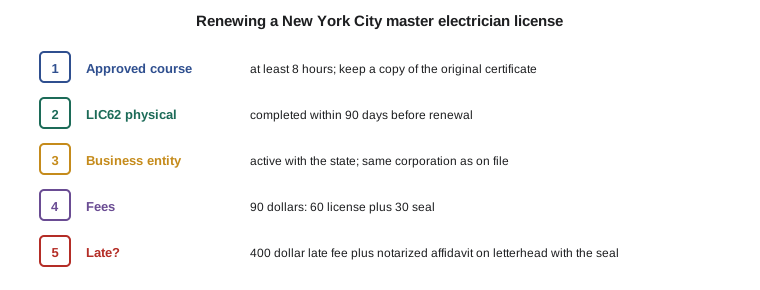
Renewal in the city is done online through the department's licensing system. The department's page lists a total renewal fee of 90 dollars, made up of a 60 dollar license fee and a 30 dollar seal fee, paid online. The license holder must also submit a LIC62 physical examination form completed by a physician within 90 days before the renewal, the same form used for the original background application. The license holder's renewal must reflect a current business setup: the department's renewal page notes that if the license holder renews through a business entity registered with New York State, the entity must be active in the state's corporation and business entity database, or the license will not be renewed, and that the corporation must be the same one the license holder had when last appearing before the Electrical Board.
The department's pages checked for this course do not state the length of the renewal period, so check the expiration date printed on your license and the department's current guidance for the renewal cycle and the window in which renewal can be filed. Teresa puts her expiration date on the company calendar with reminders six months, three months and one month ahead.
Continuing education
Since January 1, 2016, the department has required license holders renewing a master or special electrician license to complete a department-approved course of at least eight hours. The license holder submits a copy of the original certificate from the approved school with the renewal. The department maintains a list of approved course providers; a course that is not on the list does not count, however useful it may be. The course is designed to keep license holders current with code changes, rules and safety practices, and it is a natural place to learn about developments such as the 2025 New York City Electrical Code.
Teresa takes her course well before her renewal date so that the certificate is in hand early. She also keeps the original certificate with her license records, scanned and filed, because the department asks for a copy of the original and a lost certificate can delay the renewal.
Late renewal
Missing the deadline is expensive and embarrassing. The department's renewal page lists a 400 dollar late fee, paid through the online portal, and requires a notarized affidavit on the license holder's letterhead, bearing the department-issued seal, explaining why the renewal was late. Beyond the fee, a late renewal can disrupt the company's work: permits whose expiration follows the license date can lapse, and the company may be unable to file new work until the license is current. The calculator below compares an on-time renewal with a late one, using the department's listed fees.
license_fee = 60
seal_fee = 30
late_fee = 400

on_time = license_fee + seal_fee
late = on_time + late_fee
print(f"On-time renewal: {on_time} dollars plus the eight-hour course and the physical")
print(f"Late renewal: {late} dollars plus a notarized affidavit on letterhead bearing the seal")
print(f"Cost of being late, in fees alone: {late - on_time} dollars")On-time renewal: 90 dollars plus the eight-hour course and the physical Late renewal: 490 dollars plus a notarized affidavit on letterhead bearing the seal Cost of being late, in fees alone: 400 dollars
| Item | New York City requirement (as listed by DOB) |
|---|---|
| Renewal fee | 90 dollars: 60 license plus 30 seal |
| Continuing education | Department-approved course of at least eight hours; submit a copy of the original certificate |
| Physical exam | LIC62 completed by a physician within 90 days before renewal |
| Business entity | Active with the state; same corporation as when last before the Electrical Board |
| Late renewal | 400 dollar late fee and a notarized affidavit on letterhead bearing the seal |
Renewals in other jurisdictions
Each local licensing jurisdiction sets its own renewal rules. The Town of North Hempstead's code, for example, has master electricians file renewal applications in December of the year the license expires, with proof of recent work, and issues renewals for periods of up to three years starting January 1, with fees charged per year. If a license is not renewed by the first of March after it expires, the town's examining board may require a new application and a new examination. The town's code requires continuing education only if any is established through the town's reciprocity agreements. Rochester's Electrical Examining Board, upstate, reviews each renewal applicant's knowledge, technical ability and past record to decide whether to renew and what type of license to issue. Suffolk County's licensing office has its own renewal and continuing education rules.
Andre will be on his town's cycle, not the city's. If he also eventually works in the city, he will need to track two licenses, two renewal dates and two sets of requirements. Many contractors who work across jurisdictions keep a single licensing calendar with every license, its expiration, its fee and its education requirement.
Keeping the license in good standing between renewals
Renewal is a checkpoint, not the only time the license matters. Between renewals, the department expects the license holder to keep the business requirements current, to keep insurance certificates on file current, to respond to the department's notices and to resolve violations. A master who lets these slide will often find the problems surface at renewal, when the department checks the business entity, or earlier, when a permit expires because an insurance certificate lapsed. Teresa's quarterly review covers the license expiration date, the insurance policies and certificates on file, the corporation's status with the state, the approved place of business and telephone, open violations and open filings. It takes an hour and has never failed to find something worth fixing.
Personal changes matter too. If the license holder moves, changes name or changes companies, the department's records must be updated using its current procedures. A license holder who leaves one company for another must make sure the new company meets the business requirements before filing work under it, and the old company must make sure it still has a qualifying licensed master. Lesson 7 discussed how Teresa and Sal plan their own transition with these rules in mind.
Inactive status and retirement
Some licensing systems allow a license holder who is not working to place the license in an inactive status and reactivate it later, while others require continuous renewal or re-examination after a lapse. Before letting a license lapse for a planned break, check the jurisdiction's current rules for reactivation; in some places, a lapse longer than a set period means starting over with the exams. Sal, as he plans his retirement, has decided to keep his license current for a year after Teresa becomes the company's master, so that the company has a backup during the transition.
Reciprocity in New York
Reciprocity means one jurisdiction recognizing another's license or exam, so that a license holder can be licensed without repeating every step. Some states have reciprocity agreements with each other for electrician licenses. New York City does not issue its master license on the basis of another jurisdiction's license: a master from New Jersey, Connecticut or Massachusetts, or from a Long Island town, must meet the city's experience requirements, including two years in the city, and pass the city's written and practical exams. Kevin Walsh from Lesson 2, with nine years as a licensed electrician in Massachusetts, is in exactly that position.
Outside the city, some Long Island towns and villages have agreements among themselves to recognize each other's exams or licenses, or to share an examining process, and North Hempstead's code refers to reciprocity agreements in connection with continuing education. Whether a particular town will recognize another town's license depends on its local law and any agreements in place. Andre asks his town's board clerk which other towns, if any, recognize its license, and gets the answer in writing.
Working across jurisdictions
A contractor that works in several jurisdictions faces a few practical questions. Which license is needed for each job? Which code applies? Who issues permits and who inspects? What insurance certificates must be on file, and naming whom? And which renewal dates and course requirements apply? The answers differ from the city to each town and city, and getting them wrong can mean unlicensed work, failed inspections or uninsured jobs.
Teresa's answer for Halsey Street is to stay in the city, where her license, the department's systems and her inspectors are familiar. When a long-time customer asks her to wire a summer house in a Suffolk County town, she does not take the job under her city license. Instead, she refers it to a Suffolk-licensed contractor she trusts, and offers to consult. That is the right call: her city license gives her no right to perform electrical work in Suffolk.
Related licenses and registrations
Electrical work often overlaps with other licensed activities. Fire alarm systems, low-voltage and communications systems, elevators, signs and solar installations can involve additional licenses, registrations or certifications, depending on the jurisdiction and the scope. In the city, some of these are handled by the Department of Buildings, some by the Fire Department and some by other agencies, and the rules change as technologies change. A master who expands into a new kind of work should check whether it requires an additional license or registration before bidding it. Andre, for example, wants to offer residential solar and battery installations on Long Island and must check the town's permit requirements, the utility's interconnection rules and any certifications the incentive programs require.
These related credentials have their own renewal dates and education requirements, which belong on the same licensing calendar. Teresa's calendar lists her master license, the company's insurance policies, the corporation's state filings, her OSHA and site safety training, and the training records of each employee, so nothing expires unnoticed.
A renewal timeline you can reuse
Putting the pieces together, a practical renewal timeline in the city looks like this. Six months before expiration, check the department's current renewal requirements and the approved course list. Four to three months before, take the eight-hour course and file the certificate. Two months before, confirm the corporation is active with the state, the insurance certificates on file are current, and the place of business and telephone are unchanged. Within the last 90 days, get the LIC62 physical. Then file the renewal and pay the fee, well before the expiration date, and keep a copy of the confirmation. The same pattern adapts to any town or city: find the requirements early, finish the education early, and file early.
Common mistakes
MistakeTaking a course that is not on DOB's approved list.
InsteadOnly a department-approved course of at least eight hours satisfies the renewal requirement.
MistakeGetting the physical months before renewal.
InsteadThe LIC62 must be completed within 90 days before renewal.
MistakeLetting the company's corporation lapse with the state.
InsteadThe business entity must be active with the state for the license to renew.
MistakeAssuming another state's master license transfers to New York City.
InsteadThe city requires its own experience, including two years in the city, and its own exams.
MistakeWorking in a Long Island town under a city license.
InsteadEach jurisdiction requires its own license; check the local law.
Summary and key terms
- New York City renewal costs 90 dollars: a 60 dollar license fee and a 30 dollar seal fee.
- Renewals require a department-approved course of at least eight hours, required since January 1, 2016.
- The LIC62 physical must be completed within 90 days before renewal.
- The business entity must be active with the state and match the one on file.
- A late renewal costs a 400 dollar late fee plus a notarized affidavit on letterhead bearing the seal.
- The city does not license by reciprocity; towns and villages set their own renewal and reciprocity rules.
- Renewal
- Extending a license for another period by meeting the jurisdiction's requirements.
- Continuing education
- Required training, such as the city's eight-hour course, completed before renewal.
- Seal fee
- The part of the city's renewal fee charged for the department-issued seal.
- Late renewal affidavit
- A notarized statement on the license holder's letterhead, bearing the seal, explaining a late renewal.
- Reciprocity
- Recognition of another jurisdiction's license or exam.
- Licensing calendar
- A single schedule of every license, expiration date, fee and education requirement.
Practice problems
Work each problem on paper first, then reveal the answer to check.
What is the total New York City renewal fee and how is it split?
Show answer
90 dollars: 60 for the license and 30 for the seal.
How long must the approved renewal course be?
Show answer
At least eight hours.
What does a late renewal require besides the late fee?
Show answer
A notarized affidavit on the license holder's letterhead, bearing the department-issued seal, explaining the late renewal.
When does North Hempstead's code have masters file renewal applications?
Show answer
In December of the year the license expires.
Can Teresa wire a house in Suffolk County under her city license?
Show answer
No; she needs a license for that jurisdiction.
Lesson quiz · 5 questions
Score 60% or more to complete this lesson.
Create a free account to save your progress, take quizzes and earn a certificate.