
MELU-307 · Lesson 2 of 12 · 20 min
Eligibility for the Local Master Electrician Licenses
▶ Video coming soon A video version of this lesson is on the way.
Before Teresa spends a dollar on exam fees, she needs to know whether she qualifies. In New York City the answer turns almost entirely on experience: how many years, in what window, under whose supervision, and how much of it in the city. The other requirements, such as age and character, rarely stop anyone who is otherwise ready, but they can delay a license if the paperwork is careless. This lesson works through the New York City Master Electrician requirements as the Department of Buildings states them, applies them to Teresa and to two of her co-workers, and then compares how a Long Island town and an upstate city approach eligibility.
Remember the caution from Lesson 1: the figures here were checked against the Department of Buildings' page on obtaining a master and special electrician license in November 2026. The department can change its requirements by law or rule, so confirm the current version before you rely on it, and keep a copy of the page you relied on in your file.
The basic personal requirements
The department lists four personal qualifications for the master license. An applicant must be at least eighteen years old. An applicant must be able to read and write English, because the exams, the codes and the permit system are all in English. An applicant must be fit to perform the work the license authorizes, which is why the background application includes a physical examination form completed by a physician. And an applicant must be of good moral character, to the extent that character bears on fitness for the license. The department reviews character as part of the background investigation described in Lesson 3.
Good moral character does not mean a spotless past. The question is whether something in the applicant's history bears on the duties of a master electrician: honesty in filings, safe work, responsibility to customers and the public. A candidate with a history of license violations, fraud or false filings should expect careful questions and should gather documents that explain what happened and what has changed. Lying on the application is far more damaging than the underlying history, both in New York City and in every other licensing jurisdiction.
The standard experience route: seven in ten
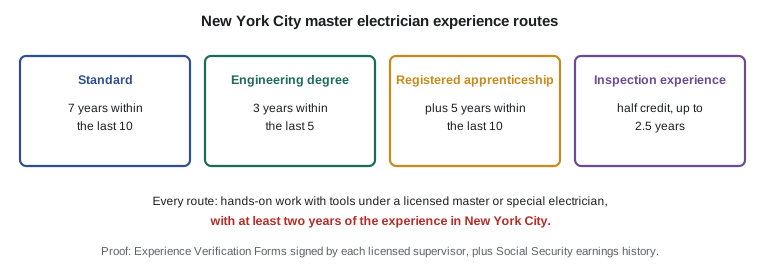
The standard route requires at least seven years of experience within the ten years immediately before the application. The experience must be hands-on, which the department describes as working with tools on the installation, alteration and repair of electrical wiring and appliances. It must be under the direct and continuing supervision of a licensed master electrician or special electrician, and the supervising license may be from anywhere in the United States, not only New York City. At least two of the years must be in New York City.
Each piece of that rule does work. The ten-year window means old experience expires: an electrician who worked seven years in the trade, left for a decade, and came back cannot count the old years. The hands-on requirement means estimating, sales, design or project management alone does not count, even inside an electrical company. The supervision requirement means self-employed work without a licensed master, or work for an unlicensed contractor, generally does not count. And the New York City requirement means that a master from another state, however experienced, must spend at least two years working in the city before applying.
The degree route: three in five
An applicant who holds a bachelor's degree in electrical engineering or an appropriate engineering technology from an accredited institution needs less field experience: at least three years within the five years before the application, with at least two of those years in New York City. The experience must still be hands-on and supervised. The degree route exists because an engineering education covers theory and design that the field years otherwise teach, but it does not replace the field years entirely; an engineer with no tool time does not qualify.
Halsey Street's newest hire, Priya Natarajan, has a degree in electrical engineering technology from a college in New Jersey. She joined the company two years ago after a short stint at a design firm. Her design work does not count, because it was not hands-on under a licensed master, but her field time at Halsey Street does. She will qualify under the degree route after one more year, assuming she keeps working under Sal's license in the city.
The apprenticeship route: five in ten
An applicant who completed an apprenticeship registered with the New York State Department of Labor in electrical wiring, installations and design, or in applied electricity, needs five years of experience within the ten years before the application, with at least two in the city. The registration matters: a privately run training program that was never registered with the state does not qualify for the shorter route, though the years worked may still count under the standard route.
This is Teresa's route. She completed a four-year registered apprenticeship and has worked in the city since, for a total of eleven years in the trade, about nine of them in the ten-year window and all but two of them in New York City. The apprenticeship route needs five years in the window, and she has more than enough. She also qualifies under the standard route, but documenting the apprenticeship gives her a margin if one of her early employers is hard to reach for a signature.
Inspection experience
Some candidates come from code enforcement rather than contracting. The department credits employment in electrical code inspection at half its length, up to a maximum of two and a half years of credit. The rest of the requirement must come from hands-on work, and at least two of those hands-on years must be in New York City. The department adds a detail that is easy to miss: the ten-year window does not apply to the remaining balance of hands-on work when inspection experience is used. An applicant should read the current rule closely before counting on it, because the interaction between inspection credit and the window is the kind of detail an examiner or reviewer will check.
The calculator below applies the inspection credit. It halves the inspection years, caps the credit, and adds the hands-on years. It is a planning aid, not an official determination; the department makes the final decision based on the documents you submit.
# Planning aid: experience credit under the inspection rule (illustrative)
def credited_years(hands_on, inspection, cap=2.5):
    inspection_credit = min(inspection / 2, cap)
    return hands_on + inspection_credit

candidates = {
    "Inspector who left the city agency": (4.5, 6.0),
    "Electrician with a short inspection job": (5.5, 2.0),
}
for name, (hands_on, inspection) in candidates.items():
    total = credited_years(hands_on, inspection)
print(f"{name}: {hands_on} hands-on + credit for {inspection} inspection = {total} years")Inspector who left the city agency: 4.5 hands-on + credit for 6.0 inspection = 7.0 years Electrician with a short inspection job: 5.5 hands-on + credit for 2.0 inspection = 6.5 years
Documenting the experience
Experience counts only if the department believes it, and the department believes documents. The key document is the Experience Verification Form. Each supervising licensed electrician for the years claimed must sign it, describing the applicant's work and the period. The department does not accept a form completed by the applicant or by a human resources office; it wants the licensed supervisor. The application also requires a Social Security earnings history for the claimed years, requested by company name, so the department can match the employers on the forms to the employers that actually paid the applicant. The Social Security Administration charges a fee for that history, and it can take weeks to arrive.
Teresa's early years present a practical problem. Her first employer, a small shop in Jersey City, closed six years ago, and the master who supervised her retired to Florida. She tracks him down through a former co-worker, mails him the form with a cover letter and a stamped return envelope, and calls him the week it arrives. If she could not reach him, she would fall back on the years she can document, which is one reason the apprenticeship route is valuable to her: it needs fewer years.
| Document | Who prepares it | Common problems |
|---|---|---|
| Experience Verification Form | Each licensed supervisor for the years claimed | Signed by HR or the applicant; supervisor's license number missing |
| Social Security earnings history | Social Security Administration, at the applicant's request | Requested too late; employer names don't match the forms |
| Apprenticeship completion record | Registered program sponsor or state Department of Labor | Program was never registered with the state |
| Degree transcript | The accredited college | Degree not in electrical engineering or an appropriate technology |
Two of Teresa's co-workers
Marco Delgado has worked for Halsey Street for eight years and spent four years before that with a non-union shop in the Bronx. He never did a registered apprenticeship and has no degree. He has twelve years in the trade, but only the last ten count in the window, and all of them were under licensed masters in the city. He qualifies under the standard route with three years to spare. His challenge is the Bronx shop, whose owner is still licensed and still in business; he simply needs to ask.
Kevin Walsh moved to New York from Boston two years ago after nine years as a licensed electrician in Massachusetts. His Massachusetts years were under a licensed master, so they count toward the hands-on requirement, and he now has two years in New York City. He has eleven years in the trade, nine of them in the window, two of them in the city, so he qualifies under the standard route today. What he does not have is a shortcut: the city does not issue a master license by reciprocity, so he must pass both exams like everyone else. Lesson 11 returns to reciprocity.
Eligibility outside New York City
Outside the city, each licensing jurisdiction writes its own rules, and they vary in ways that matter. Many Long Island towns and villages require several years of experience under a licensed electrician, proof of insurance before work begins, and a passing grade on the town examining board's exam. The Town of North Hempstead, for example, requires master electricians to file a certificate of public liability insurance with specified minimum limits naming the town before starting work, and sets its renewal cycle in its town code. Suffolk County licenses electricians through its county Department of Labor, Licensing and Consumer Affairs, with county-set experience and examination requirements. Upstate, a city examining board such as Rochester's examines each applicant's knowledge and technical ability and reviews fitness at renewal.
Andre's town publishes its requirements in its town code, which he reads on the town's code website. It asks for a specified number of years under a licensed electrician, references, proof of insurance and an exam set by the town's board. The details differ from the city's, and he cannot assume that because he would qualify in the city he qualifies in his town, or the reverse. The general lesson is simple: find the local law, read the eligibility section in full, and ask the board's clerk when something is unclear.
Building a qualifying record from today
Candidates who are a few years short can use the time well. The most useful habit is to keep your own experience log as you go: for each job, the employer, the supervising master's name and license number, the dates, the type of work and the borough or town. Keep pay stubs or W-2 forms for each employer, because they make the Social Security record easier to reconcile. When you change employers, ask your departing supervisor to sign a verification form while the details are fresh, even though you will not file it for years; you can attach the signed form to your application later or use it to help the supervisor complete the current version of the form. Licensed masters retire, move and lose touch, and a signature collected today is far easier than one chased across the country in five years.
The other habit is to stay inside the rules that make experience count. Work under a licensed master or special electrician, keep at least two years of your history in the city if you want the city license, and avoid side jobs that are not under a licensed master's supervision, which do not count and can create a character problem if they involved unpermitted work. If you are considering a registered apprenticeship or an engineering technology degree, weigh how each shortens the requirement against the time and cost; for many electricians early in their careers, a registered apprenticeship is both the fastest path to skill and the fastest path to eligibility.
Common mistakes
MistakeCounting design, estimating or project management years as hands-on experience.
InsteadThe department counts hands-on work with tools on installation, alteration and repair under a licensed master or special electrician.
MistakeIgnoring the ten-year window.
InsteadExperience must fall within the ten years before the application on the standard and apprenticeship routes.
MistakeHaving human resources sign the Experience Verification Form.
InsteadThe licensed supervisor must sign; forms completed by HR or the applicant are not accepted.
MistakeAssuming any training program qualifies for the apprenticeship route.
InsteadThe apprenticeship must be registered with the New York State Department of Labor.
MistakeForgetting the two years in New York City.
InsteadEvery route requires at least two years of experience in the city.
Summary and key terms
- New York City masters must be at least 18, read and write English, be fit for the work and be of good moral character.
- The standard route requires seven years of supervised, hands-on experience within ten years, at least two in the city.
- An accredited electrical engineering or technology degree reduces the requirement to three years within five, at least two in the city.
- A state-registered apprenticeship plus five years within ten also qualifies, with at least two years in the city.
- Inspection experience counts at half its length, up to two and a half years of credit.
- Experience is proved with supervisor-signed verification forms and Social Security earnings records.
- Ten-year window
- The period before the application within which qualifying experience must fall on the standard and apprenticeship routes.
- Hands-on experience
- Work with tools installing, altering and repairing electrical wiring and appliances.
- Direct and continuing supervision
- Supervision by a licensed master or special electrician throughout the period claimed.
- Registered apprenticeship
- An apprenticeship program registered with the New York State Department of Labor.
- Experience Verification Form
- The form each licensed supervisor signs to confirm the applicant's experience.
- Earnings history
- A Social Security record of wages by employer, used to confirm claimed employment.
Practice problems
Work each problem on paper first, then reveal the answer to check.
How many years within ten does the standard New York City route require?
Show answer
Seven years, with at least two in New York City.
Priya has an accredited electrical engineering technology degree. How many years of field experience does she need?
Show answer
Three years within the five years before applying, with at least two in the city.
An inspector has six years of inspection experience. How much credit can it give?
Show answer
Half of six is three, but the credit is capped at two and a half years.
Who must sign the Experience Verification Form?
Show answer
The licensed supervisors for the years claimed, not the applicant or a human resources office.
Can Kevin's Massachusetts years count?
Show answer
Yes, if they were hands-on under a licensed master, but he still needs two years in the city and must pass the exams.
Lesson quiz · 5 questions
Score 60% or more to complete this lesson.
Create a free account to save your progress, take quizzes and earn a certificate.