
MELU-307 · Lesson 12 of 12 · 24 min
Practice exam review and test-day strategy
▶ Video coming soon A video version of this lesson is on the way.
Teresa's written exam is booked for a Tuesday in February. This final lesson brings together the New York material from the course into a review, a practice set, and a test-day plan for both the closed-book written exam and the practical. It also reminds candidates for Long Island and upstate licenses how to adapt the plan to their own exams. Use it in the last weeks before your exam, alongside the timed practice sets from the core courses.
A reminder about the facts: the licensing details reviewed here come from the Department of Buildings, its exam administrator, the Workers' Compensation Board and local codes as checked in November 2026. Before exam day, read your current exam notice and the administrator's candidate materials, which control.
What the written exam rewards
The city's written exam rewards three kinds of preparation. First, recall of the code facts and methods that come up again and again: branch circuit and feeder rules, overcurrent protection, grounding and bonding, required outlets, wiring methods, conduit fill and special occupancies, as the city code states them. Second, understanding of the code's structure and purposes, so that an unfamiliar question can be reasoned out. Third, the discipline to work steadily through 80 questions in three hours without references, leaving no question blank.
Because the exam is closed book, many candidates find that the hardest questions are not the ones with the most arithmetic but the ones that test a specific value or rule they half remember. The answer is not to memorize the entire code, which is impossible, but to know the high-frequency material cold and to recognize which answer choices are inconsistent with the code's logic. A choice that would allow a smaller conductor than the overcurrent device protects, for example, is almost never right.
A pacing plan for the written exam
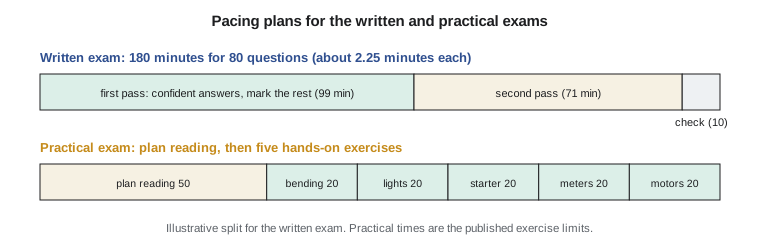
Three hours for 80 questions gives two and a quarter minutes per question on average. Teresa uses a two-pass method. On the first pass, she answers every question she can answer with confidence in about a minute, marks any question that needs more time or that she is unsure of, and moves on. On the second pass, she works the marked questions, starting with those she thinks she can solve. In the last ten minutes she makes sure every question has an answer, because a blank is always wrong and a reasoned guess sometimes is not. The program below turns that plan into checkpoints.
total_minutes = 180
questions = 80
first_pass_share = 0.55   # share of time planned for the first pass (illustrative)
reserve = 10              # final minutes kept for checking every answer is filled in

first_pass = round(total_minutes * first_pass_share)
second_pass = total_minutes - first_pass - reserve
print(f"Average per question: {total_minutes / questions:.2f} minutes")
print(f"First pass: {first_pass} minutes; second pass: {second_pass} minutes; final check: {reserve} minutes")
for done in (20, 40, 60, 80):
print(f"Checkpoint: question {done} by about minute {round(first_pass * done / questions)} of the first pass")Average per question: 2.25 minutes First pass: 99 minutes; second pass: 71 minutes; final check: 10 minutes Checkpoint: question 20 by about minute 25 of the first pass Checkpoint: question 40 by about minute 50 of the first pass Checkpoint: question 60 by about minute 74 of the first pass Checkpoint: question 80 by about minute 99 of the first pass
A plan for the practical
The practical exam's Part 1 is a 50-minute plan-reading exercise with a minimum of 71 in 100, and Part 2 is five 20-minute hands-on exercises, covering bending, lights, a starter, meters and motors, each with a minimum of 70 and an average of at least 70. Each exercise is short and scored on its own, so a strong performance on one cannot rescue a weak one. The plan, then, is consistency: a routine for each exercise that is fast, safe and accurate.
For plan reading, Teresa reads every question first, then scans the drawing set's legend, general notes and schedules before answering, because the notes and schedules answer many questions. For the hands-on exercises, she starts each one by reading the task sheet twice, laying out her tools and materials, and checking the starting conditions, such as whether a circuit is de-energized. She works methodically, checks her work against the task before calling it done, and keeps an eye on the clock. If something goes wrong, she stops, thinks, and fixes it rather than rushing. Safe practices count; an unsafe act can cost points or the exercise.
Review of the New York facts
The licensing facts in this course are likely to appear in law and rules questions on local exams and are worth knowing in any case. The table gathers the most important ones for the city.
| Topic | Key fact |
|---|---|
| State license | None; licensing is local |
| City licensing agency | Department of Buildings, under Administrative Code Title 27 |
| Standard experience route | Seven years within ten, at least two in the city |
| Degree route | Three years within five, at least two in the city |
| Apprenticeship route | State-registered apprenticeship plus five years within ten, at least two in the city |
| Inspection experience | Half credit, up to two and a half years |
| Written exam | 80 questions, three hours, closed book, 56 correct to pass, 585 dollar fee |
| Practical exam | Part 1 plan reading 50 minutes, minimum 71; Part 2 five 20-minute exercises, minimum 70 each and average 70; 530 dollar fee |
| Windows | Practical within 24 months of written notice; background application within one year of practical notice |
| City code | 2025 NYC Electrical Code, 2020 NEC base, in full effect December 21, 2025 |
| Permits | DOB NOW; valid up to 12 months; expire early with license or insurance |
| Renewal | Eight-hour approved course; 90 dollars (60 plus 30 seal); LIC62 within 90 days; 400 dollar late fee |
Practice set
Work these questions without looking back at the lessons, then check your answers against the explanations. They review the New York material; use the core courses' practice sets for code calculations.
Worked problem
Practice set, part 1: eligibility and process
Answer each question.
Show solution
- 1. Marco has twelve years in the trade, the last ten under licensed masters in the city. Does he meet the standard route? Yes: seven years within ten, with at least two in the city.
- 2. A candidate passed the written exam with a notice dated April 3, 2027. By when must the practical be passed? Within 24 months, so by about April 3, 2029.
- 3. A candidate's physical was completed 120 days before filing the background application. Is it acceptable? No; it must be within 90 days before submission.
- 4. An applicant with six years of inspection experience and four years of hands-on work, two of them in the city: how many years are credited? Four plus the capped two and a half, so six and a half, which is short of seven on the standard route.
Answer: Answers are shown in each item; review any you missed in Lessons 2 and 3.
Worked problem
Practice set, part 2: code, permits and business
Answer each question.
Show solution
- 5. A job includes a new energy storage system. Is electrical plan review required? Yes; energy storage is one of the listed triggers.
- 6. A permit was issued July 1; the insurance certificate on file expires October 31; the license expires the next March. When does the permit expire if nothing is updated? October 31.
- 7. Which three insurance types does DOB require for electrical businesses? General liability, workers' compensation and disability.
- 8. A new employee starts June 1. By when must disability and paid family leave coverage be in place? The thirtieth day of employment is June 30; four weeks later is July 28.
Answer: Answers are shown in each item; review any you missed in Lessons 5, 6 and 8.
Worked problem
Practice set, part 3: liens, safety and renewal
Answer each question.
Show solution
- 9. The last substantial work on a single-family house was March 15. What is the general lien deadline? Four months later, about July 15.
- 10. Within how many hours must an employee's in-patient hospitalization be reported to OSHA? Twenty-four hours.
- 11. What does an on-time New York City renewal cost in fees? 90 dollars: 60 for the license and 30 for the seal.
- 12. A renewal is filed late. What else is required besides the 400 dollar late fee? A notarized affidavit on the license holder's letterhead bearing the department-issued seal.
Answer: Answers are shown in each item; review any you missed in Lessons 9, 10 and 11.
The last week
In the last week before the written exam, Teresa stops learning new material. She reviews her flash cards, especially the ones she has missed most often, takes one final full-length timed practice set early in the week, and spends the rest of the week on light review. She confirms her test center, her admission information and her identification, plans her route with a margin for transit delays, and gets enough sleep. On the morning of the exam, she eats a normal breakfast and arrives early.
In the exam room, she reads each question completely, including every answer choice, before choosing. She watches for words like not, except and always, which reverse or narrow a question. She marks questions she is unsure of rather than agonizing, and she trusts her preparation on the second pass. When the exam ends, she leaves knowing her result, because the city gives written exam results at the test site.
For Long Island and upstate candidates
Andre's town exam follows a different format, but the same strategy adapts. He reads his exam letter for the format, time limit and allowed references. If references are allowed, he practices with exactly the books he will bring, and if they are not, he uses Teresa's recall methods. He reviews the town's own code and rules, because local exams often ask about local requirements, such as insurance certificates naming the town and permit procedures. And he confirms the board's meeting schedule and the date results will be issued.
Whatever the jurisdiction, the habits that pass exams are the same: study from the code and rules the exam is built on, practice under real time limits, review mistakes systematically, and arrive rested and early.
If you do not pass
Some strong candidates fail a part on the first attempt, and the city's process allows for it. If the written exam result is a near miss, consider whether the administrator's appeal process applies and whether you have specific grounds. Otherwise, use the score report to see which content areas were weakest, rebuild the study plan around them, and apply to retake. For the practical, note which exercise fell short, practice it under the timer until it is reliable, and retake within the 24-month window. A failure costs time and fees, but it also shows exactly what to work on next.
After the exams
Passing the written and practical exams is a milestone, not the finish line. In the city, the background application, the business setup and the license pickup follow, each with its own deadline, as Lesson 3 described. Teresa has her documents organized and her calendar marked, so she files within weeks of her practical notice. Within a few months, Halsey Street Electric has a second licensed master, Sal has a retirement date, and Teresa has a plan for her first renewal.
Common mistakes
MistakeSpending too long on one hard question early in the exam.
InsteadUse two passes: answer confident questions first, mark the rest, and return to them.
MistakeBringing a code book to the city's written exam.
InsteadThe written exam is closed book; leave references at home.
MistakeTreating the practical as one combined score.
InsteadPart 1 and each Part 2 exercise have their own minimums.
MistakeLearning new material the night before.
InsteadUse the last week for review, one timed set and rest.
MistakeAssuming a town exam follows the city's format.
InsteadRead your exam letter; formats and reference rules vary.
Summary and key terms
- The city's written exam rewards recall, understanding of the code's structure and steady pacing through 80 questions in three hours.
- Use a two-pass method and keep a final reserve to make sure every answer is filled in.
- The practical rewards consistent, safe routines for plan reading and five short hands-on exercises.
- Review the New York licensing facts: routes, exams, windows, the city code, permits, insurance, liens, safety and renewal.
- Spend the last week reviewing, not learning new material.
- Adapt the plan to local exams by reading the exam letter and studying local rules.
- Two-pass method
- Answering confident questions first and returning to marked questions on a second pass.
- Reserve time
- Minutes kept at the end of an exam to check that every question has an answer.
- Distractor
- A wrong answer choice designed to look plausible.
- Elimination
- Ruling out choices that contradict the code or each other before choosing.
- Task sheet
- The instructions for a practical exam exercise.
- Exam letter
- The official notice of a candidate's exam date, location and rules.
Practice problems
Work each problem on paper first, then reveal the answer to check.
How many minutes per question does the written exam allow on average?
Show answer
Two and a quarter minutes: 180 minutes for 80 questions.
What should Teresa do with a question she is unsure of on the first pass?
Show answer
Mark it, choose a provisional answer if she can, and return on the second pass.
Why read the general notes and schedules early in the plan-reading exercise?
Show answer
Because they answer many questions about what the drawings require.
What should the last week before the exam look like?
Show answer
Review of flash cards, one timed practice set early in the week, light review, logistics, and rest.
What should Andre check first about his town exam?
Show answer
The format, time limit and allowed references in his exam letter.
Lesson quiz · 5 questions
Score 60% or more to complete this lesson.
Create a free account to save your progress, take quizzes and earn a certificate.