
MELU-307 · Lesson 4 of 12 · 19 min
The exam format and the references allowed
▶ Video coming soon A video version of this lesson is on the way.
Ask a master electrician from Texas, Florida or Colorado about the master exam and you will hear about tabbing a code book, because those exams are open book. Ask a New York City master and you will hear something different: the written exam is closed book. No code book, no reference sheets, no notes. Teresa's first reaction was alarm. Her second, after talking with two masters Sal knows, was to change how she studies. This lesson describes the New York City written and practical exams as the exam administrator and the Department of Buildings describe them, explains what closed book means for preparation, and compares the open-book exams used in many other places.
The details here come from the exam administrator's overview of the New York City Master Electrician exam and the department's license page, checked in November 2026. Exam outlines are revised from time to time, and the administrator's current candidate materials control.
The written exam
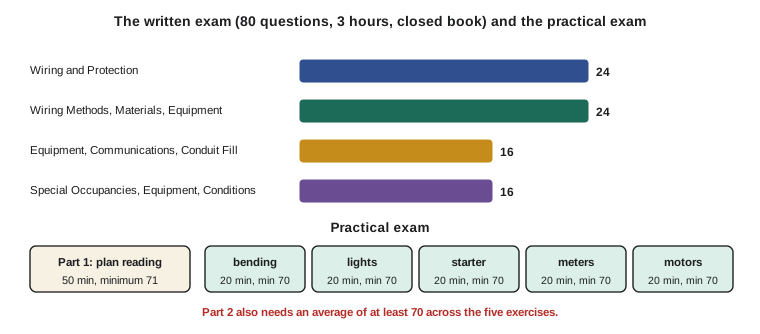
The written exam has 80 multiple-choice questions and a time limit of three hours. It is closed book: reference materials are not allowed at the test site. The passing score is 56 correct answers out of 80, which is seven in ten. Results are given at the test site. The questions cover the city's electrical code, rules and regulations; the department's page describes the exam as covering New York City electrical codes, rules and regulations, and the administrator's outline breaks the questions into four content areas.
Three hours for 80 questions is two and a quarter minutes per question, which sounds generous until you remember that nothing can be looked up. Every question is answered from memory and reasoning. A calculation question, such as sizing a feeder or checking conduit fill, depends on remembering the method and the key values, or on recognizing which answer choice is consistent with them.
| Content area | Questions | Typical topics |
|---|---|---|
| Wiring and Protection | 24 | Branch circuits and calculations, feeders, grounding and bonding, outside circuits, overcurrent protection, required outlets, services, surge arresters |
| Wiring Methods, Materials, and Equipment for General Use | 24 | General-use equipment, special systems, wiring methods |
| Equipment for General Use, Communications and Conduit Fill | 16 | Conduit fill, general-use equipment, installation requirements, special systems |
| Special Occupancies, Equipment, and Conditions | 16 | Special systems, special equipment, special conditions |
What closed book changes
On an open-book exam, the skill being tested is partly finding things fast: knowing which article covers a topic, where the table is, and how the exceptions read. On a closed-book exam, the skill is knowing things. That shifts preparation in three ways. First, the important numbers have to live in your head: common branch-circuit ratings and the conductors that go with them, the general rules for continuous loads, the structure of the service and feeder calculations, grounding electrode conductor sizing logic, the working space principles and the conduit fill rules. Second, the structure of the code has to be understood, not just indexed, so you can reason from the purpose of a rule to its likely answer. Third, the city's amendments matter, because a question built on the city code may have a different answer than the same question under the national code.
Teresa builds a study plan around this. She keeps her copy of the city code open while she studies, of course; the exam is closed book, not the preparation. She writes her own one-page summaries in her own words for each content area, quizzes herself with flash cards, and works practice problems without looking anything up, checking her answers against the code only afterward. Every week she reviews the cards she missed. This course's core lessons on calculations and grounding are written to support exactly that kind of practice.
The practical exam
The practical exam has two parts. Part 1 is plan reading, a single exercise with a 50-minute limit, and the candidate must score at least 71 in 100 on it. Part 2 consists of five hands-on exercises of 20 minutes each, covering wire or conduit bending, lights, a motor starter, meters and motors. Each Part 2 exercise has a minimum score of 70 in 100, and the average across the five must also be at least 70. To pass the practical, the candidate must meet the Part 1 minimum and the Part 2 requirements.
The practical rewards people who do the work. Plan reading tests whether a candidate can read an electrical drawing set the way a master does: identify symbols, follow circuits, find conflicts and answer questions about what the drawings require. The hands-on exercises test whether the candidate can bend conduit to a required shape within tolerance, wire lighting and control circuits correctly, connect and troubleshoot a motor starter circuit, use meters safely and correctly, and work with motor connections. Twenty minutes is not much time for each, so the habits that matter are speed with accuracy and a calm, safe routine.
Teresa practices the hands-on skills in Halsey Street's shop on Saturday mornings. Sal sets her a timer: twenty minutes to bend a back-to-back ninety and an offset to marks on the bench, twenty minutes to wire a three-way and four-way lighting circuit on a practice board, twenty minutes to wire a start-stop station with a magnetic starter and an overload. She keeps a log of her times and mistakes, and by the third month she finishes each task with several minutes to spare.
# Practical exam check using the published minimums (illustrative scores)
part1 = 74
part2 = {"bending": 72, "lights": 85, "starter": 70, "meters": 78, "motors": 69}

part1_ok = part1 >= 71
each_ok = all(score >= 70 for score in part2.values())
average = sum(part2.values()) / len(part2)
avg_ok = average >= 70
print(f"Part 1: {part1} -> {'pass' if part1_ok else 'fail'}")
print(f"Part 2 average: {average:.1f}; every exercise at least 70: {each_ok}")
print("Practical result:", "pass" if part1_ok and each_ok and avg_ok else "fail")Part 1: 74 -> pass Part 2 average: 74.8; every exercise at least 70: False Practical result: fail
In the example, the motors exercise scored 69, one point under the minimum, so the practical is failed even though the average is well above 70. That is how the published rule reads: each exercise has its own minimum. Check the administrator's current materials for how a retake works and whether a partial retake is allowed.
Appeals
The administrator describes an appeal process. A candidate who failed the written exam by no more than five points, or who failed only one section of the practical exam, may appeal. The appeal must be received within 30 days of the failure notification and must include the exam title, the candidate's name and return address, the test date and a detailed statement of the grounds. The administrator provides an appeal form and asks that it be emailed from the same address the candidate gave the department on the license application. An appeal is not a second attempt; it asks the administrator to reconsider whether a question or a scoring decision was wrong, so it needs specific, reasoned grounds.
Preparing for plan reading
Plan reading is the part of the practical that candidates most often underestimate, because it looks like something they do every day. On the job, though, a foreman has days to study a drawing set and can call the engineer with a question. On the exam, the candidate has 50 minutes and nobody to call. Good preparation starts with the basics: the standard electrical symbols and abbreviations, how panel schedules relate to the floor plans, how riser diagrams show services, feeders and distribution, how lighting and power plans show circuits and home runs, and how specifications and general notes change what the drawings mean. A candidate should be able to trace a circuit from a device back to its panel, read its rating and conductor size, and say whether the drawing is consistent with itself.
Teresa practices with old drawing sets from Halsey Street's finished jobs. Sal pulls a set, sets a 50-minute timer and writes ten questions: which panel feeds the walk-in cooler, what size feeder serves the second floor, how many circuits are shown for the kitchen, where the emergency lighting gets its supply, and what the general notes require for receptacles in wet locations. She answers on paper, then checks her answers against the drawings with Sal. After a dozen sets she is fast, and more importantly, she has stopped making careless errors in reading the schedules.
A recall study plan
A closed-book exam rewards spaced review: seeing the same material several times over weeks, with gaps in between, rather than reading it once intensely. Teresa divides the written exam's content areas into weekly blocks, writes flash cards for the facts and methods in each block, and reviews old cards every week while adding new ones. She also does a full timed practice set every third week. The table shows her first twelve weeks; the pattern matters more than the exact schedule.
| Weeks | New material | Review and practice |
|---|---|---|
| 1-3 | Wiring and protection: branch circuits, feeders, services, overcurrent protection | Daily cards; one timed set in week 3 |
| 4-6 | Grounding and bonding; required outlets; surge protection | Cards from weeks 1-3 plus new; timed set in week 6 |
| 7-9 | Wiring methods, materials and general-use equipment | Cumulative cards; timed set in week 9 |
| 10-12 | Conduit fill, special occupancies, special equipment and conditions | Cumulative cards; full 80-question timed set in week 12 |
The plan uses the written exam's own outline to decide where to spend time. Wiring and protection, and wiring methods, carry 24 questions each, so together they are 48 of the 80 questions, which is six in ten. The other two areas carry 16 each. A candidate who is strong in special occupancies but weak in feeders and services should spend most of the remaining time on the larger areas.
Open-book exams elsewhere
Many jurisdictions outside the city, and most states, use open-book exams given by national testing vendors, with the candidate's own copy of the adopted NEC allowed and rules about tabs, highlighting and calculators. A Long Island town or an upstate city board may write its own exam, use a vendor's exam or use a combination, and its rules on references may differ from both the city's and the states'. Andre's town board, for example, tells him in his exam letter which references he may bring. The only safe assumption is the one in your own exam letter or candidate bulletin.
If you face an open-book exam, the core course MELU-101 on navigating the code applies directly. If you face the city's closed-book written exam, the same code knowledge applies, but the navigation skills become understanding and recall skills. Either way, the practice of working problems under time pressure is the same.
Exam day rules
Every testing organization has rules for exam day: identification requirements, arrival times, what may be brought into the room, rules on phones and watches, and conduct rules. The administrator's candidate materials list them. A candidate who arrives without acceptable identification, or with a forbidden item, can be turned away and lose the fee. Teresa reads the instructions twice, lays out her identification and admission information the night before, and leaves early enough to absorb a subway delay.
Practice under real conditions
The last month before each exam is for rehearsal. For the written exam, that means full three-hour sessions at the same time of day as the exam, with the phone in another room and no breaks beyond what the exam allows. For the practical, it means running all five hands-on exercises back to back, with a short pause between each, so that fatigue in the fourth and fifth exercises is not a surprise. Teresa also rehearses the logistics: the subway route to the test center, how long the walk from the station takes, and what she will eat beforehand. These sound trivial, but candidates lose points to rushing, hunger and nerves every testing day, and rehearsal removes most of that risk.
After each rehearsal she writes down three things: what took longer than it should have, which mistakes she made, and what she will change next time. The list gets shorter each week. By the week of the written exam, her timed sets are finishing with twenty minutes to spare and her error list is down to two or three topics, which she reviews on the train.
Common mistakes
MistakeStudying for the city's written exam by tabbing a code book.
InsteadThe city's written exam is closed book; build recall and understanding instead.
MistakeAssuming a high practical average makes up for one weak exercise.
InsteadEach Part 2 exercise has its own minimum of 70, as well as the average requirement.
MistakeTreating an appeal as a free retake.
InsteadAn appeal must state specific grounds and is limited to near misses, filed within 30 days.
MistakeAssuming every New York jurisdiction uses the city's format.
InsteadLocal boards and vendors set their own formats and reference rules.
MistakeStudying only the national code for the city exam.
InsteadThe city exam covers the city's electrical code, rules and regulations, including city amendments.
Summary and key terms
- The city's written exam has 80 multiple-choice questions, three hours, and a passing score of 56 correct.
- It is closed book, with four content areas of 24, 24, 16 and 16 questions.
- The practical exam's Part 1 is a 50-minute plan-reading exercise with a minimum of 71 in 100.
- Part 2 is five 20-minute exercises: bending, lights, starter, meters and motors, each at least 70 with an average of at least 70.
- Appeals are allowed for near misses if received within 30 days of the failure notice.
- Outside the city, exam formats and reference rules vary; your exam letter controls.
- Closed book
- An exam in which no reference materials may be used.
- Plan reading
- Interpreting electrical drawings and specifications to answer questions about what they require.
- Practical exam
- The city's hands-on and plan-reading exam, taken after passing the written exam.
- Content area
- A group of related topics with a set number of exam questions.
- Appeal
- A request to the exam administrator to reconsider a question or score, with specific grounds.
- Candidate bulletin
- The testing organization's official document describing exam rules and content.
Practice problems
Work each problem on paper first, then reveal the answer to check.
How many correct answers are needed to pass the 80-question written exam?
Show answer
56, which is seven in ten.
How long is the written exam, and how much time is that per question?
Show answer
Three hours, or two and a quarter minutes per question.
A candidate scores 75 on Part 1 and 82, 80, 66, 90 and 88 on Part 2. Pass or fail?
Show answer
Fail: the third exercise is below the minimum of 70, even though the average is above 70.
Who may appeal a written exam result?
Show answer
A candidate who failed by no more than five points, within 30 days of the failure notice.
What should Andre rely on to learn what he may bring to his town exam?
Show answer
His exam letter or the board's candidate instructions.
Lesson quiz · 5 questions
Score 60% or more to complete this lesson.
Create a free account to save your progress, take quizzes and earn a certificate.