
MELU-307 · Lesson 5 of 12 · 19 min
Local code adoption and amendments in New York
▶ Video coming soon A video version of this lesson is on the way.
Every master electrician exam asks, in one way or another, which code applies. In most states the answer is one edition of the NEC adopted statewide, perhaps with a few amendments. In New York the answer depends on where the work is. Inside New York City, the governing code is the city's own electrical code, written by the city and built on a particular NEC edition with extensive city amendments. Outside the city, the state's Uniform Code references the NEC, and local governments may add their own ordinances. This lesson explains both systems, the recent change to the city code, and how Teresa decides which code governs a given job.
As in every lesson, the code itself is not reproduced here. The lesson cites the code by name and section and describes requirements in plain words. Keep your own copies of the codes that apply to your work.
The 2025 New York City Electrical Code
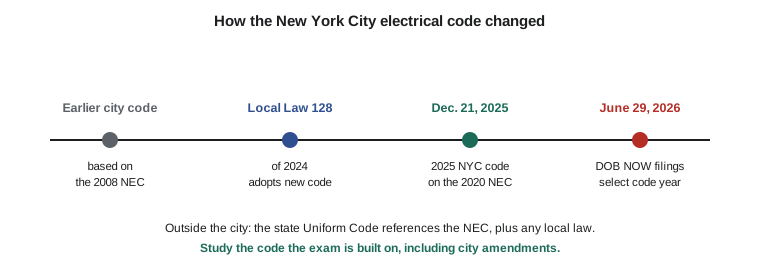
New York City adopted a new electrical code through Local Law 128 of 2024. The resulting 2025 New York City Electrical Code took full effect on December 21, 2025, according to the Department of Buildings. It is built on the 2020 edition of NFPA 70, the National Electrical Code, with New York City amendments. The previous city code had been built on the 2008 NEC, so the new code brought twelve years of national changes into the city at once, along with changes to the city's administrative provisions.
Trade coverage of the new code highlighted several practical changes. Electrical construction documents for many projects now go through plan review before permits are issued, bringing electrical work closer to how mechanical, plumbing and fire protection work were already handled. National changes from the 2020 NEC arrived too, such as expanded ground-fault circuit-interrupter protection and receptacle requirements for meeting rooms. The city kept special local review for some large installations; reporting on the change noted that the city's Electrical Plans Review Board still reviews certain large overcurrent device changes in large installations. Confirm the details of any requirement in the code and the department's current guidance, because trade articles summarize and can lag behind later rules and bulletins.
Why the city lags the national edition
Candidates from other states sometimes ask why the city's 2025 code is built on the 2020 NEC rather than the 2023 or 2026 edition. The answer is that writing a city code takes years. The city reviews each national edition, decides which changes fit its buildings, its utilities and its enforcement system, drafts amendments, takes them through public review and the City Council, and then gives industry time to prepare before the code takes effect. By the time a city code built on one edition takes effect, the national organization has often published one or two newer editions. The city may adopt a newer base edition in a future cycle; watch the department's code page and its industry notices.
For exam purposes, the lesson is to study the edition the exam is built on. The city's written exam tests the city's electrical code, rules and regulations. A candidate who learned the 2023 NEC in a class outside the city, or who studied a 2026 NEC book, must check where the 2020-based city code differs, including where the city's amendments change a national rule.
Code review year for filings
The department's DOB NOW: Build electrical filing guidance adds an administrative wrinkle. Filings created on or after June 29, 2026 require the applicant to select a code review year. According to the department's frequently asked questions, standalone electrical filings use the 2020 NEC as amended by the 2025 New York City Electrical Code. A licensed electrician filing work therefore has to understand which code year a filing is reviewed under and make sure the design and the installation match it.
The department's guidance also says that electrical plan review is required when the scope includes service equipment, transformers, uninterruptible power supplies, generators or other power sources, or energy storage systems, and that this electrical plan review is submitted outside DOB NOW. For Teresa, the bakery fit-out on Ditmars Boulevard is a good example: it includes a new service, so it needs electrical plan review before the permit can proceed, while the brownstone kitchen renovations in Brooklyn usually do not.
| Job | New service, transformer, UPS, generator or storage? | Electrical plan review expected? |
|---|---|---|
| Ditmars Boulevard bakery fit-out with a new 400 A service | Yes, new service equipment | Yes |
| Brooklyn brownstone kitchen renovation on existing service | No | Usually not, but confirm the scope |
| Jackson Heights co-op riser upgrade with new service equipment | Yes | Yes |
| Office with a new battery energy storage system | Yes, energy storage | Yes |
Outside New York City: the Uniform Code
Outside the city, the New York State Uniform Fire Prevention and Building Code, which the Department of State administers, governs construction. Local governments enforce it through their code enforcement officials, and the Uniform Code incorporates the National Electrical Code for electrical installations through the building and residential codes it adopts. The state updates the Uniform Code in cycles, and the 2025 update moved to newer model codes, including the 2023 NEC as the electrical reference; confirm the effective date, the transition rules and any state modifications with the Department of State before relying on them.
Local governments outside the city can also adopt their own electrical laws. Many Long Island towns and villages, and many upstate cities, have local laws that require electrician licenses, permits and inspections and that may add administrative requirements. Some local laws designate approved electrical inspection agencies. A local law cannot generally lower the state's minimum construction requirements, but it can add administrative and licensing requirements that sit alongside them. When Andre bids a job in a village on the North Shore, he checks both the state code edition in effect and the village's local law.
Which code applies to a job
Most code-applicability questions come down to three facts: where the job is, when the work was filed or permitted, and what kind of work it is. Inside the city, the city electrical code applies, and the code review year selected in the filing matters for filings created on or after June 29, 2026. Outside the city, the Uniform Code edition in effect when the permit was applied for generally governs, along with any local law. For work in transition periods, the department or the local code enforcement office can tell you which code it will apply.
The small program below captures Teresa's decision process. It is not legal advice and does not replace the department's guidance; it simply reminds her which questions to ask.
from datetime import date

def which_code(location, filed):
    if location == "nyc":
        code = "2025 NYC Electrical Code (2020 NEC base with NYC amendments)"
        if filed >= date(2026, 6, 29):
            code += "; select the code review year in DOB NOW"
        return code
    return "NYS Uniform Code edition in effect when the permit was applied for, plus any local law"

jobs = [("Ditmars bakery", "nyc", date(2026, 9, 14)),
        ("North Shore village kitchen", "li", date(2026, 10, 2))]
for name, loc, filed in jobs:
print(f"{name}: {which_code(loc, filed)}")Ditmars bakery: 2025 NYC Electrical Code (2020 NEC base with NYC amendments); select the code review year in DOB NOW North Shore village kitchen: NYS Uniform Code edition in effect when the permit was applied for, plus any local law
The electrical code among the city's other codes
The electrical code does not stand alone. New York City's construction codes include a building code, a mechanical code, a plumbing code, a fuel gas code, an energy conservation code and a fire code, each of which can touch electrical work. The building code governs things like fire-rated construction that a conduit or cable penetrates, site safety and the general permit framework. The energy code drives lighting power limits, lighting controls and other electrical design choices. The fire code governs matters such as energy storage installations, emergency power maintenance and some signage. A master electrician working in the city needs to know where the electrical code hands a question to another code, because inspectors from different units enforce different codes on the same job.
Teresa sees this on the Jackson Heights co-op riser job. The new riser runs through fire-rated shafts, so the penetrations must be firestopped with a listed system, which the building code governs. The new hallway lighting must meet the energy code's control requirements. And the building's fire alarm interface, which the riser work disturbs, falls under rules and inspections of its own. None of these are electrical code questions in the narrow sense, but all of them can stop the job.
Utility requirements
Utilities add a layer of their own. In most of the city and Westchester, Con Edison publishes requirements for electric service that cover metering, service equipment arrangement, clearances and the process for new and upgraded services. On Long Island the electric utility service is operated for the Long Island Power Authority, and upstate the utilities include National Grid, NYSEG and others, each with its own service requirements manual. These manuals are not building codes, but a service that does not meet them will not be energized. A master electrician planning a new service checks both the electrical code and the utility's current requirements, and coordinates the utility application early, because utility schedules often set the critical path.
The bakery fit-out shows why. Halsey Street's design for the new 400 A service meets the city code, but Con Edison's review asks for a different meter location to suit its access requirements. Because Teresa started the utility application the same week as the DOB filing, the change costs a week instead of a month.
Studying the differences
For the city exam, the hardest part of code study is keeping three things separate: the national rule in the base edition, the city's amendment to it, and what newer national editions say. Teresa uses a simple method. When she studies a topic, she reads the city code's version of the rule, then checks whether the city amended the base NEC section, then writes a one-line card in her own words that states the city rule. If she knows that the newer national edition changed the rule, she writes that on the back of the card, marked clearly as not the city rule. On exam day, the front of each card is what she needs.
This method also helps on the job. Halsey Street's estimator, Mei Chen, sometimes prices work from a national-code assumption, and Teresa catches the difference before it becomes a change order or a failed inspection.
Keeping current after you are licensed
Code knowledge is not a one-time achievement. After licensing, a master in the city needs a way to hear about bulletins, rule changes, code interpretations and future code cycles. The department publishes buildings bulletins, service notices and industry newsletters, and it posts rules and proposed rules for comment. Trade associations and training providers summarize changes, and the eight-hour course required for each license renewal, described in Lesson 11, is designed partly to keep license holders current. Teresa signs up for the department's email notices and sets a reminder to read the service notices every Friday. Outside the city, the Department of State announces Uniform Code updates, and local code enforcement offices announce local changes; Andre plans to check his town's website and attend the local electrical inspectors' association meetings.
Staying current also protects the business. A master who keeps installing to a superseded rule will fail inspections and pay for rework, and a master who misreads a transition date can file work under the wrong code year. The cost of reading notices every week is small compared with either mistake.
Common mistakes
MistakeAssuming New York City uses the newest NEC edition.
InsteadThe 2025 NYC Electrical Code is built on the 2020 NEC with city amendments.
MistakeIgnoring the code review year in DOB NOW for new filings.
InsteadFilings created on or after June 29, 2026 require a code review year selection.
MistakeAssuming every job needs electrical plan review, or that none do.
InsteadPlan review is required when the scope includes service equipment, transformers, UPS, generators or other power sources, or energy storage.
MistakeTreating the Uniform Code as applying inside New York City.
InsteadThe Uniform Code governs outside the city; the city has its own construction codes.
MistakeForgetting local laws outside the city.
InsteadTowns, villages and cities may add licensing, permit and inspection requirements.
Summary and key terms
- Local Law 128 of 2024 produced the 2025 New York City Electrical Code, in full effect on December 21, 2025.
- The city code is built on the 2020 NEC with New York City amendments; the previous code was built on the 2008 NEC.
- Filings created on or after June 29, 2026 select a code review year; standalone filings use the 2020 NEC as amended by the 2025 city code.
- Electrical plan review is required for service equipment, transformers, UPS, generators or other power sources, and energy storage.
- Outside the city, the state Uniform Code references the NEC, and local laws may add requirements.
- For the city exam, study the city's code and amendments, not only the newest national edition.
- Local Law 128 of 2024
- The city law that adopted the 2025 New York City Electrical Code.
- City amendment
- A change the city makes to a national code section when adopting it into the city code.
- Code review year
- The code year a DOB NOW filing created on or after June 29, 2026 is reviewed under.
- Electrical plan review
- Review of electrical construction documents, required for certain scopes such as new services and power sources.
- Uniform Code
- New York State's building and fire code for areas outside New York City.
- Base edition
- The edition of the NEC on which a local code is built.
Practice problems
Work each problem on paper first, then reveal the answer to check.
When did the 2025 NYC Electrical Code take full effect?
Show answer
December 21, 2025.
Which NEC edition is the 2025 city code built on?
Show answer
The 2020 NEC, with New York City amendments.
Name three scopes that trigger electrical plan review in the city.
Show answer
Any three of: service equipment, transformers, UPS systems, generators or other power sources, energy storage systems.
Which code governs a kitchen renovation in a Long Island village?
Show answer
The state Uniform Code edition in effect when the permit was applied for, plus any village local law.
Why does Teresa write newer national changes on the back of her cards?
Show answer
To keep them separate from the city rule she needs on the exam.
Lesson quiz · 5 questions
Score 60% or more to complete this lesson.
Create a free account to save your progress, take quizzes and earn a certificate.