
MELU-305 · Lesson 9 of 12 · 19 min
Contracts and construction liens in New Jersey
▶ Video coming soon A video version of this lesson is on the way.
In October, a developer stopped paying Raritan Valley on the Carteret warehouse. The building was nearly finished, the service was energized and the last two pay applications, totaling 186,000 dollars, were sixty days past due. The developer's project manager stopped returning calls. Walter had seen this before. 'New Jersey gives you real tools,' he told Danielle, 'but only if you used a signed contract and only if you watch the calendar. Miss the deadline by a day and the lien is gone.' This lesson covers the contract basics the Business and Law exam tests, New Jersey's Construction Lien Law and the Prompt Payment Act.
Contract basics
A construction contract is an agreement between parties who have capacity to contract, with an offer, an acceptance, consideration and a lawful purpose. It defines the scope of work, the price or the method of pricing, the schedule, payment terms, change procedures, insurance and indemnity, warranties, dispute resolution and termination. The Business and Law reference guide covers these elements in detail, along with standard contract forms, bidding procedures and the difference between lump-sum, unit-price and cost-plus contracts. Danielle's rule for every job is simple: no work starts without a signed written agreement, and no change is performed without a signed change order. As the rest of this lesson shows, New Jersey's lien law makes that rule more than good practice.
Contracts also allocate risk. Indemnity clauses can make a subcontractor responsible for losses well beyond its own work, pay-when-paid or pay-if-paid clauses can shift the owner's payment risk down the chain, and no-damages-for-delay clauses can limit recovery when the schedule slips. New Jersey courts enforce many such clauses as written, subject to statutes and public policy limits, so a contractor must read them before signing. Raritan Valley sends any contract over 250,000 dollars to its lawyer for review.
The Construction Lien Law
New Jersey's Construction Lien Law, N.J.S.A. 2A:44A-1 and following, gives contractors, subcontractors and suppliers who improve real property a lien right that secures payment. The law has two goals: to secure payment for those who add value to the property and to protect owners from paying twice for the same work. Many states call these mechanics' liens, and the term is still used informally in New Jersey, but the state's statute calls them construction liens, and exam questions and forms use that name. Several features distinguish it from lien laws in other states, and the exam tests them.
First, a lien claim must be based on a signed written contract. Work performed under an oral agreement or an unsigned change order does not support a lien claim. Second, the owner's exposure is limited by the lien fund: when several lien claims are filed on a project, the owner's total liability is capped at the amount the owner owes under its contract for work completed, regardless of how many claims are filed. Third, the law sets strict deadlines and requires the claim to be filed with the county clerk where the property is located and served on the owner and others as the statute requires.
Commercial deadlines
For non-residential projects, a lien claim must be filed within ninety days after the last date the claimant provided work, services, material or equipment under its contract. Minor repairs, warranty work and punch-list items generally do not extend that date. The claim must be filed with the county clerk of the county where the property is located, on the form the statute prescribes, and served within the time the statute sets. The claimant must then start a court action to enforce the lien within one year after the last date of work, or the lien becomes unenforceable.
Residential deadlines
Residential construction follows a different process designed to protect homeowners. Before a lien claim can be filed on a residential project, the claimant must file a notice of unpaid balance and demand for arbitration within sixty days after the last date of work, and the dispute goes through a short arbitration process to determine whether the lien claim may be filed and in what amount. Any lien claim must then be filed within 120 days after the last date of work. The definitions of residential construction and the details of the arbitration process are in the statute, and a contractor doing residential work should know them before a dispute arises.
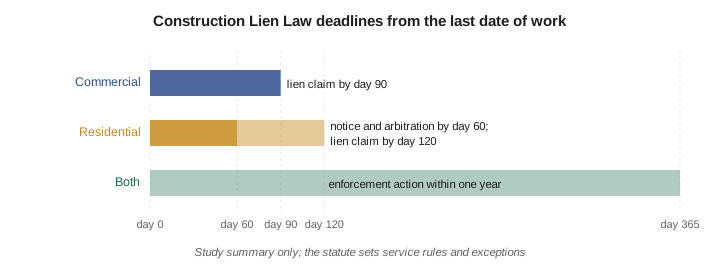
| Step | Commercial project | Residential project |
|---|---|---|
| Contract | Signed written contract required | Signed written contract required |
| Before the lien claim | No pre-lien notice for the claim itself | A notice of unpaid balance and demand for arbitration within 60 days of last work |
| Lien claim | Filed within 90 days of last work | Filed within 120 days of last work, after arbitration |
| Where filed | County clerk where the property is located | County clerk where the property is located |
| Enforcement | Court action within one year of last work | Court action within one year of last work |
# Lien calendar from the last date of work (study aid; confirm with counsel)
from datetime import date, timedelta
last_work = date(2026, 9, 25)
commercial = True
if commercial:
    print("Lien claim due by:      ", last_work + timedelta(days=90))
else:
    print("Arbitration demand by:  ", last_work + timedelta(days=60))
    print("Lien claim due by:      ", last_work + timedelta(days=120))
print("Enforcement action by: ", last_work.replace(year=last_work.year + 1))Lien claim due by: 2026-12-24 Enforcement action by: 2027-09-25
The calculation gave Danielle a firm date: the Carteret lien claim had to be filed by December 24, 2026. She and Walter met the company's lawyer that week. The lawyer prepared the claim in the statutory form, confirmed the amount against the signed contract and approved change orders, filed it with the Middlesex County clerk and served it as the statute requires. A week later the developer's lender, who did not want a lien on the property, arranged payment.
Overstated claims and lien waivers
The Construction Lien Law punishes abuse. A claimant who willfully overstates a lien claim, or files a claim without a basis, can be liable for the owner's attorney fees, costs and damages, and the claim can be discharged. Claims should include only amounts due under the signed contract and approved changes, not disputed extras, interest or lost profit. Lien waivers, which contractors are often asked to sign with each payment, can give up lien rights; New Jersey law addresses when waivers are enforceable and the form they must take. Contractors should read every waiver and never sign one for amounts not yet received.
The Prompt Payment Act
New Jersey's Prompt Payment Act, N.J.S.A. 2A:30A-1 and following, sets payment deadlines on private construction contracts and gives unpaid contractors remedies. Under the act, an owner must pay a prime contractor within thirty calendar days after the billing date for work that has been approved and certified by the owner or its authorized agent. If the owner does not provide a written statement of the amount withheld and the reason within twenty days after receiving the billing, the billing is deemed approved and certified. A prime contractor must pay its subcontractors, and subcontractors their sub-subcontractors, within ten calendar days after receiving payment, unless the parties agree otherwise in writing.
Late payments accrue interest at the prime rate plus one, and an unpaid contractor or subcontractor may suspend work seven days after giving written notice of the violation to the party that has not paid. Contracts covered by the act must include a provision for submitting payment disputes to mediation or arbitration, and the prevailing party in a civil action to collect payment under the act is entitled to reasonable costs and attorney fees. Public contracts are governed by their own payment statutes, which have similar themes but different details.
| Rule | Prompt Payment Act (study summary) |
|---|---|
| Owner to prime contractor | Within 30 calendar days of the billing date for approved and certified work |
| Deemed approval | If no written statement of withheld amounts within 20 days of the billing |
| Prime to subcontractor | Within 10 calendar days of receiving payment, unless agreed otherwise in writing |
| Interest | Prime rate plus one |
| Suspension | After 7 days' written notice of the violation |
| Disputes and fees | Mediation or arbitration clause; prevailing party recovers reasonable costs and fees |
Worked problem
Using the Prompt Payment Act on a subcontract
Raritan Valley is a subcontractor on the Metuchen dental office. It billed the general contractor on November 2. The owner paid the general contractor on November 20, but by December 5 Raritan Valley has not been paid. What does the act provide?
Show solution
- Unless the subcontract says otherwise in writing, the general contractor had ten calendar days after receiving payment on November 20, so payment was due by November 30.
- From the due date, the unpaid amount accrues interest at the prime rate plus one.
- Raritan Valley may give written notice of the violation and, seven days later, suspend work, and may pursue the dispute process in the contract, with fee shifting to the prevailing party.
Answer: Payment was due by November 30; Raritan Valley can claim interest, give written notice and suspend work after seven days, and use the dispute process.
Public projects
Liens generally do not attach to public property, so New Jersey protects subcontractors and suppliers on public works through payment bonds and through notice and claim procedures in its public contract laws. A subcontractor on a public project should identify the payment bond at the start of the job, follow any notice requirements in the bond statute and keep the same careful records of first and last work dates. The Business and Law exam expects candidates to know that lien rights and bond rights are different tools for different kinds of projects.
Building the record before a dispute
Lien rights and payment remedies depend on facts that are easy to prove when they are recorded at the time and hard to prove later. Raritan Valley's project files hold the signed contract, every signed change order, each pay application with its date of submission, any written statement from the owner about withheld amounts, daily reports showing the first and last dates of work, and delivery tickets for equipment and material. When the Carteret dispute arose, the lawyer asked for the last date of work, and Priscilla produced the daily report and the inspection record for that day within an hour.
The company also tracks the date of each billing and the date each payment arrives, so that it can tell at a glance whether an owner or general contractor is late under the Prompt Payment Act. A short, polite written notice that cites the act often resolves late payment without any further step, because most owners and general contractors know that interest and fee shifting can follow.
Change orders and disputed work
Many payment disputes start with extra work performed on a verbal instruction from a superintendent. The contract usually says who may authorize changes and how, and New Jersey's lien law requires a signed writing for the amount to be lienable. Danielle's crews carry a one-page field change form that the owner's representative signs before extra work starts, with the price or the method of pricing to follow.
Common mistakes
MistakeStarting work on a handshake or performing extras without a signed change order.
InsteadA New Jersey lien claim must be based on a signed written contract.
MistakeCounting the lien deadline from the date of the last invoice.
InsteadDeadlines run from the last date of work under the contract; punch-list work generally does not extend them.
MistakeFiling a residential lien claim without the notice and arbitration step.
InsteadResidential claims require a notice of unpaid balance and demand for arbitration within 60 days first.
MistakePadding a lien claim with interest, profit or disputed extras.
InsteadWillfully overstated claims expose the claimant to fees, costs and damages.
Summary and key terms
- Every job should rest on a signed written contract and signed change orders, which the lien law requires.
- Commercial lien claims must be filed with the county clerk within 90 days of the last date of work.
- Residential claims require a notice of unpaid balance and demand for arbitration within 60 days and a lien claim within 120 days.
- An enforcement action must start within one year of last work, and the lien fund caps the owner's exposure.
- The Prompt Payment Act requires owner payment within 30 days of approved billings, subcontractor payment within 10 days, interest, suspension rights and fee shifting.
- Construction Lien Law
- N.J.S.A. 2A:44A, which secures payment for those who improve real property.
- Lien fund
- The cap on an owner's total exposure to lien claims, based on what the owner owes under its contract.
- Unpaid balance notice
- The residential pre-lien filing that starts the arbitration process.
- Prompt Payment Act
- N.J.S.A. 2A:30A, which sets payment deadlines on private construction contracts.
- Deemed approval
- Automatic approval of a billing when the owner does not object in writing within 20 days.
Practice problems
Work each problem on paper first, then reveal the answer to check.
What kind of contract must support a New Jersey lien claim?
Show answer
A signed written contract.
Within how many days of last work must a commercial lien claim be filed?
Show answer
Within 90 days.
Within how many days must a contractor pay its subcontractor under the Prompt Payment Act?
Show answer
Within 10 calendar days of receiving payment, unless agreed otherwise in writing.
How long after written notice may an unpaid contractor suspend work?
Show answer
Seven days.
Lesson quiz · 5 questions
Score 60% or more to complete this lesson.
Create a free account to save your progress, take quizzes and earn a certificate.