
MELU-305 · Lesson 8 of 12 · 19 min
Contractor licensing, insurance and bonding
▶ Video coming soon A video version of this lesson is on the way.
The week Danielle's license arrived, Priscilla spread the business permit paperwork across the conference table: the board's change form naming Danielle as qualifying licensee, the company's certificate of general liability insurance, its workers' compensation certificate, the federal tax identification number, a copy of the certificate of formation and a list of the municipal registrations that would need updating. 'The license lets you be responsible,' she said. 'This stack lets the company keep working.' This lesson covers what a New Jersey electrical business needs on file to operate legally: the business permit, liability insurance or a letter of credit, workers' compensation coverage, business registration and the bonds that owners and public agencies may require.
The business permit
As Lesson 1 explained, the business permit is the board credential that lets a business offer and perform electrical contracting. It can be issued to an individual licensee operating as a sole proprietor or to a firm, such as a corporation, partnership or limited liability company, that has a licensed electrical contractor as its qualifying licensee. The board's licensure and business permit rules are in subchapter 2 of N.J.A.C. 13:31. The board expects the qualifying licensee to have a genuine role in the firm and to meet the presence and supervision requirements described in Lesson 7; candidates should read the current rules on who may qualify a business permit and how many businesses one licensee may qualify, rather than relying on informal advice.
When the qualifying licensee leaves a firm, retires or dies, the firm must notify the board and replace the qualifying licensee within the time the rules allow, or stop electrical contracting. Raritan Valley planned its change months ahead so that there was never a day without a qualifying licensee. Walter's license stayed active through the transition, and the board's records were updated the same week Danielle's license was issued.
Liability insurance or a letter of credit
The statute requires every business permit holder to maintain financial responsibility for property damage and bodily injury. Under N.J.S.A. 45:5A-9.1, the permit holder must maintain either general liability insurance from an insurer authorized to do business in New Jersey with combined coverage of at least 300,000 dollars per accident or occurrence, or a bank letter of credit of at least 300,000 dollars covering the same risks. Proof of coverage must be filed with the board, and cancellation is not effective until the board receives at least ten days' written notice. The permit holder must also file its federal tax identification number with the board.
The statutory minimum is a floor, not a recommendation. Many owners, general contractors and public agencies require far higher limits in their contracts, often a million dollars or more per occurrence with an umbrella policy above it, and they may require the contractor to name them as additional insureds. Raritan Valley carries limits well above the minimum because its larger customers require it. Priscilla keeps a spreadsheet of each contract's insurance requirements and sends the broker a request for a certificate whenever a new contract is signed.
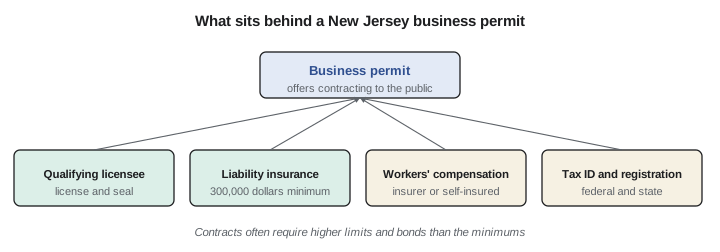
| Requirement | Minimum or rule | Filed with or shown to |
|---|---|---|
| General liability insurance | At least 300,000 dollars combined per occurrence, from an insurer authorized in New Jersey | The board, with ten days' notice of cancellation |
| Or bank letter of credit | At least 300,000 dollars for property damage and bodily injury or death | The board |
| Federal tax identification number | Required | The board |
| Workers' compensation | As required by New Jersey law for employees | Certificate kept on file; shown to customers and agencies |
| Contract insurance | Whatever the contract requires, often much higher | Owners and general contractors |
Workers' compensation
New Jersey requires most employers to provide workers' compensation coverage for their employees, either by buying a policy from an insurer authorized in New Jersey or by obtaining approval to self-insure from the Commissioner of Banking and Insurance. New Jersey does not have a state-run monopoly fund; employers buy coverage in the private market, and the New Jersey Compensation Rating and Inspection Bureau can help employers that have trouble finding a carrier. Premiums depend on job classifications, payroll and claims history.
The penalties for failing to insure are severe. According to the Department of Labor and Workforce Development, failing to provide coverage is a disorderly persons offense, and a crime of the fourth degree if willful. Civil penalties can reach 5,000 dollars for the first ten days of non-coverage and up to 5,000 dollars for each additional ten-day period, corporate officers can be held personally liable, and an uninsured employer is directly responsible for benefits if a worker is injured. Employers must post a notice at the workplace stating that they are covered and naming the carrier, and they must report work injuries to their carrier promptly so that a first report of injury can be filed with the state.
The board's own rule, N.J.A.C. 13:31-3.1, adds a licensing angle. A business permit holder must carry the coverage New Jersey law requires for its employees, keep a certificate of coverage on file, and make sure that temporary workers under its supervision are covered and that subcontractors' employees are covered as the law requires. Failing to do so is a licensing problem as well as a labor-law problem.
# Rough workers' compensation premium estimate (illustrative rates, not real ones)
payroll = {"electricians": 1850000, "clerical": 210000}
rate_per_100 = {"electricians": 4.20, "clerical": 0.15}   # illustrative only
experience_mod = 0.92
base = sum(payroll[k] / 100 * rate_per_100[k] for k in payroll)
print("Base premium:     ", round(base))
print("Experience mod:   ", experience_mod)
print("Modified premium: ", round(base * experience_mod))Base premium: 78015 Experience mod: 0.92 Modified premium: 71774
The calculation shows why safety pays. The experience modification compares a company's claims to what is expected for its size and trades. A modification below 1.00, like Raritan Valley's 0.92, lowers the premium; a modification above 1.00 raises it. Many owners also use the modification as a prequalification test for bidders.
Independent contractors and misclassification
New Jersey applies a strict test to decide whether a worker is an employee or an independent contractor for purposes of wage, unemployment and related laws, and the state has given misclassification serious attention, including penalties and stop-work authority in the construction industry. A contractor who calls an electrician a 'subcontractor' to avoid payroll taxes and workers' compensation runs a serious risk, and the board's rules separately prohibit subcontracting electrical work to anyone who does not hold a business permit. In short, people doing electrical work for Raritan Valley are either its employees, under Danielle's supervision, or employees of another business permit holder.
Business registration and taxes
Every business operating in New Jersey must register with the Division of Revenue and Enterprise Services for tax purposes and obtain a business registration certificate. Corporations and limited liability companies are formed by filing with the state and must file annual reports. Contractors on public works projects often must show proof of business registration, and the public works contractor registration program under the Department of Labor and Workforce Development applies to contractors on public works, along with prevailing wage requirements. Sales and use tax rules for contractors, which treat contractors as consumers of the materials they install in many cases, affect pricing and should be reviewed with an accountant.
These requirements sit outside the electrical licensing law, but the Business and Law exam tests the general principles, and a contractor who ignores them can lose bids or face penalties. Priscilla keeps a calendar of every renewal: the business permit, insurance policies, workers' compensation, the annual corporate report, the public works registration and each municipal registration.
Home improvement work
New Jersey's Contractors' Registration Act requires home improvement contractors to register with the Division of Consumer Affairs and imposes contract requirements for home improvement work, such as written contracts with specified terms for jobs above a threshold amount and a right to cancel within a short period. The act exempts some licensed trades for work within the scope of their licenses. Licensed electrical contractors should confirm with the Division whether and when registration applies to their residential work, and should follow the consumer contract requirements that apply to home improvement jobs in any case, because consumer protection rules can make contracts unenforceable if they are ignored.
Bonds
New Jersey's electrical licensing law does not require a license bond as a condition of the business permit; the financial responsibility requirement is met with liability insurance or a letter of credit. Bonds still matter, because contracts often require them. On public projects, New Jersey law generally requires prime contractors to furnish payment bonds, and often performance bonds, so that subcontractors and suppliers have a source of payment, since liens are not available against public property in the usual way. Private owners may also require performance and payment bonds on larger projects.
A surety bond is a three-party agreement: the contractor is the principal, the owner or obligee is protected, and the surety promises to pay if the contractor fails to perform or pay. Unlike insurance, the surety expects to be repaid by the contractor, so it reviews the contractor's finances, experience and work in progress before issuing bonds. Raritan Valley's bonding capacity, the total amount of bonded work the surety will support, sets a ceiling on the public work the company can bid.
Worked problem
Is the company ready to bid?
Raritan Valley wants to bid a 1.2 million dollar electrical contract for a Woodbridge school renovation. The bid documents require general liability of 1 million dollars per occurrence with a 5 million dollar umbrella, workers' compensation, proof of public works contractor registration, a bid bond, and performance and payment bonds for the full contract value if awarded. What should Priscilla check?
Show solution
- Confirm that the business permit is current with Danielle as qualifying licensee and that proof of insurance is on file with the board.
- Confirm with the broker that the general liability and umbrella limits meet the contract, and request a certificate naming the district as required.
- Confirm workers' compensation coverage and public works contractor registration are current.
- Ask the surety for the bid bond and confirm that the bonding capacity supports another 1.2 million dollars of work.
Answer: Priscilla verifies the permit, insurance limits, workers' compensation, public works registration and surety capacity before Raritan Valley submits the bid.
Certificates of insurance on every job
Owners and general contractors usually ask for a certificate of insurance before work starts, often naming them as additional insureds. Priscilla keeps a log of every certificate issued and the contract that required it, and she checks that coverage meets each contract's limits, which are often higher than the board's minimum. When a policy renews, she sends updated certificates to every open job before the old ones expire, so no job is ever left showing expired coverage.
Common mistakes
MistakeTreating the 300,000 dollar minimum as enough insurance for every job.
InsteadIt is the statutory floor; contracts often require much higher limits and additional insured status.
MistakeLetting liability insurance lapse without telling the board.
InsteadProof must stay on file, and cancellation takes effect only after ten days' written notice to the board.
MistakeCalling helpers independent contractors to avoid workers' compensation.
InsteadNew Jersey applies a strict test, and board rules bar subcontracting electrical work to anyone without a business permit.
MistakeAssuming a license bond is required for the business permit.
InsteadNew Jersey uses liability insurance or a letter of credit; bonds come from contract and public works law.
Summary and key terms
- A business needs a business permit with a qualifying licensee to contract for electrical work.
- N.J.S.A. 45:5A-9.1 requires liability insurance of at least 300,000 dollars per occurrence, or a 300,000 dollar letter of credit, filed with the board, plus the federal tax identification number.
- Workers' compensation coverage is mandatory, bought from private insurers or through approved self-insurance; failing to insure brings criminal and civil penalties.
- Business registration, public works registration, consumer contract rules and tax rules also apply.
- Bonds are required by contracts and public works law rather than by the licensing statute.
- Letter of credit
- A bank guarantee that can substitute for the liability insurance requirement.
- Experience modification
- A factor comparing a company's claims to expected losses, used to adjust workers' compensation premiums.
- Additional insured
- A party, such as an owner, added to the contractor's liability policy by contract.
- Payment bond
- A surety bond that guarantees payment to subcontractors and suppliers.
- Bonding capacity
- The total amount of bonded work a surety will support for a contractor.
Practice problems
Work each problem on paper first, then reveal the answer to check.
What minimum liability insurance must a business permit holder maintain?
Show answer
At least 300,000 dollars combined per accident or occurrence, or a 300,000 dollar letter of credit.
How much notice must the board receive before a cancellation of coverage takes effect?
Show answer
At least ten days' written notice.
Does New Jersey have a monopolistic state workers' compensation fund?
Show answer
No. Employers buy coverage from authorized insurers or self-insure with approval.
Who are the three parties to a surety bond?
Show answer
The principal (contractor), the obligee (owner) and the surety.
Lesson quiz · 5 questions
Score 60% or more to complete this lesson.
Create a free account to save your progress, take quizzes and earn a certificate.