
MELU-305 · Lesson 6 of 12 · 19 min
Permits, inspections and the inspection authority
▶ Video coming soon A video version of this lesson is on the way.
On her first Monday as Raritan Valley's qualifying licensee, Danielle signed and sealed four permit applications before eight in the morning: a dental office fit-out in Metuchen, a panel replacement for a homeowner in Edison, ten EV chargers for an apartment garage in Highland Park and a temporary service for a Carteret warehouse under construction. Each went to a different municipal construction office, each with its own fee schedule and inspection calendar. Priscilla had a printed checklist for each town. 'Same state code, same forms,' she said, 'but every office has its own habits, and the inspector is the one who decides whether we pass.'
Who enforces the code
The Uniform Construction Code is enforced locally. Each municipality has an enforcing agency, usually called the construction office or construction department, headed by a construction official. The agency has subcode officials for each discipline: building, fire protection, plumbing and electrical. The electrical subcode official is responsible for plan review and inspection under the electrical subcode, and inspectors working under that official carry out field inspections. Electrical inspectors and subcode officials hold licenses issued by the Department of Community Affairs, with classifications that depend on the kinds of buildings they may handle; the rules describe separate electrical inspector licenses for different hazard and building categories, such as the high-hazard and special classification commonly abbreviated HHS and the one- and two-family and small building classification commonly abbreviated ICS.
In some places the municipality contracts with the Department of Community Affairs or with another municipality to provide enforcement, and state-owned buildings are handled by the department itself. Contractors should confirm who the enforcing agency is for each job, especially near municipal boundaries, at state facilities and on large campuses that straddle towns.
When a permit is required
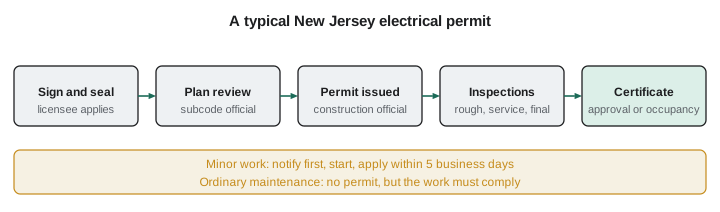
The Uniform Construction Code requires a construction permit before construction, alteration, repair, demolition or a change of use of a building or its systems, with stated exceptions. For electrical work, two categories matter most: ordinary maintenance, which needs no permit, and minor work, which needs a permit but may start before the permit is issued. Everything else needs a permit issued before work begins.
Ordinary maintenance is defined in N.J.A.C. 5:23-2.7. For electrical work it generally covers like-for-like replacement of certain components and small tasks that do not change the system, under conditions the rule sets. The details are specific, for example limits on what devices may be replaced and in what types of buildings, so contractors should read the rule rather than assume a task qualifies. Ordinary maintenance must still comply with the code even though no permit is needed.
Minor work
Minor work, defined in N.J.A.C. 5:23-2.17A, is a middle category. It requires a permit and an inspection, but the work may begin as soon as the enforcing agency has been notified. For electrical work in one- and two-family dwellings, the rule lists items such as electrical work incidental to installing air conditioning equipment, clothes dryers and ranges, installing five or fewer receptacles or fixtures where the existing circuits can carry the load, replacing wiring with wiring of the same capacity, and installing fire detection devices. In other buildings, items such as burglar alarms, security systems and doorbells can be minor work, and certain communications wiring is included. The rule has conditions and exclusions, so the exact list must be checked.
The minor work process runs in this order. The owner, or a contractor acting for the owner, notifies the enforcing agency before starting, orally or in writing, in person or electronically, with a brief description of the work and its location. A complete permit application must follow within five business days of the notice. The work may start on the notice, and the fee is paid before the permit is issued. The agency generally inspects within three business days of a request, or within another period of up to thirty days if the agency and the owner or agent agree. When the work passes, the construction official issues a certificate of approval.
| Category | Permit? | When work may start | Inspection? |
|---|---|---|---|
| Ordinary maintenance | No | Any time | No, but the work must comply |
| Minor work | Yes, application within five business days of notice | After notifying the enforcing agency | Yes |
| All other work | Yes | After the permit is issued | Yes, at each required stage |
The permit application
A New Jersey construction permit application uses standard forms: a jacket that identifies the project, owner and contractor, and technical sections for each subcode. The electrical technical section lists the devices, equipment, services, feeders and other items covered, which also drives the fee. Under the board's rules, the licensed electrical contractor must sign the application and apply the board-issued pressure seal to every permit application and every inspection request. The enforcing agency may also ask to see the contractor's identification card. For larger projects, construction documents prepared by a registered design professional may be required, and the electrical subcode official reviews them for compliance before the permit is issued.
Homeowners working on their own occupied homes under the licensing exemption apply for permits themselves, and many enforcing agencies require them to sign a statement confirming that they own and live in the home and will do the work personally. Priscilla has seen homeowners try to use that route for work actually done by an unlicensed friend. Inspectors notice, and the result is usually a stop on the job.
Inspections
The permit lists the inspections required for the work. For a typical electrical job, inspections include rough wiring before walls or ceilings are closed, services and feeders, underground or slab work before it is covered, and a final inspection when the work is complete. Larger projects may require above-ceiling inspections and inspections of specific systems such as fire alarms. The contractor calls for each inspection when the work is ready, and the agency generally performs it within the time the rules set, commonly three business days.
When an inspection fails, the inspector issues a notice of violation or a correction list, and the contractor must correct the work and call for a reinspection. The subcode official may issue a stop construction order when work proceeds without a required permit or in a way that endangers the public, and the agency may impose penalties for violations. A contractor who covers work before it is inspected may have to uncover it at the contractor's expense.
Certificates at the end
When all inspections pass, the construction official issues the appropriate certificate. For new buildings and changes of use, that is a certificate of occupancy; for work in existing buildings that does not require a new certificate of occupancy, it is a certificate of approval. A temporary certificate of occupancy may be issued when part of a project is ready and safe to use. The utility will not connect a new service until the enforcing agency confirms that the electrical work has passed, through a release or similar notice to the utility.
Electrical inspections and the utility
Raritan Valley's jobs are served by different utilities depending on the town. Each utility has its own requirements for service applications, meter locations and equipment, published in its service rules or customer guides. Those requirements sit alongside the electrical subcode: the code governs the installation, and the utility governs the connection and metering. The contractor coordinates both, applying to the utility early for new services and upgrades so that the utility's schedule does not delay the job after inspection.
# Track inspection requests and the expected window (study aid)
from datetime import date, timedelta

def add_business_days(d, n):
    while n > 0:
        d += timedelta(days=1)
        if d.weekday() < 5:
            n -= 1
    return d

requests = [
    ("Metuchen dental office - rough", date(2026, 9, 14)),
    ("Edison panel change - final", date(2026, 9, 16)),
    ("Highland Park EV chargers - underground", date(2026, 9, 18)),
]
for job, asked in requests:
    print(job)
print(" requested:", asked, " expected by:", add_business_days(asked, 3))Metuchen dental office - rough requested: 2026-09-14 expected by: 2026-09-17 Edison panel change - final requested: 2026-09-16 expected by: 2026-09-21 Highland Park EV chargers - underground requested: 2026-09-18 expected by: 2026-09-23
Worked problem
Minor work or full permit?
A homeowner in Edison asks Raritan Valley to add three receptacles in a finished basement on an existing circuit that has capacity, and separately to install a new 60-ampere subpanel for a detached garage. How should Danielle handle each part?
Show solution
- Adding a few receptacles on an existing circuit with capacity in a one-family dwelling can fall within the minor work list, so the work may start after notifying the enforcing agency, with the application following within five business days.
- A new subpanel and feeder to a detached garage is not on the minor work list, so it needs a permit issued before the work begins.
- Both parts need inspections, and she signs and seals both applications or combines them as the enforcing agency prefers.
Answer: The receptacles can proceed as minor work after notice; the subpanel and feeder need a permit before work starts; both are inspected.
Working with inspectors
Inspectors enforce the code as adopted and modified by the state. They do not have authority to require more than the code requires, and contractors may appeal decisions they believe are wrong, first by discussing the issue with the subcode official and, if needed, through the construction board of appeals process that the Uniform Construction Code provides. In practice, most disagreements are resolved by talking through the code section and the facts. Danielle's habit is to bring the relevant code page, the approved drawings and photos of the work to any discussion and to listen first.
Plan review on larger jobs
On larger projects, plan review happens before the permit is issued. The electrical subcode official checks the construction documents for compliance with the electrical subcode, including load calculations, service and feeder sizes, available fault current, grounding, emergency and standby systems and the location of equipment. Comments come back to the design professional, who revises the documents. Contractors who build from the approved set avoid most field disputes, because the inspector and the crew are looking at the same drawings. Changes made in the field that affect code compliance may require revised documents and approval before the work is covered.
On the Carteret warehouse, the design professional's original drawings showed a 2,000-ampere service with a fault current figure that the utility later revised upward. Omar caught the change when the utility's letter arrived, and the design professional submitted revised documents showing equipment with an adequate interrupting rating before the switchgear was ordered. The subcode official approved the revision in two weeks, far less time than it would have taken to replace installed equipment.
Records at the end of the job
When a job closes, Priscilla files the permit, the inspection results, the certificate of approval or occupancy and the approved drawings together. Those records answer questions years later, for example when an owner sells a building or a new tenant asks whether earlier work was permitted.
Common mistakes
MistakeStarting work that is not minor work before the permit is issued.
InsteadOnly minor work may start on notice; other work needs an issued permit.
MistakeTreating ordinary maintenance as a loophole for any small job.
InsteadOrdinary maintenance is defined narrowly in N.J.A.C. 5:23-2.7; read the rule.
MistakeSending a permit application without the licensee's seal and signature.
InsteadBoard rules require the licensee's signature and pressure seal on every permit and inspection request.
MistakeCovering work before the rough inspection.
InsteadCovered work may have to be uncovered at the contractor's expense.
Summary and key terms
- Municipal enforcing agencies, with construction officials and electrical subcode officials, enforce the Uniform Construction Code.
- Ordinary maintenance needs no permit; minor work may start after notice with an application within five business days; other work needs a permit before it starts.
- The licensee must sign and seal every permit application and inspection request.
- Inspections occur at required stages, generally within three business days of a request, and failed work must be corrected and reinspected.
- The construction official issues a certificate of approval or occupancy when the work passes, and the utility connects after the agency releases the service.
- Enforcing agency
- The municipal office that enforces the Uniform Construction Code.
- Construction official
- The head of the enforcing agency, who issues permits and certificates.
- Minor work
- Work that needs a permit and inspection but may start after notifying the enforcing agency.
- Ordinary maintenance
- Work that needs no permit under N.J.A.C. 5:23-2.7 but must still comply.
- Certificate of approval
- The document issued when permitted work in an existing building passes inspection.
Practice problems
Work each problem on paper first, then reveal the answer to check.
Within how many business days after notice must a minor work application be filed?
Show answer
Five business days.
Who heads the municipal enforcing agency?
Show answer
The construction official.
What must the licensee apply to an inspection request?
Show answer
A signature and the board-issued pressure seal.
What certificate is issued for permitted work in an existing building that does not require a new certificate of occupancy?
Show answer
A certificate of approval.
Lesson quiz · 5 questions
Score 60% or more to complete this lesson.
Create a free account to save your progress, take quizzes and earn a certificate.