
MELU-305 · Lesson 2 of 12 · 19 min
Eligibility for the Electrical Contractor License
▶ Video coming soon A video version of this lesson is on the way.
Before Danielle could book an exam, she had to convince the board that she was qualified to sit for it. New Jersey does not let candidates walk in and test. The board first reviews an application, decides whether the applicant meets the experience requirements in the statute and the rules, and only then issues an authorization to test. Priscilla pulled Danielle's records out of the company files on the first evening: payroll history, her apprenticeship completion certificate, her Class A journeyman license and the letters Walter had written for her when she topped out. 'The board will want proof of every year you claim,' she said. 'Better to find the gaps now than after you send the application.'
The core experience requirement
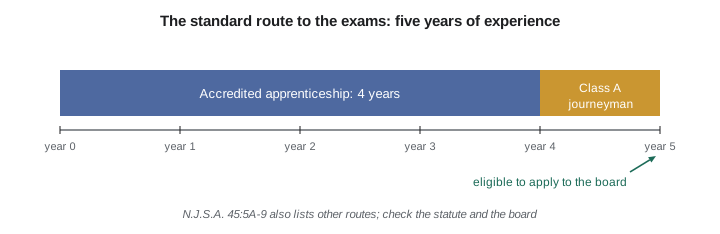
The statute at N.J.S.A. 45:5A-9 sets the experience needed to qualify for the electrical contractor examination. In its current form, an applicant must have worked in or engaged in electrical construction and installation for at least five years before applying. Within those five years, the applicant must have spent one year as a Class A journeyman electrician and four years in an electrical apprenticeship program that is accredited and approved by the United States Department of Labor, and must show that the program was completed while working as a Class A electrical apprentice. In other words, the standard route is a registered four-year apprenticeship followed by at least a year working at the journeyman level.
Danielle fit this route easily. She completed a four-year registered apprenticeship through a joint apprenticeship and training program, received her completion certificate, and then worked five years as a Class A journeyman. Her five years of experience before applying were really nine, and her application would document all of them. Omar Haddad, Raritan Valley's estimator, was a different case. He had worked as an electrician for six years before moving into estimating, but his early years were in a non-union shop that did not run a registered apprenticeship. Omar's path would depend on whether his training could be credited under the board's rules, and the board, not Omar, would decide that.
The temporary credit for prior employment
When the Legislature revised the eligibility section in 2018, through P.L.2018, c.155, it recognized that many working electricians had learned the trade without a registered apprenticeship. For a period of four years after the law took effect, the board was directed to accept credit for each year of employment in the electrical trade, or for formal apprenticeship enrollment completed before that date, in place of a year of accredited apprenticeship, up to a total of four years. That window was meant to be temporary. Candidates who are hoping to rely on older, non-apprenticeship experience should confirm with the board whether any part of that credit remains available for their situation and how the board is applying the current version of the statute.
For exam purposes, the useful lesson is the structure of the rule rather than the transition dates: the long-term route centers on an accredited apprenticeship and journeyman experience, the Legislature created a time-limited bridge for experienced workers, and the board applies the statute to each application. Questions about whether a specific candidate qualifies are answered by the board after it reviews the documents.
Other conditions the board considers
The board's rules and application set additional conditions, such as a minimum age and a high school diploma or equivalent, and the board reviews the applicant's background, including any criminal convictions or prior discipline in another jurisdiction, under the general standards in the Uniform Enforcement Act and related laws. The board also has rules for applicants who rely on other kinds of experience, such as certain engineering or supervisory backgrounds. Because these alternative routes and their documentation change, the course does not list them in detail. The point to remember is that every route ends in the same place: the board must approve the application before PSI will schedule an exam.
New Jersey does not have reciprocity agreements that let an electrical contractor licensed in another state skip the New Jersey exams. A contractor licensed in New York or Pennsylvania who wants to work in New Jersey generally applies, documents qualifying experience and passes the New Jersey exams like any other candidate. The board's materials should be checked for any change, but candidates should not assume that an out-of-state license transfers.
| Requirement | Standard route | What proves it |
|---|---|---|
| Years of experience | At least five years in electrical construction and installation before applying | Employment records, tax forms, employer letters |
| Apprenticeship | Four years in a U.S. Department of Labor accredited program, completed while a Class A apprentice | Completion certificate and apprenticeship records |
| Journeyman experience | At least one year as a Class A journeyman electrician | Journeyman license and employment records |
| Other conditions | Age, education and background standards set by the board | Diploma or equivalent, identification, disclosure questions |
Documenting experience
Experience that cannot be documented does not count. The board's application asks applicants to list their work history and support it with evidence. Common evidence includes apprenticeship completion certificates, letters from employers or licensed contractors describing the work performed and the dates, payroll or tax records, union or training program records and copies of other licenses held. The board may ask for more information if the application is incomplete or inconsistent, and an applicant who overstates experience risks denial and discipline later.
Priscilla built Danielle's packet the way she builds a bid: a cover sheet listing each claim and the document that proves it. Apprenticeship years: the program's completion certificate and its record of hours. Journeyman years: Danielle's journeyman license and a letter from Walter, on company letterhead, listing her start date, her classification, the kinds of projects she worked on and the license number of the supervising contractor. Earlier employment: tax records from the contractor she worked for before joining Raritan Valley. Nothing went into the envelope that Priscilla could not tie back to a claim on the form.
# Check a candidate's documented experience against the standard route (study aid)
records = [
    ("apprentice", 2017, 2021, "completion certificate"),
    ("journeyman", 2021, 2026, "license and employer letter"),
]
def years(kind):
    return sum(end - start for k, start, end, _ in records if k == kind)
appr = years("apprentice")
journ = years("journeyman")
total = appr + journ
print("Apprenticeship years:", appr)
print("Journeyman years:", journ)
print("Total years:", total)
ok = appr >= 4 and journ >= 1 and total >= 5
print("Meets the standard route:", ok)Apprenticeship years: 4 Journeyman years: 5 Total years: 9 Meets the standard route: True
The check above is only a planning aid. It treats calendar years as whole years and assumes every document is accepted. Real applications can involve part-time work, gaps for injury or military service, work in other states and overlapping roles. Those details are exactly why the board reviews applications case by case.
The journeyman license and its own requirements
Danielle's Class A journeyman license is itself a board credential, created by legislation that brought journeyman licensing under the board. The board's rules in subchapter 5 of N.J.A.C. 13:31 set its requirements. Published summaries describe a combination of documented practical wiring experience, commonly stated as 8,000 hours of hands-on tool work, and related classroom instruction, commonly stated as 576 hours, with supervisory, estimating and engineering time excluded. Candidates should confirm the exact numbers and the accepted alternatives in the current rule, but the shape is consistent: the journeyman license recognizes hands-on, documented field experience.
The journeyman license matters for the contractor license in two ways. First, the standard eligibility route requires a year as a Class A journeyman. Second, board rules on supervision allow a Class A journeyman to act as a supervisor of other workers, which Lesson 7 covers. The board also recognizes Class B wiremen and registers Class A electrical apprentices, each with its own subchapter of rules. A contractor who employs all three classifications needs to know what each may do.
Worked problem
Who on the crew can apply now?
Walter asks Priscilla to check three people who have talked about getting their own licenses: Danielle (four-year registered apprenticeship completed in 2021, Class A journeyman since 2021), Jamal Price (third-year registered apprentice), and Omar Haddad (six years of non-apprenticeship electrical work from 2008 to 2014, then estimating). Who meets the standard route today?
Show solution
- Danielle has four apprenticeship years and five journeyman years, so she meets the standard route.
- Jamal has not finished his apprenticeship and has no journeyman year, so he cannot apply yet.
- Omar has no accredited apprenticeship and no Class A journeyman year; his experience does not fit the standard route, and whether any other credit applies is a question for the board.
Answer: Only Danielle clearly meets the standard route; Jamal must finish his apprenticeship and work a journeyman year, and Omar must ask the board about his options.
Common reasons applications are delayed
Most delays come from paperwork rather than from disputes about qualifications. Missing signatures, letters that do not state dates or classifications, tax records that do not match the work history, unanswered disclosure questions and unpaid fees all send an application back. The board meets on a schedule, and an application that misses a meeting can lose weeks. A complete, consistent packet is the fastest route to an authorization to test.
Applicants should also keep copies of everything they submit. If the board asks a follow-up question months later, the applicant needs to know exactly what was sent. Danielle scanned every page of her packet into a folder named for the date she mailed it, and Priscilla added a reminder to the office calendar to call the board if nothing arrived within the time the board's website suggested.
Why the standard matters
Some candidates see eligibility as a hurdle to clear before the real test. The board sees it as part of public protection. A licensed electrical contractor will pull permits, supervise crews that include apprentices and less experienced workers, and certify, by signing and sealing, that work will meet the code. The experience requirement is meant to ensure that the person taking on that responsibility has done the work under supervision for years before supervising others. The exams then test whether that experience is backed by knowledge of the code and of the business and legal rules that govern contracting.
Walter put it more bluntly at the next morning meeting. 'Nobody hands you the seal because you can pass a test,' he told the crew. 'They hand it to you because you have already done the work, and the test proves you know the rules too.' Jamal, who still had two years of apprenticeship ahead of him, wrote the date he expected to qualify on a piece of tape and stuck it inside his hard hat.
Common mistakes
MistakeAssuming any five years of electrical work qualifies.
InsteadThe current statute centers on four years of accredited apprenticeship plus one year as a Class A journeyman; other experience depends on the board's review.
MistakeTreating an out-of-state license as a substitute for the New Jersey exams.
InsteadNew Jersey does not grant reciprocity; out-of-state contractors generally apply and test like other candidates.
MistakeSending letters that only say a person 'worked for us.'
InsteadEmployer letters should state dates, classification, kinds of work and the supervising licensee.
MistakeCounting estimating or supervisory time as hands-on journeyman experience.
InsteadPublished descriptions of the journeyman requirements exclude managerial and estimating time; check the rule for what counts.
Summary and key terms
- The board must approve an application before a candidate can schedule the exams.
- N.J.S.A. 45:5A-9 requires at least five years of experience before applying, including four years of accredited apprenticeship and one year as a Class A journeyman.
- A 2018 law created a temporary credit for prior employment in place of apprenticeship years; confirm with the board how it applies now.
- The board also applies age, education and background standards and reviews alternative routes case by case.
- Experience must be documented with certificates, letters, licenses and tax or payroll records; New Jersey does not offer reciprocity.
- Authorization to test
- The board's approval that allows a candidate to register for the PSI exams.
- Accredited apprenticeship
- An apprenticeship program accredited and approved by the U.S. Department of Labor.
- Class A journeyman electrician
- A board-licensed electrician credential that is part of the standard route to the contractor exam.
- Reciprocity
- An agreement to accept another state's license; New Jersey does not grant it for electrical contractors.
- Employer letter
- A signed letter documenting an applicant's dates, classification and kinds of work.
Practice problems
Work each problem on paper first, then reveal the answer to check.
How many years of experience before applying does the standard route require?
Show answer
At least five years.
How many of those years must be in an accredited apprenticeship under the standard route?
Show answer
Four years.
Can a contractor licensed in Pennsylvania skip the New Jersey exams?
Show answer
No. New Jersey does not grant reciprocity; the contractor applies and tests.
Name three kinds of documents that support an experience claim.
Show answer
Any three of apprenticeship completion certificates, employer letters, tax or payroll records, journeyman or other licenses and training program records.
Lesson quiz · 5 questions
Score 60% or more to complete this lesson.
Create a free account to save your progress, take quizzes and earn a certificate.