
MELU-305 · Lesson 5 of 12 · 18 min
The NEC as adopted in New Jersey and state amendments
▶ Video coming soon A video version of this lesson is on the way.
In August 2026, two months after Danielle passed her exams, the Department of Community Affairs adopted a new round of construction codes. The electrical subcode moved from the 2020 edition of the National Electrical Code to the 2023 edition. Walter called a short meeting with the foremen and estimators. 'Two things,' he said. 'First, the exam was already on the 2023 code, so Danielle is ahead of the rest of us. Second, for the next six months some of our jobs will be under the old code and some under the new one, and we need to know which is which before anyone buys material.' This lesson explains how New Jersey adopts the NEC, how to tell which edition applies to a job, and the kinds of state modifications that change the model code.
The Uniform Construction Code and its subcodes
The State Uniform Construction Code Act of 1975 directs the Commissioner of the Department of Community Affairs to adopt a single construction code for the whole state. Municipalities may not write their own building or electrical codes; they enforce the state code. The rules that make up the Uniform Construction Code are in Chapter 23 of Title 5 of the New Jersey Administrative Code. Subchapter 3 adopts the model codes as subcodes: a building subcode based on the International Building Code, a one- and two-family dwelling subcode based on the International Residential Code, a plumbing subcode, a mechanical subcode, an energy subcode, a fire protection subcode and an electrical subcode. Each subcode section names the model code and edition and then lists the state's modifications.
The electrical subcode is in N.J.A.C. 5:23-3.16. It adopts the National Electrical Code, NFPA 70, together with the state's changes. Because the rule names a specific edition, the code that applies in New Jersey changes only when the department amends that section. A new NEC edition published by NFPA does not take effect in New Jersey on its own.
The 2023 NEC adoption
For several years before August 2026, the electrical subcode was the 2020 edition of the NEC, with a list of state modifications. According to the department's fall 2026 Construction Code Communicator, the 2023 NEC was adopted as the electrical subcode effective August 17, 2026, together with the 2024 editions of the International Codes and the 2024 National Standard Plumbing Code. The department provided a grace period: for six months after August 17, 2026, applicants may choose to submit complete permit applications under the previous editions. The department identified February 17, 2027 as the last day to submit a complete application under the older codes.
The grace period does not mean contractors may mix editions on a single job. The code edition is tied to the permit application. A complete application submitted under the 2020 NEC during the grace period is reviewed and inspected under the 2020 NEC; one submitted under the 2023 NEC is reviewed and inspected under the 2023 NEC. After the grace period ends, new applications must use the 2023 edition. Contractors should state clearly on each application which edition the design follows and keep the whole job consistent.
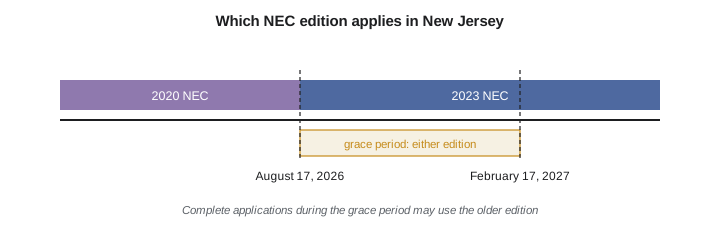
# Which NEC edition can a New Jersey permit application use? (study aid)
from datetime import date
ADOPTED = date(2026, 8, 17)
GRACE_END = date(2027, 2, 17)
def editions(app_date):
    if app_date < ADOPTED:
        return "2020 NEC only"
    if app_date <= GRACE_END:
        return "2023 NEC, or 2020 NEC if the applicant chooses (grace period)"
    return "2023 NEC only"
for d in (date(2026, 6, 1), date(2026, 9, 15), date(2027, 2, 17), date(2027, 3, 1)):
print(d, "->", editions(d))2026-06-01 -> 2020 NEC only 2026-09-15 -> 2023 NEC, or 2020 NEC if the applicant chooses (grace period) 2027-02-17 -> 2023 NEC, or 2020 NEC if the applicant chooses (grace period) 2027-03-01 -> 2023 NEC only
Why the exam was already on the 2023 NEC
Danielle noticed that the PSI bulletin listed the 2023 NEC for the exam months before the state adopted it. Licensing exams and construction code adoption follow separate schedules. The board and PSI choose a reference edition for the exam, and the Department of Community Affairs adopts an edition for enforcement. For a while, the exam edition can be ahead of, or behind, the edition enforced on job sites. Candidates should study the edition the bulletin lists, and working contractors should design to the edition the permit uses.
How state modifications work
New Jersey adopts the NEC with modifications listed section by section in N.J.A.C. 5:23-3.16. Some modifications are administrative and appear in every edition. Others change technical requirements. The department revises the list when it adopts a new edition, so a modification that existed under the 2020 NEC may be kept, changed or dropped under the 2023 NEC. The examples below describe modifications that appeared in the rule adopting the 2020 NEC. They show the kinds of changes the state makes. Check the current rule before relying on any of them for a 2023 NEC job.
The administrative modifications replace the NEC's references to the authority having jurisdiction with the state's own enforcement structure. In New Jersey, the official who interprets and enforces the electrical subcode is the electrical subcode official of the municipal enforcing agency, and approvals of materials and methods follow the procedures in the Uniform Construction Code. The modifications also substitute the Uniform Construction Code's definition of a building for the NEC's definition. The NEC's informative annex on administration and enforcement is deleted, because the Uniform Construction Code supplies its own administration. The state also treats the NEC's informational notes as explanatory only.
Technical modifications under the 2020-based rule included deleting the dwelling-unit requirement in 210.12(D) for AFCI protection when branch circuits are modified, replaced or extended, deleting the AFCI requirement for replacement receptacles in 406.4(D)(4), replacing the bored-hole spacing language in 300.4(A)(1) with a reference to the building subcode and a minimum distance of 32 millimeters, or 1 1/4 inches, to the nearest edge of a wood member, deleting most of Article 425 on fixed industrial process heating equipment, changing amusement-ride clearances in 525.5(B), and removing provisions on mobile homes, recreational vehicles and park trailers that are regulated elsewhere in New Jersey law. The rule also deleted 680.4, which deals with inspections of pools after installation, and 805.156, which requires a communications outlet in dwelling units.
| Kind of modification | Example under the 2020-based rule | Why it matters |
|---|---|---|
| Administrative | Authority having jurisdiction means the electrical subcode official | Tells you who interprets the code on your job |
| Administrative | Informative Annex H deleted | The Uniform Construction Code supplies its own administration |
| Technical, removed requirement | 210.12(D) and 406.4(D)(4) AFCI provisions deleted | Changes what is required in dwelling renovations |
| Technical, changed requirement | 300.4(A)(1) bored holes tied to the building subcode | Changes framing protection measurements |
| Scope | Mobile home and RV provisions deleted | Those units are regulated by other New Jersey rules |
The GFCI exception for HVAC equipment
The fall 2026 Construction Code Communicator also discussed a model-code provision that affects many residential jobs. The 2023 NEC requires GFCI protection for outlets supplying outdoor equipment at dwellings under 210.8(F), and Exception No. 2 temporarily excused listed HVAC equipment until September 1, 2026. The department noted that the exception expired on that date and had not been extended by NFPA when the article was printed. The same issue included an article from the department's regulatory office explaining that, under the rehabilitation subcode, simply replacing existing HVAC equipment in an existing building is generally treated as a repair rather than a new installation, so the 210.8(F) requirement would not automatically apply to a like-for-like replacement. Contractors should read the department's guidance and confirm the treatment of specific jobs with the electrical subcode official.
The rehabilitation subcode
That HVAC discussion points to a part of the Uniform Construction Code that every New Jersey contractor needs to know: the rehabilitation subcode in N.J.A.C. 5:23-6. It governs work in existing buildings. Rather than requiring an entire existing building to be brought up to the current code whenever anything is changed, the rehabilitation subcode classifies work into categories such as repair, renovation, alteration, reconstruction, change of use and additions, and sets the requirements for each. New work must generally meet the current subcodes, while existing elements that are not part of the project usually may remain. For electrical work, this affects how far into an existing system the new requirements reach.
For Raritan Valley's service upgrades and renovations, the rehabilitation subcode is as important as the NEC itself. A homeowner who wants a new kitchen circuit does not have to rewire the whole house, but the new circuit must meet the current electrical subcode. A change of use, such as converting a warehouse to an assembly space, can trigger much broader requirements. When in doubt, Danielle asks the electrical subcode official before pricing the job.
Worked problem
Which code applies?
Raritan Valley has three jobs: a Woodbridge office fit-out whose complete permit application was submitted on July 20, 2026; a Highland Park EV charger job whose application will be submitted on October 5, 2026, with drawings prepared to the 2020 NEC; and a Metuchen dental office whose application will be submitted on March 3, 2027. Which edition applies to each?
Show solution
- The Woodbridge application was submitted before August 17, 2026, so it is under the 2020 NEC.
- The Highland Park application falls inside the grace period, so the applicant may choose the 2020 NEC, and the drawings follow it; the whole job stays on the 2020 NEC.
- The Metuchen application comes after February 17, 2027, so it must use the 2023 NEC.
Answer: Woodbridge: 2020 NEC. Highland Park: 2020 NEC by choice during the grace period. Metuchen: 2023 NEC.
Forms and the technical section of the permit
The department also revises the standard construction permit forms. Its fall 2026 newsletter noted that the electrical technical section, form F120, was revised in December 2025 to combine lighting fixtures, receptacles and switches into a single devices line and to add lines for EV chargers and photovoltaic systems, with municipalities allowed to use old stock until it runs out. Small changes like this affect how contractors fill out applications and how fees are calculated, so Priscilla keeps the current forms on file and checks each municipality's website.
Staying current between editions
The Department of Community Affairs announces code adoptions and grace periods in the New Jersey Register and in its Construction Code Communicator newsletter, and it publishes bulletins that explain how the electrical subcode is applied. Raritan Valley's estimators subscribe to the department's notices, and the company keeps a one-page summary on its server of which edition applies to each open job, based on the permit application date. That summary prevented a costly mistake on the Woodbridge school, where the design began under the older edition but the permit application followed the new adoption date.
Common mistakes
MistakeAssuming a new NEC edition takes effect in New Jersey when NFPA publishes it.
InsteadThe edition changes only when the Department of Community Affairs amends N.J.A.C. 5:23-3.16.
MistakeMixing 2020 and 2023 requirements on one job during the grace period.
InsteadThe edition is tied to the permit application; keep the whole job on the edition the application uses.
MistakeRelying on a 2020-era state modification for a 2023 NEC job without checking.
InsteadModifications are revised with each adoption; confirm the current list.
MistakeApplying new-construction rules to every repair in an existing building.
InsteadThe rehabilitation subcode sets requirements by category of work.
Summary and key terms
- The electrical subcode in N.J.A.C. 5:23-3.16 adopts the NEC with state modifications; municipalities enforce it but cannot write their own code.
- The 2023 NEC was adopted effective August 17, 2026, with a six-month grace period ending February 17, 2027 for complete applications under the older editions.
- The PSI exam already used the 2023 NEC; exam editions and enforced editions follow separate schedules.
- State modifications include administrative changes, such as the electrical subcode official acting as the authority having jurisdiction, and technical changes that the department revises with each adoption.
- The rehabilitation subcode governs work in existing buildings by category of work.
- Electrical subcode
- The NEC as adopted and modified by N.J.A.C. 5:23-3.16.
- Grace period
- The six months after adoption during which applicants may choose the previous code editions.
- Electrical subcode official
- The municipal official who enforces the electrical subcode and acts as the authority having jurisdiction.
- Rehabilitation subcode
- N.J.A.C. 5:23-6, which governs work in existing buildings by category.
- Construction Code Communicator
- The Department of Community Affairs newsletter that announces code changes and guidance.
Practice problems
Work each problem on paper first, then reveal the answer to check.
Which rule section adopts the electrical subcode?
Show answer
N.J.A.C. 5:23-3.16.
On what date was the 2023 NEC adopted in New Jersey?
Show answer
August 17, 2026.
What was the last day to submit a complete application under the previous code editions?
Show answer
February 17, 2027.
Who acts as the authority having jurisdiction for the electrical subcode on a New Jersey job?
Show answer
The electrical subcode official of the municipal enforcing agency.
Lesson quiz · 5 questions
Score 60% or more to complete this lesson.
Create a free account to save your progress, take quizzes and earn a certificate.