
MELU-305 · Lesson 10 of 12 · 19 min
Workplace safety law and OSHA for electrical contractors
▶ Video coming soon A video version of this lesson is on the way.
Jamal Price was in his second year of apprenticeship when he reached into a lighting panel at the Woodbridge school to check a breaker label. The panel was supposed to be off, and it was, but only because Omar had walked by ten minutes earlier and noticed the lockout had never been applied; he had opened the main and locked it himself. Nobody was hurt. That afternoon Danielle stopped work on every Raritan Valley site for a one-hour safety stand-down. 'As the qualifying licensee I sign for the work,' she told the crews, 'and as an employer we answer for how you do it. Those are two different laws, and both of them count.'
Who regulates job safety in New Jersey
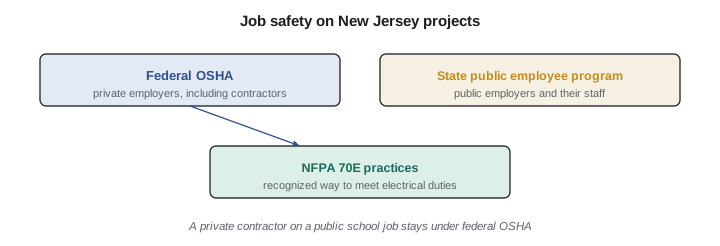
New Jersey has no state plan covering private employers, so federal OSHA, the Occupational Safety and Health Administration of the United States Department of Labor, enforces workplace safety rules on private construction sites in the state, including every private job Raritan Valley performs. Public employers are different. New Jersey operates a public employee program, commonly called PEOSH, that covers state, county and municipal employees and public schools. When Raritan Valley works at the Woodbridge school, its own employees remain under federal OSHA as a private employer, while the school district's staff are covered by the public employee program. Contractors working on public property should expect both the school's safety rules and federal OSHA rules to apply on the same site.
OSHA rules for construction appear in 29 CFR Part 1926, and the general industry rules in Part 1910 can also apply to some electrical work, such as maintenance in existing facilities. Subpart K of the construction standards covers electrical safety, including ground-fault protection on construction sites, and Subpart M covers fall protection. The exam does not expect candidates to quote sections, but it does expect them to know the employer's general duty to provide a workplace free of recognized serious hazards, the main electrical rules and the reporting and recordkeeping requirements.
Electrical hazards on construction sites
Electrical work brings shock, electrocution, arc flash and arc blast hazards, plus the falls and burns that often follow them. OSHA requires employers on construction sites to protect workers from ground faults on temporary wiring and cord-and-plug equipment, either with ground-fault circuit interrupters on receptacle outlets that are not part of the permanent wiring or with an assured equipment grounding conductor program that inspects and tests cords and tools on a schedule. Raritan Valley uses ground-fault protection on every temporary power setup and color-codes cords by inspection quarter so a supervisor can see at a glance whether a cord is current.
Lockout and tagout are the core of safe work on de-energized equipment. Before work begins, the circuit is identified, the disconnecting means is opened, locks and tags are applied by each worker, stored energy is released and the absence of voltage is verified with a tester that has itself been checked on a known live source. Only then is the equipment treated as de-energized. The near miss at Woodbridge happened because a crew skipped the lock and relied on someone's memory of having switched the main off.
NFPA 70E and electrically safe work
NFPA 70E, the Standard for Electrical Safety in the Workplace, is a consensus standard rather than a law, but OSHA treats it as a recognized way to meet the employer's duty to protect workers from electrical hazards, and many owners require it in their contracts. Its central principle is that energized work is the exception: equipment should be placed in an electrically safe work condition before work begins unless de-energizing creates a greater hazard or is infeasible. When energized work is justified, the standard calls for an energized work permit, a shock risk assessment, an arc flash risk assessment and protective equipment selected for the hazard.
The standard also requires training for qualified persons, an electrical safety program, job briefings before each job and periodic retraining. Arc flash labels on equipment give workers the information needed to choose protective equipment. Raritan Valley's written electrical safety program follows the current edition, and every crew leader runs a short job briefing at the start of each shift. The Business and Law and Electrical Contractor exams can include questions about these principles, so candidates should know the hierarchy of controls, with elimination of the hazard by de-energizing at the top, and the purpose of each document the standard requires.
| Control | Example on an electrical job |
|---|---|
| Elimination | De-energize and lock out the panel before work |
| Substitution | Use a lower-voltage control circuit or remote racking |
| Engineering controls | Arc-resistant switchgear, insulated barriers, remote operation |
| Awareness | Labels, signs, barricades and attendants |
| Administrative controls | Energized work permits, job briefings, training, procedures |
| Protective equipment | Arc-rated clothing, rubber insulating gloves, face shields |
Fall protection, ladders and other trade hazards
Falls are a leading cause of death in construction, and electricians are exposed on ladders, lifts, roofs and open floors. OSHA's construction rules generally require fall protection at six feet or more above a lower level, with ladder, scaffold and lift rules of their own. Non-conductive ladders must be used near energized parts. Other trade hazards include trenching for underground services, which requires protective systems in excavations above certain depths, confined spaces such as vaults and manholes, silica dust from cutting and drilling concrete, and noise. A competent person must oversee several of these activities, and that person must be able to identify hazards and have authority to correct them.
Reporting and recordkeeping
Federal OSHA requires an employer to report a work-related fatality within eight hours and an in-patient hospitalization, amputation or loss of an eye within twenty-four hours. Employers above a small-employer size threshold must keep injury and illness records on the OSHA 300 log, the 301 incident report and the 300A annual summary, and post the summary each year during the period the rule sets. Construction is not one of the industries exempt from recordkeeping. Some establishments must also submit data electronically. These records are separate from the workers' compensation claim reporting covered in the insurance lesson, although the same injury often triggers both.
Recordkeeping supports a common measure of safety performance, the total recordable incident rate, which owners and general contractors use to prequalify subcontractors. The rate is calculated by multiplying the number of recordable cases by 200,000 and dividing by the total hours worked by all employees during the year. The 200,000 figure represents 100 full-time workers working 40 hours a week for 50 weeks, so the rate shows recordable cases per 100 full-time workers.
# Total recordable incident rate (study aid)
recordable_cases = 3
hours_worked = 118_000   # all employees, calendar year
rate = recordable_cases * 200_000 / hours_worked
print("Recordable cases:", recordable_cases)
print("Hours worked:    ", hours_worked)
print("Incident rate: {:.2f} per 100 full-time workers".format(rate))Recordable cases: 3 Hours worked: 118000 Incident rate: 5.08 per 100 full-time workers
Worked problem
Reporting an injury
On a Tuesday afternoon, a Raritan Valley apprentice falls from a ladder at the Highland Park garage and is admitted to the hospital overnight with a broken wrist. What must the company do?
Show solution
- An in-patient hospitalization must be reported to OSHA within twenty-four hours of the company learning of it, by phone, online or at an area office.
- The case is recorded on the OSHA 300 log with a 301 incident report within the time the recordkeeping rule allows.
- Separately, the company notifies its workers' compensation carrier promptly, and it reviews ladder use and training on all sites before work continues.
Answer: Report to OSHA within 24 hours, record the case, notify the workers' compensation carrier and correct the hazard.
Training, inspections and penalties
Employers must train workers on the hazards of their jobs in a language and vocabulary they understand. Many contractors send foremen to the OSHA 10-hour and 30-hour construction outreach courses, and owners often require them, although the courses themselves are voluntary under federal law. OSHA inspections are triggered by imminent danger, fatalities and serious injuries, complaints, referrals and targeted programs, and an inspector may arrive without notice. Citations are classified by seriousness, with willful and repeated violations carrying the highest penalties, and the employer has a limited time to contest a citation. Penalty amounts are adjusted for inflation each year.
Danielle's stand-down produced three changes: every crew leader now carries spare locks and tags, absence-of-voltage testing is recorded on the job briefing sheet, and nobody opens a panel cover without a second person confirming the lock. Walter added one more rule from forty years in the trade: 'If you are not sure it is dead, it is live.'
The written safety program
A written safety program turns rules into habits. Raritan Valley's program covers hazard communication for chemicals such as cleaners and sealants, lockout and tagout, electrical safety under NFPA 70E, fall protection, ladders and lifts, excavation, confined spaces, silica, personal protective equipment, first aid, emergency action and incident investigation. Each section names who is responsible and how often training happens. The program is reviewed every year and after every serious incident or near miss, and the Woodbridge near miss led to the changes in lockout described earlier in this lesson.
Owners increasingly ask for the written program, the incident rate and the experience modification rate from the workers' compensation carrier when they prequalify contractors. A low experience modification rate reflects fewer and less costly claims than expected for a company's size and trade, and it lowers premiums. Safety and insurance cost are therefore connected: a serious injury affects the company's people first, but it also affects bids for years afterward.
Job briefings and stop-work authority
A job briefing before each job, and whenever conditions change, covers the hazards, the work procedures, the energy source controls, the protective equipment and the plan for an emergency. NFPA 70E calls for briefings, and they are the simplest way to catch a missing lock or an unexpected source of power. Every Raritan Valley worker, including apprentices, has the authority to stop work if they believe a task is unsafe, and supervisors are expected to thank them for using it. Jamal used that authority for the first time a month after the Woodbridge stand-down, when he found a second feed into a panel that the drawings did not show.
Multi-employer sites
On construction sites with several contractors, OSHA's multi-employer citation policy can hold more than one employer responsible for a hazard: the employer that created it, the employer whose workers are exposed, the employer responsible for correcting it and the controlling employer, usually the general contractor, who has general supervisory authority over the site. An electrical contractor that leaves an open panel or an unguarded floor opening can be cited even if the exposed workers belong to another trade. Coordinating with other trades at weekly meetings, and protecting energized equipment and openings left at the end of each shift, reduces that risk.
Danielle now reviews the company's incident log at each monthly crew leader meeting, alongside near misses, so that patterns show up before an injury does.
Common mistakes
MistakeAssuming the state public employee program covers a private contractor on a public school job.
InsteadPrivate employers in New Jersey are under federal OSHA; the state program covers public employers.
MistakeTreating NFPA 70E as optional because it is not a statute.
InsteadOSHA treats it as a recognized way to meet the employer's duty, and contracts often require it.
MistakeWorking near energized parts on a metal ladder.
InsteadUse non-conductive ladders where contact with energized parts is possible.
MistakeReporting only to the workers' compensation carrier after a hospitalization.
InsteadIn-patient hospitalizations must also be reported to OSHA within 24 hours.
Summary and key terms
- Federal OSHA covers private employers in New Jersey; the state public employee program covers public employers.
- Construction sites need ground-fault protection or an assured equipment grounding conductor program for temporary power.
- NFPA 70E makes de-energized work the norm and requires permits, risk assessments, training and protective equipment for justified energized work.
- Work-related deaths are reported within 8 hours and hospitalizations, amputations and eye losses within 24 hours, and injuries are recorded on the OSHA 300 log.
- The incident rate equals recordable cases times 200,000 divided by hours worked.
- OSHA
- The federal agency that enforces workplace safety for private employers in New Jersey.
- PEOSH
- New Jersey's public employee safety and health program for public employers.
- NFPA 70E
- The consensus standard for electrical safety in the workplace.
- Electrically safe work condition
- Equipment disconnected, locked out, tested for absence of voltage and grounded where needed.
- Incident rate
- Recordable cases per 100 full-time workers, based on 200,000 hours.
Practice problems
Work each problem on paper first, then reveal the answer to check.
Who enforces workplace safety for a private electrical contractor in New Jersey?
Show answer
Federal OSHA.
Within how many hours must a work-related fatality be reported to OSHA?
Show answer
Eight hours.
What number is multiplied by recordable cases in the incident rate formula?
Show answer
200,000.
What is at the top of the hierarchy of risk controls?
Show answer
Elimination, such as de-energizing the equipment.
Lesson quiz · 5 questions
Score 60% or more to complete this lesson.
Create a free account to save your progress, take quizzes and earn a certificate.