
MELU-305 · Lesson 3 of 12 · 19 min
Applying, approval and booking the exam
▶ Video coming soon A video version of this lesson is on the way.
Danielle mailed her application in the first week of February. Six weeks later an envelope from the Division of Consumer Affairs arrived at her apartment in Piscataway: the board had approved her to test, and the letter included an examination eligibility notice with instructions for paying PSI and scheduling her exams. Walter read it over her shoulder in the shop office. 'Now the clock starts,' he said. He was right in more ways than he meant. The eligibility date on that notice controls several deadlines that every New Jersey candidate needs to understand before booking a single exam.
From application to authorization
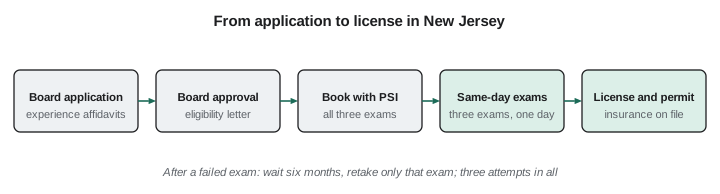
The process has a clear order. First, the candidate applies to the board, pays the application fee and submits the documents that prove eligibility. Second, the board reviews the application, sometimes asking for more information, and votes or delegates approval under its procedures. Third, the board notifies the candidate of approval and the candidate receives an examination eligibility notice. Fourth, the candidate pays PSI and schedules the exams. Fifth, after passing all required exams, the candidate applies for licensure, and the business that will use the license applies for or updates its business permit.
Each step depends on the one before. PSI will not schedule a candidate whom the board has not authorized, and the board will not issue a license to a candidate whose passing results it has not received. Candidates who try to shortcut the order, for example by booking a date before approval or by bidding work in their own name before licensure, only create problems for themselves.
Three exams, one day, first time
New Jersey requires electrical contractor candidates to pass three separate exams: the Electrical Contractor exam, the Business and Law exam and the Alarm Systems exam. The alarm exam surprises many candidates from other states. In New Jersey, the electrical contractor license covers alarm and low-voltage systems work as well as power wiring, so the board tests that knowledge directly.
Under the current PSI bulletin, candidates approved on or after March 16, 2015 must take all three exams on the same day for their first attempt, and that first attempt must occur within two years of the eligibility date on the notice. A candidate who fails one or more exams retakes only the exams failed. The full set must be passed within three attempts, and a candidate who has not passed all three within five years of the eligibility date must reapply to the board. Candidates approved before March 16, 2015 followed an older version of the rules, which the bulletin also describes.
| Rule | What the bulletin says (study summary) |
|---|---|
| First attempt | All three exams on the same day, within two years of the eligibility date |
| After a failure | Retake only the exams failed |
| Waiting period | Six months from the previous testing date after a failure on the first or second attempt |
| Attempt limit | Pass all three within three attempts |
| Outer limit | Pass all three within five years of the eligibility date or reapply to the board |
The six-month wait
The six-month waiting period after a failed attempt is the rule that most changes a candidate's planning. A candidate who fails the Business and Law exam in April cannot simply rebook for May. The next attempt can come no sooner than six months after the April test date. With only three attempts and a five-year outer limit, a candidate who fails twice has used much of the margin. The practical conclusion is that candidates should not take the first attempt casually as a practice run. It is far cheaper to study an extra month than to wait six months and spend another attempt.
# Plan retake windows from a first test date (study aid; check the bulletin)
from datetime import date

def add_months(d, months):
    y, m = divmod(d.month - 1 + months, 12)
    y, m = d.year + y, m + 1
    return date(y, m, min(d.day, 28))

eligible = date(2026, 3, 16)
first_test = date(2026, 6, 10)
print("Eligibility date:     ", eligible)
print("First attempt by:     ", add_months(eligible, 24))
print("First test taken:     ", first_test)
second = add_months(first_test, 6)
print("Earliest second try:  ", second)
third = add_months(second, 6)
print("Earliest third try:   ", third)
print("All exams passed by: ", add_months(eligible, 60))Eligibility date: 2026-03-16 First attempt by: 2028-03-16 First test taken: 2026-06-10 Earliest second try: 2026-12-10 Earliest third try: 2027-06-10 All exams passed by: 2031-03-16
The calculator shows how quickly the calendar fills. Even if Danielle failed an exam twice, she would still have time inside the five-year limit, but each failure costs six months, and the third attempt is the last. Walter's advice was blunt: book the first attempt only when practice scores are consistently well above the passing mark on all three exams.
Fees and payment
The PSI bulletin lists a separate fee for each exam. As of the current bulletin, the fees are 84 dollars for the Electrical Contractor exam, 47 dollars for the Business and Law exam and 49 dollars for the Alarm Systems exam, paid to PSI when scheduling. The bulletin states that exam fees are non-refundable and non-transferable and are valid for one year from the date of payment. The board charges its own application and licensing fees, which are separate from PSI's exam fees and are listed in the board's fee rules and application.
A candidate who pays PSI and then does not test within a year forfeits the fee, so Danielle waited to pay until she had chosen a test date. Priscilla set up a simple budget: board application fee, three PSI exam fees, the Business and Law reference book, study materials and two Saturdays of Danielle's time each month, which Walter agreed to cover as paid study time.
Scheduling with PSI
After receiving the eligibility notice, candidates schedule with PSI online or by telephone. PSI operates test centers in New Jersey and nearby states and lists available dates and times. Candidates should schedule early, because the first-attempt rule requires a block of time long enough for all three exams on one day. The Electrical Contractor exam alone is just over four hours, and the three together take most of a working day, as Lesson 4 explains.
The bulletin explains identification requirements, arrival times, rescheduling deadlines and what happens if a candidate is late or absent. In general, candidates must bring current government-issued photo identification matching the name on their registration, must arrive before the scheduled time for check-in, and may forfeit fees if they miss an appointment without rescheduling within the deadline. Personal items, phones and notes are not allowed in the testing room, with exceptions only for the approved reference books the bulletin lists for exams that allow candidates to bring their own copies.
Worked problem
Choosing a test date
Danielle's eligibility date is March 16, 2026. She wants to finish her study plan by the end of May, and Raritan Valley's busy season runs from July through October. She can test on a Tuesday, when PSI has openings for a full day. What test date makes sense, and what deadlines should she write down?
Show solution
- The first attempt must come within two years of March 16, 2026, so the outer deadline for the first attempt is March 2028.
- Testing in early June, after the study plan ends and before the busy season, gives time to retake in December if needed.
- She writes down the five-year outer limit, March 2031, and the six-month wait that would follow any failure.
Answer: A Tuesday in early June 2026 works well; she records the March 2028 first-attempt deadline, the six-month retake wait and the March 2031 outer limit.
Accommodations and special situations
Candidates who need testing accommodations because of a disability must request them through the process the bulletin describes, usually before scheduling and with supporting documentation. Candidates whose names have changed must make sure the board's records, the eligibility notice and their identification all match. Military candidates and those with unusual employment histories should raise their circumstances with the board early, before the eligibility clock is running. The bulletin and the board office are the sources for these questions.
After passing
PSI reports results to the candidate at the test center and to the board. When a candidate has passed all three exams, the candidate applies to the board for the license, pays the license fee and completes any remaining requirements. The board then issues the license and, at renewal time, the pocket identification card and pressure seal described in Lesson 1. A license by itself does not let the holder contract with the public. The holder must either obtain a business permit in his or her own name or become the qualifying licensee for a firm's business permit, with the insurance and filings Lesson 8 describes.
For Raritan Valley, the plan was that Danielle would pass in June, receive her license, and then the company would apply to change the qualifying licensee on its business permit from Walter to Danielle. Walter would keep his own license active for a transition period, but the permits the company pulled after the change would carry Danielle's seal. Priscilla added each of those steps to the office calendar with the forms they required.
Keeping the paper trail
Every notice, receipt and score report should be kept. The eligibility notice establishes the two-year and five-year deadlines. PSI receipts show when fees were paid and when they expire. Score reports show which exams have been passed if a retake is needed. If a dispute ever arises about dates or attempts, the candidate who kept everything is in a far better position than the one relying on memory. Danielle kept a single folder, paper and digital, with every document in date order.
Keeping the paperwork organized
An application produces more documents than most journeymen expect, and they arrive at different times: the application itself with its experience affidavits, the board's approval letter, the PSI bulletin, the booking confirmation, three score reports and finally the license and business permit paperwork. Priscilla keeps a single checklist for each applicant with a line for every document, the date it was sent or received and where the copy is filed. When the board or PSI asks a question, the answer is in one place, and nobody has to search old email for an approval date that controls the first-attempt deadline.
Danielle added a step of her own. She scanned each document into a folder on her phone, including both forms of identification she planned to bring. On the morning of her exams the check-in clerk asked for her confirmation and identification, and having both ready made the process quick. When her license arrived she scanned it too and sent a copy to the construction offices in the towns where Raritan Valley pulls the most permits, so that their records showed the new qualifying licensee before her first application reached them.
Common mistakes
MistakeBooking an exam before receiving board approval.
InsteadPSI schedules only candidates the board has approved; the eligibility notice comes first.
MistakePlanning to take the exams on different days the first time.
InsteadFirst-time candidates approved since March 16, 2015 must take all three exams on the same day.
MistakeTreating the first attempt as a practice run.
InsteadA failure triggers a six-month wait and uses one of only three attempts.
MistakePaying PSI months before choosing a date.
InsteadExam fees are valid for one year from payment and are not refundable.
MistakeAssuming passing the exams lets you contract immediately.
InsteadYou still need the license and a business permit with insurance on file.
Summary and key terms
- The order is board application, approval and eligibility notice, PSI scheduling, the exams, then licensure and the business permit.
- Candidates must pass three exams: Electrical Contractor, Business and Law, and Alarm Systems.
- First-time candidates take all three on the same day within two years of the eligibility date.
- After a failure, candidates retake only failed exams, wait six months, and must pass all three within three attempts and five years.
- PSI fees are 84, 47 and 49 dollars for the three exams under the current bulletin, valid for one year and non-refundable.
- Eligibility notice
- The document issued after board approval that lets a candidate pay PSI and schedule.
- Eligibility date
- The date on the notice that starts the two-year and five-year deadlines.
- Alarm Systems exam
- The third New Jersey exam, covering alarm and low-voltage systems.
- Waiting period
- The six months a candidate must wait after a failed attempt before retesting.
- Attempt limit
- The rule that all three exams must be passed within three attempts.
Practice problems
Work each problem on paper first, then reveal the answer to check.
How many exams must a New Jersey electrical contractor candidate pass?
Show answer
Three: Electrical Contractor, Business and Law, and Alarm Systems.
Within how long after the eligibility date must the first attempt occur?
Show answer
Within two years.
After failing an exam, how long must a candidate wait to retest?
Show answer
Six months from the previous testing date.
What happens if a candidate has not passed all three exams within five years of the eligibility date?
Show answer
The candidate must reapply to the board.
Lesson quiz · 5 questions
Score 60% or more to complete this lesson.
Create a free account to save your progress, take quizzes and earn a certificate.