
MELU-305 · Lesson 4 of 12 · 18 min
The exam format and the references allowed
▶ Video coming soon A video version of this lesson is on the way.
Danielle had taken plenty of open-book tests in her apprenticeship, so she assumed the New Jersey exams would work the same way: bring a well-tabbed code book, look things up, finish early. The PSI bulletin corrected her on the first page she read closely. For the Electrical Contractor exam, the test center provides the code book, and candidates may not bring their own, mark it up or tab it. 'So the tabs I spent three weekends on are useless on test day,' she said to Walter. 'No,' he said. 'They taught you where things are. Now you have to find them without the tabs.'
Three exams at a glance
The three exams differ in length, time and references. Under the current bulletin, the Electrical Contractor exam has 100 questions, a time limit of 255 minutes and a passing score of 70 correct answers. The Business and Law exam has 50 questions, a time limit of 130 minutes and a passing score of 35 correct. The Alarm Systems exam has 50 questions, a time limit of 165 minutes and a passing score of 35 correct. All three are open book, and all three are delivered by computer at PSI test centers. Put another way, the passing standard on each exam is 70 correct out of every 100 questions.
| Exam | Questions | Time | To pass |
|---|---|---|---|
| Electrical Contractor | 100 | 255 minutes | 70 correct |
| Business and Law | 50 | 130 minutes | 35 correct |
| Alarm Systems | 50 | 165 minutes | 35 correct |
The Electrical Contractor exam and the provided code book
The Electrical Contractor exam tests the National Electrical Code and its application: definitions, wiring methods, conductor sizing, overcurrent protection, grounding and bonding, motors, transformers, services and feeders, special occupancies, special equipment and the calculations that go with them. The bulletin lists the 2023 edition of NFPA 70, the National Electrical Code, as the reference. The test center provides the book, and candidates may not write on it, highlight it, underline it or add tabs or index marks. Candidates may not bring their own copy for this exam.
That single rule shapes study strategy more than any other. In many states, candidates spend weeks building a tab system. In New Jersey, the tab system is not available on test day for this exam. The skill that matters is navigation from memory: knowing that grounding and bonding is Article 250, that the conductor ampacity tables are in Article 310, that Chapter 9 holds the conduit fill tables and that motor rules are in Article 430. Candidates who use the index quickly and know the table numbers do well. Candidates who depended on colored tabs and sticky notes struggle.
The Business and Law exam and its reference
The Business and Law exam covers business organization, licensing law, contracts, bidding and estimating, project management, lien and payment law, insurance and bonds, tax and payroll, labor law and safety. The bulletin lists a single reference: the NASCLA Contractor's Guide to Business, Law and Project Management, New Jersey edition, second edition. Unlike the code book for the Electrical Contractor exam, candidates bring their own copy of this guide.
The bulletin allows candidates to highlight, underline and index their own reference before the exam, but not to write notes in it. Only permanent tabs are allowed, and temporary tabs such as sticky notes must be removed before the exam starts. That means the Business and Law guide can and should be tabbed carefully. Danielle used permanent index tabs for the chapters on lien law, payroll taxes, insurance and the New Jersey licensing statute, and highlighted the formulas for markup, margin and break-even analysis so she could find them in seconds.
The Alarm Systems exam and its references
The Alarm Systems exam covers fire alarm, intrusion, access control, video surveillance and other low-voltage systems, along with the NEC articles that apply to them. Its reference list is the longest. The current bulletin lists the 2023 NEC, which the test center provides under the same no-marking rule, and several references that candidates bring themselves: the 2022 edition of NFPA 72, the National Fire Alarm and Signaling Code, and a set of industry handbooks on video security, security system design and low-voltage systems, along with a text on closed-circuit television. The exact titles and editions are listed in the bulletin and change from time to time.
The same rules apply to the candidate's own references: highlighting, underlining and permanent tabs are allowed, written notes are not, and loose papers are not permitted. The bulletin also explains how downloaded or printed references must be bound, for example spiral-bound, punched into a binder or stapled, so that they are not loose sheets. Candidates should read those rules carefully before printing anything.
| Exam | Reference | Provided or brought | Marking allowed? |
|---|---|---|---|
| Electrical Contractor | NFPA 70, 2023 edition | Provided at the center | No marking, tabs or highlighting |
| Business and Law | NASCLA Contractor's Guide, New Jersey, 2nd edition | Brought by the candidate | Highlighting, underlining and permanent tabs; no written notes |
| Alarm Systems | NFPA 70 (provided) plus NFPA 72 and listed handbooks (brought) | Mixed | NFPA 70 unmarked; own references may be highlighted and permanently tabbed |
How the computer exam works
Each exam is delivered on a computer at the test center. Candidates read each question on screen, select an answer and can usually move forward and back, mark questions for review and change answers before time runs out. The bulletin describes a short tutorial before the exam begins and explains how the clock is displayed. Candidates should confirm in the current bulletin how review marking works and whether a basic calculator is provided or allowed, because those details affect pacing. Scores are reported at the end of each exam session.
Questions are multiple choice, usually with four options. Some ask for a code fact, some for a calculation, some for an application of a rule to a short scenario. The calculation questions on the Electrical Contractor exam come from the same topics as the core courses: dwelling and commercial load calculations, conductor ampacity with adjustment and correction, voltage drop, box and conduit fill, motor circuit sizing and transformer protection.
Pacing
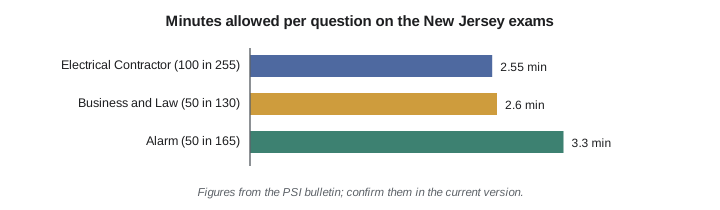
On the Electrical Contractor exam, 255 minutes for 100 questions is about two and a half minutes per question. That sounds generous until a candidate spends eight minutes chasing a single table. The standard method is two passes: on the first pass, answer every question you can answer quickly and mark the rest; on the second pass, return to the marked questions with the remaining time. Lesson 12 develops the method further.
# Minutes per question and checkpoint times for each exam (study aid)
exams = [("Electrical Contractor", 100, 255), ("Business and Law", 50, 130), ("Alarm Systems", 50, 165)]
for name, q, minutes in exams:
    per = minutes / q
    print(name)
    print("   minutes per question:", round(per, 2))
    for frac in (0.25, 0.5, 0.75):
        n = int(q * frac)
print(" by minute", round(minutes * frac), "be past question", n)Electrical Contractor minutes per question: 2.55 by minute 64 be past question 25 by minute 128 be past question 50 by minute 191 be past question 75 Business and Law minutes per question: 2.6 by minute 32 be past question 12 by minute 65 be past question 25 by minute 98 be past question 37 Alarm Systems minutes per question: 3.3 by minute 41 be past question 12 by minute 82 be past question 25 by minute 124 be past question 37
The checkpoints give a simple way to know whether you are on pace. If Danielle reached minute 64 on the Electrical Contractor exam and had not passed question 25, she knew she had spent too long on something and needed to mark and move on.
Worked problem
Planning the day of three exams
Danielle's first attempt is a single day with all three exams. The times are 255, 130 and 165 minutes. Ignoring check-in, tutorials and breaks, how long is the testing time, and what order might she prefer if PSI lets her choose?
Show solution
- Total testing time is 255 + 130 + 165 = 550 minutes, a little over nine hours.
- With check-in, tutorials and breaks, the day is longer still, so food, water and rest matter.
- If the order can be chosen, many candidates take the longest and hardest exam first while fresh, but the order is set by PSI's scheduling, so she should confirm it.
Answer: About 550 minutes of testing, or more than nine hours; she plans the day around that and confirms the exam order with PSI.
What the provided-book rule means for study
Because the code book is provided unmarked, Danielle changed her study plan. She practiced with a clean copy of the 2023 NEC, with her tabbed copy put away. Each evening she did twenty lookups from a list of random topics and timed herself: from reading the question to having her finger on the right section. In the first week her average was over two minutes per lookup. By the end of the month it was under forty seconds. She also memorized the articles and tables that come up most often, such as Article 100 for definitions, Article 210 for branch circuits, Article 220 for load calculations, Article 240 for overcurrent protection, Article 250 for grounding, Table 310.16 for ampacity, Article 430 for motors, Article 450 for transformers and Chapter 9 for conduit fill.
For the Business and Law exam, the opposite was true: the tab system mattered, because she could bring her own marked guide. She spent two Saturdays tabbing and highlighting it, and then practiced with it the way she would use it on test day. For the alarm exam she did both: clean-book drills for the NEC and tabs for NFPA 72 and the handbooks.
Preparing the Business and Law guide
Because candidates bring their own Business and Law reference guide, the way it is prepared is part of the preparation for the exam. Permanently attached tabs at each chapter, and at the pages for formulas and tables used in calculations, save time on every look-up. Highlighting the key numbers, such as tax rates, depreciation lives and record retention periods in the guide, helps the eye land on the right line. Loose sticky notes, handwritten notes and inserted pages are not allowed, and a guide that has them may be refused at check-in, so candidates should check the bulletin and inspect the book before test day.
Danielle bought a new copy of the edition the bulletin listed rather than borrowing Walter's older one, because the page numbers in her practice materials matched the current edition. She tabbed it over two evenings and then spent a week answering practice questions using only the tabs, adjusting any tab that did not get her to the answer quickly.
Common mistakes
MistakeBringing a tabbed NEC to the Electrical Contractor exam.
InsteadThe center provides the NEC and candidates may not bring or mark their own copy for that exam.
MistakeUsing sticky notes as tabs in the Business and Law guide.
InsteadOnly permanent tabs are allowed; temporary tabs must be removed before the exam.
MistakeWriting formulas in the margins of the reference guide.
InsteadHighlighting and underlining are allowed, but written notes are not.
MistakeAssuming all three exams have the same time limit.
InsteadThe Electrical Contractor, Business and Law and Alarm Systems exams have different limits: 255, 130 and 165 minutes.
Summary and key terms
- The Electrical Contractor exam has 100 questions in 255 minutes; 70 correct passes.
- The Business and Law and Alarm Systems exams have 50 questions each, with 130 and 165 minutes; 35 correct passes.
- The 2023 NEC is provided at the center and may not be marked; candidates may not bring their own copy for the Electrical Contractor exam.
- Candidates bring their own NASCLA New Jersey guide for Business and Law, and NFPA 72 and listed handbooks for the alarm exam; highlighting and permanent tabs are allowed.
- A two-pass method and checkpoint times help candidates keep pace on long open-book computer exams.
- Open book
- An exam that allows approved references during the test, under the rules in the bulletin.
- Provided reference
- A book the test center supplies, such as the NEC for the Electrical Contractor exam.
- Permanent tab
- An index tab fixed to the page; the only kind allowed in a candidate's own references.
- NASCLA guide
- The Contractor's Guide to Business, Law and Project Management, the Business and Law reference.
- Two-pass method
- Answer quick questions first, mark the rest, and return to them with the remaining time.
Practice problems
Work each problem on paper first, then reveal the answer to check.
How many correct answers pass the Electrical Contractor exam?
Show answer
70 out of 100.
May a candidate bring a tabbed NEC to the Electrical Contractor exam?
Show answer
No. The center provides the NEC and it may not be marked.
Which reference does the candidate bring to the Business and Law exam?
Show answer
The NASCLA Contractor's Guide to Business, Law and Project Management, New Jersey edition.
What is the time limit of the Alarm Systems exam?
Show answer
165 minutes for 50 questions.
Lesson quiz · 5 questions
Score 60% or more to complete this lesson.
Create a free account to save your progress, take quizzes and earn a certificate.