
MELU-305 · Lesson 1 of 12 · 22 min
How electrical licensing works in New Jersey
▶ Video coming soon A video version of this lesson is on the way.
Walter Kowalski started Raritan Valley Electric Co. in Edison in 1994 with a rented garage, a second-hand van and the New Jersey electrical contractor license he had passed the year before. Thirty-two years later the company has twenty-two electricians, two estimators and a steady book of commercial and residential work across Middlesex and Union counties: medical office fit-outs in Metuchen, warehouse services in Carteret, school renovations in Woodbridge, apartment-building EV chargers in Highland Park and a long list of service upgrades for homeowners. On a cold Monday in January, Walter asked his lead foreman, Danielle Reyes, to stay after the safety meeting. 'I am sixty-one,' he said. 'Every permit this company pulls carries my seal. If Raritan Valley is going to outlast me, you need to sit for the state exams and become our qualifying licensee.' He handed her the board's application packet and the PSI candidate bulletin he had printed the night before.
Danielle had nine years in the trade: a four-year registered apprenticeship through a joint training program, five years as a Class A journeyman wiring commercial and residential jobs, and the last two years running crews for Raritan Valley. She had also worked through the master electrician core courses on the National Electrical Code, load calculations, grounding, motors and transformers, special occupancies, and business and law. This course applies that preparation to New Jersey: who licenses electrical contractors, who must hold a license and who is exempt, how the three exams work, which code edition applies, how permits and inspections are handled under the Uniform Construction Code, what the qualifying licensee is responsible for, and the New Jersey law on insurance, contracts, liens, prompt payment, workers' compensation, safety and renewal that the business and law exam tests.
The agency and the board
New Jersey licenses electrical contractors through the State Board of Examiners of Electrical Contractors. The board was created by the Electrical Contractors Licensing Act, enacted in 1962 and codified at N.J.S.A. 45:5A-1 and the sections that follow. It sits within the Division of Consumer Affairs, which is part of the Department of Law and Public Safety. The division provides the staff who process applications, issue licenses and business permits, collect fees and investigate complaints, while the board itself decides who is qualified, adopts rules and disciplines licensees. The board's detailed rules are in N.J.A.C. 13:31, which is organized into subchapters on general rules, licensure and business permits, standards of practice, licensure exemptions, the Class A journeyman electrician license, the Class B wireman license and the Class A electrical apprentice.
The board's authority also comes partly from the Uniform Enforcement Act at N.J.S.A. 45:1-14 and following, which applies to most professional and occupational boards under the Division of Consumer Affairs. That act sets out the general grounds for discipline, such as fraud, gross negligence, professional or occupational misconduct and failure to cooperate with an investigation, along with the board's powers to subpoena records, impose civil penalties and suspend or revoke licenses. When a board rule says a violation is occupational misconduct under N.J.S.A. 45:1-21, that is the Uniform Enforcement Act at work.
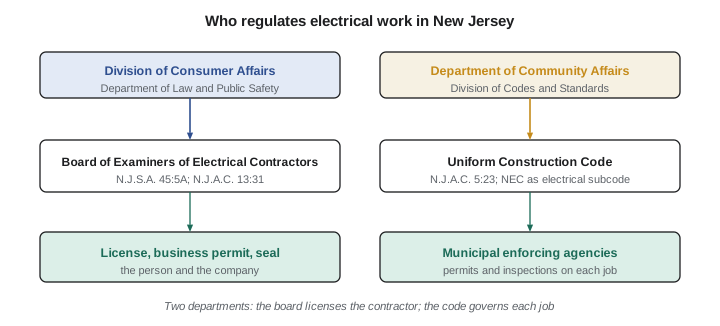
Two departments, two jobs
Students who come from other states are sometimes surprised that two separate departments matter to a New Jersey electrical contractor, and that both happen to be abbreviated DCA in casual conversation. The Division of Consumer Affairs, in the Department of Law and Public Safety, houses the licensing board. The Department of Community Affairs houses the Division of Codes and Standards, which adopts and administers the Uniform Construction Code under the State Uniform Construction Code Act of 1975. The construction code includes an electrical subcode, which is the National Electrical Code as adopted and amended by the state. Municipal enforcing agencies apply that code to individual jobs through permits and inspections.
The practical difference is simple. The licensing board decides whether a person and a business are allowed to do electrical contracting at all. The construction code system decides whether a particular installation is acceptable. A licensed contractor who does sloppy work can be cited by the municipal electrical subcode official under the construction code and can also be disciplined by the board, because board rules require work that complies with the Uniform Construction Code in effect when it is done. On the business and law exam and in practice, it helps to ask first which system a question belongs to.
The license and the business permit
New Jersey separates the person from the business. The license is issued to an individual who has met the experience requirements and passed the exams. The business permit is issued to the business that wants to offer electrical contracting to the public, and it can be held by an individual licensee or by a firm such as a corporation, partnership or limited liability company that has a licensed electrical contractor as its qualifying licensee. A business cannot advertise, bid, contract for or perform electrical work for others in New Jersey without a business permit, and it cannot get a business permit without a qualifying licensee who meets the board's requirements.
This split matters for Raritan Valley. Walter's license is personal. The business permit belongs to Raritan Valley Electric Co., with Walter named as its qualifying licensee. When Walter retires, his license does not transfer to the company or to Danielle. Danielle must earn her own license, and the company must then update its business permit so that she is the qualifying licensee. Lesson 7 covers the qualifying licensee's duties in detail, and Lesson 8 covers the insurance and other requirements that come with the business permit.
| Credential | Who holds it | What it allows |
|---|---|---|
| Electrical contractor license | An individual who passed the exams | Qualifies that person to be responsible for electrical contracting |
| Business permit | An individual licensee or a firm with a qualifying licensee | Lets the business offer and perform electrical contracting |
| Class A journeyman electrician license | An individual electrician | Recognizes journeyman-level qualification; may supervise under board rules |
| Class B wireman license | An individual worker | A board-issued credential for a lower classification of worker |
| Class A electrical apprentice | A registered apprentice | Recognizes enrollment in an accredited apprenticeship |
Who must be licensed and who is exempt
The default rule in New Jersey is broad: electrical work for others requires a licensed electrical contractor working under a business permit. The statute then lists exemptions in N.J.S.A. 45:5A-18. They include minor repairs such as replacing lamps and fuses, plugging portable appliances into existing outlets, testing, servicing and repairing electrical equipment, electrical work in mines, ships, railroad cars, elevators, escalators and vehicles, the facilities of public utilities and municipal electric systems, regulated communications and signal companies, commercial radio and television transmitting equipment, work by the federal government, and work involving less than ten volts.
Several exemptions come up again and again on the exam and in practice. A person may do electrical work on a home occupied solely by that person or the person's immediate family. Regular employees who are Class A licensed journeymen may install and maintain electrical equipment on premises occupied by their employer. Qualified employees of the state, counties, municipalities and school districts may work on their employer's own property under conditions the statute sets. Landscape irrigation work at thirty volts or less is exempt from licensing, although it still needs construction code inspection. Licensed alarm businesses may do alarm work, but not branch circuit wiring, and stepping outside that limit is treated as professional misconduct. The board's rules add a limited telecommunications wiring exemption and limited exemptions for well drillers and pump installers and for testing and servicing equipment.
An exemption from licensing is not an exemption from the construction code. A homeowner who rewires her own kitchen in Edison still needs a permit from the Edison construction office and still has to pass inspection. A school district maintenance electrician working on district property still has to meet the electrical subcode. The exemption only answers the question of whether a licensed electrical contractor with a business permit must do the work.
| Kind of work | Licensed contractor with business permit needed? | Construction code permit? |
|---|---|---|
| New lighting and receptacles in a dental office | Yes | Yes |
| Homeowner rewiring her own single-family home | No, owner-occupant exemption | Yes |
| Changing a lamp or a fuse | No, minor repair | No |
| Doorbell or thermostat wiring under ten volts | No, under-ten-volt exemption | Depends on the work and the subcode |
| Landscape irrigation controls at 24 volts | No, irrigation exemption | Yes, the statute keeps the inspection |
| Plant electrician installing equipment for his own employer | No, if a regular employee holding a Class A journeyman license | Yes |
# Does a job need a licensed contractor with a business permit? (simplified study aid)
jobs = [
    ("New feeder and panel in a Metuchen dental office", "for_others", 208),
    ("Owner rewiring her own house", "owner_occupant", 120),
    ("Smart thermostat wiring", "for_others", 9),
    ("Irrigation controller wiring", "irrigation", 24),
    ("EV chargers in a Highland Park apartment garage", "for_others", 208),
]
def needs_contractor(kind, volts):
    if kind == "owner_occupant":
        return "no (owner-occupant exemption; permit still needed)"
    if volts < 10:
        return "no (under ten volts)"
    if kind == "irrigation" and volts <= 30:
        return "no (irrigation exemption; inspection still needed)"
    return "yes"
for name, kind, volts in jobs:
    print(name)
print(" licensed contractor:", needs_contractor(kind, volts))New feeder and panel in a Metuchen dental office licensed contractor: yes Owner rewiring her own house licensed contractor: no (owner-occupant exemption; permit still needed) Smart thermostat wiring licensed contractor: no (under ten volts) Irrigation controller wiring licensed contractor: no (irrigation exemption; inspection still needed) EV chargers in a Highland Park apartment garage licensed contractor: yes
The calculator captures three filters that decide many exam questions: is the person working on a home occupied only by the owner's family, is the work under ten volts, and is it landscape irrigation at thirty volts or less? Real situations can be more detailed. A low-voltage control system fed from a 120-volt supply still needs the power side installed by someone allowed to do it, and many alarm and communications questions turn on the exact wording of the exemptions and the separate alarm licensing law.
Worked problem
Sorting Raritan Valley's spring jobs
Walter lists four jobs for the spring: a 2,000-ampere service for a distribution warehouse in Carteret, a kitchen remodel for a homeowner who wants to do her own wiring in Edison and only needs advice, a ten-charger EV installation in a Highland Park apartment garage, and replacing failed lamps in a Woodbridge office's parking lot fixtures. Which jobs require a licensed electrical contractor working under a business permit?
Show solution
- The warehouse service is electrical work for others with no exemption, so it needs the license and business permit.
- The homeowner may do the work on her own occupied home under the owner-occupant exemption, though she still needs a permit and inspection; Raritan Valley's advice alone is not contracting.
- The EV chargers are electrical work for others in a multi-family building, so they need the license and business permit.
- Replacing failed lamps is a minor repair listed in the exemptions, so no license is needed for that task alone.
Answer: The warehouse and the EV chargers need a licensed contractor with a business permit; the homeowner's own work and the lamp replacement do not.
Unlicensed contracting and the identification card
Engaging in electrical contracting without a license and business permit, or claiming to be licensed when you are not, violates the act. The board and the Division of Consumer Affairs can seek civil penalties, and the Uniform Enforcement Act allows penalties that increase for repeat violations. The board's rules also guard against lending a license. Each licensed electrical contractor receives a pocket identification card when the license or business permit is renewed every three years, and the contractor must show it to the inspection agency on request when applying for permits. A licensee who knowingly or carelessly lets someone else use the card can be disciplined, and an unlicensed person who uses another person's card can be treated as practicing without a license and may be refused a license later.
The pressure seal works the same way. The board issues each licensed contractor an official seal, and the contractor must sign and seal every permit application and every inspection request. The seal is for that contractor's own work only. Walter's rule at Raritan Valley is that the seal never leaves the office safe except in his hand, and Priscilla Grant, the office manager, logs every application it touches.
Where the rules live
New Jersey electrical contractors work under several layers of law, and the business and law exam expects candidates to know which layer answers which question. The statutes set the framework: N.J.S.A. 45:5A for contractor licensing, the Uniform Enforcement Act at N.J.S.A. 45:1-14 and following for discipline, the State Uniform Construction Code Act at N.J.S.A. 52:27D-119 and following for the construction code system, the Construction Lien Law at N.J.S.A. 2A:44A for liens, the Prompt Payment Act at N.J.S.A. 2A:30A for payment timing and the workers' compensation law in Title 34. Board rules in N.J.A.C. 13:31 fill in licensing details such as business permits, supervision, seals and the journeyman license. The Department of Community Affairs rules in N.J.A.C. 5:23 adopt the electrical subcode and set permit and inspection procedures. Municipal enforcing agencies handle the permits, fees and inspections for each job. When a question comes up, start by asking which layer it belongs to.
Danielle started a binder with one tab for each layer and a page at the front listing the official website for each. It became the backbone of her study plan, and by the end of the course it had turned into the office reference Priscilla uses when a new employee asks why a form has to be signed a certain way.
Common mistakes
MistakeAssuming the license belongs to the company.
InsteadThe license is personal to the individual; the business holds a business permit with a qualifying licensee.
MistakeThinking a homeowner exemption means no permit is needed.
InsteadThe owner-occupant exemption removes the licensing requirement only; the Uniform Construction Code still requires permits and inspections.
MistakeConfusing the two departments called DCA.
InsteadThe Division of Consumer Affairs houses the licensing board; the Department of Community Affairs adopts and administers the construction code.
MistakeLending the seal or identification card to a non-licensed employee.
InsteadBoth are for the licensee's own work; misuse is grounds for discipline and can be treated as unlicensed practice.
Summary and key terms
- The State Board of Examiners of Electrical Contractors, within the Division of Consumer Affairs, licenses electrical contractors under N.J.S.A. 45:5A, with rules in N.J.A.C. 13:31.
- The license is issued to an individual; a business needs a business permit with a qualifying licensee before it can offer electrical contracting.
- N.J.S.A. 45:5A-18 lists exemptions, including minor repairs, work under ten volts, owner-occupied homes, certain employees and low-voltage irrigation work.
- Exemptions from licensing do not remove construction code permits and inspections, which the Department of Community Affairs governs through the Uniform Construction Code.
- Licensees receive an identification card and a pressure seal; both must be used only for the licensee's own work.
- Board of Examiners
- The State Board of Examiners of Electrical Contractors, which licenses contractors and issues business permits.
- Business permit
- The board credential that allows a business to offer and perform electrical contracting.
- Qualifying licensee
- The licensed electrical contractor who qualifies a business permit and is responsible for its electrical work.
- Uniform Construction Code
- The state construction code, including the electrical subcode, adopted by the Department of Community Affairs.
- Pressure seal
- The board-issued seal a licensee must apply, with a signature, to permit and inspection requests.
Practice problems
Work each problem on paper first, then reveal the answer to check.
Which statute creates the New Jersey electrical contractor licensing system?
Show answer
The Electrical Contractors Licensing Act, N.J.S.A. 45:5A-1 and following.
Does a homeowner need a licensed contractor to rewire her own occupied single-family home?
Show answer
No, the owner-occupant exemption applies, but she still needs a construction code permit and inspection.
Name three exemptions listed in N.J.S.A. 45:5A-18.
Show answer
Any three of minor repairs, portable appliances, testing and servicing equipment, public utilities, work under ten volts, owner-occupied homes, certain employees and landscape irrigation at thirty volts or less.
What must a licensee apply to every permit application and inspection request?
Show answer
The licensee's signature and board-issued pressure seal.
Lesson quiz · 5 questions
Score 60% or more to complete this lesson.
Create a free account to save your progress, take quizzes and earn a certificate.