
MELU-305 · Lesson 7 of 12 · 19 min
Duties and responsibilities of the Electrical Contractor License holder
▶ Video coming soon A video version of this lesson is on the way.
Walter had one more meeting with Danielle before the business permit changed hands. He brought a folder of old letters from the board, a few inspection reports with red ink on them and a copy of the board's supervision rule with the margins full of his notes. 'Passing the exams makes you a licensee,' he said. 'Becoming our qualifying licensee makes you responsible for every wire this company pulls. That is a different job.' This lesson covers what that job involves under the board's rules: supervision, presence, the seal and identification card, subcontracting and joint ventures, pricing, and the grounds on which the board can discipline a licensee.
Responsibility for all electrical work
The board's supervision rule, N.J.A.C. 13:31-3.4, makes the qualifying licensee fully responsible for overseeing all electrical work performed by the business permit holder, other than activities that are exempt from licensing. That responsibility includes making sure the work complies with the board's rules and with the Uniform Construction Code in effect when the work is done. The rule requires the qualifying licensee to personally inspect the work of employees and to make sure the level of supervision on each job fits the competence of the workers and the complexity of the work.
Responsibility does not mean the qualifying licensee personally installs every device. It means the licensee is accountable for the system of supervision, the competence of the people doing the work and the quality of the result. When an inspector writes a violation, when a customer complains to the board or when an accident happens, the qualifying licensee is the person the board looks to. Walter's way of explaining it to the crew was simple: 'Danielle's name and seal are on the permit. If you take a shortcut, you are taking it with her license.'
Regular and continuous presence
The rule also requires the qualifying licensee to be present regularly and continuously at the business permit holder's principal office in New Jersey or, if the business has no New Jersey office, at its New Jersey job sites. The purpose is to prevent a licensee from lending a name to a business that he or she does not actually run or supervise. A licensee who lives out of state and never visits the jobs, or who works full time for another employer while 'qualifying' a business on paper, is the kind of arrangement the rule is designed to stop.
For Raritan Valley, the requirement shaped the transition. Walter would stay on part time for a year as a licensed electrical contractor and adviser, but Danielle, as the qualifying licensee, would be in the Edison office or on the company's job sites every working day. Her calendar showed it: mornings in the office reviewing permits and job reports, afternoons visiting two or three sites, and a weekly walk-through on the biggest job.
The supervision ratio and the 3.5-year rule
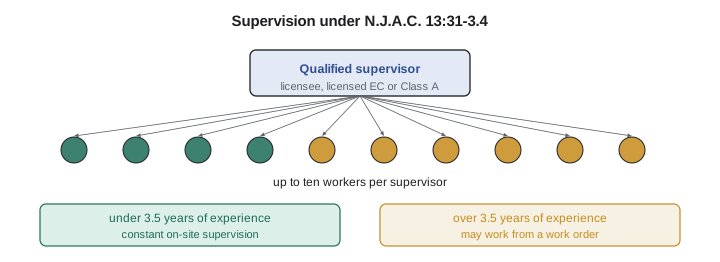
The supervision rule sets numbers as well as principles. It requires one supervisor for every ten workers, counted whether the workers are on one site or spread across several sites at the same time. Under the 2025 amendment, the supervisor may be the qualifying licensee, a licensed electrical contractor or a Class A journeyman electrician. The level of supervision then depends on each worker's experience with the Uniform Construction Code. A worker with less than three and a half years of experience must have a supervisor on site constantly. A worker with more than three and a half years may work from a verbal or written work order describing the job, and confirms in writing or verbally when the job is complete.
A violation of the supervision rule is treated as occupational misconduct under N.J.S.A. 45:1-21, which means the board can discipline the qualifying licensee, including fines, suspension or revocation in serious cases. The rule therefore affects how a contractor plans crews, especially when work spreads across many small jobs at once.
# Check a day's crew plan against the supervision rule (study aid)
import math
crews = [
    # (site, workers, supervisors on site, workers under 3.5 years experience)
    ("Metuchen dental office", 6, 1, 2),
    ("Highland Park EV garage", 4, 0, 1),
    ("Carteret warehouse", 9, 1, 3),
]
workers = sum(c[1] for c in crews)
supervisors = sum(c[2] for c in crews)
needed = math.ceil(workers / 10)
print("Total workers:", workers, " supervisors:", supervisors, " needed by ratio:", needed)
for site, w, sup, junior in crews:
    if junior > 0 and sup == 0:
        print("PROBLEM:", site, "has", junior, "junior workers but no supervisor on site")
    else:
print("ok:", site)Total workers: 19 supervisors: 2 needed by ratio: 2 ok: Metuchen dental office PROBLEM: Highland Park EV garage has 1 junior workers but no supervisor on site ok: Carteret warehouse
The check shows why both parts of the rule matter. Across the three sites, nineteen workers need at least two supervisors, and two are scheduled, so the ratio is met. But the Highland Park garage has an apprentice with less than three and a half years of experience and no supervisor on site, which breaks the constant-supervision requirement. Danielle moved a Class A journeyman from Carteret to Highland Park for the day, leaving Carteret with its own journeyman supervisor.
Seal, signature and identification card
As Lesson 1 explained, the board issues each licensee a pressure seal and requires the licensee to sign and seal every permit application and every inspection request. The seal is for the licensee's own electrical contracting work only. The board also issues a pocket identification card at each triennial renewal, which the licensee must show to the inspection agency on request when applying for permits. A licensee who knowingly or carelessly lets someone else use the card can be disciplined, and the rule treats use of the card by someone else as dishonest conduct.
These rules make the qualifying licensee the gatekeeper for every permit the company pulls. Danielle reviews each application before sealing it: scope, edition of the code, load calculation, the drawings if any and the crew assigned. Priscilla prepares the paperwork, but only Danielle applies the seal.
Subcontracting and joint ventures
The board's rule on joint ventures and subcontracting, N.J.A.C. 13:31-3.5, closes another route around licensing. When two or more parties form a joint venture to perform electrical work in New Jersey, each party must hold its own business permit. A business permit holder may subcontract electrical work only to another business permit holder, and may not subcontract electrical work to unlicensed persons. The rule allows a permit holder to assign work to its own employees, who work under the qualifying licensee's supervision, but it does not allow a permit holder to pass work to an unlicensed outside company.
In practice, this means Raritan Valley checks the business permit of every electrical subcontractor it hires and keeps a copy in the job file. When a general contractor asks Raritan Valley to bring in a low-voltage company for a security system, Danielle confirms whether that company holds a business permit, whether the work falls under the alarm-business exemption, which excludes branch circuit wiring, or whether Raritan Valley must do part of the work itself.
Excessive pricing
The board's rule on unconscionable pricing, N.J.A.C. 13:31-3.7, prohibits a licensee from charging an excessive fee. A fee is excessive when a prudent contractor who knows the local market would view it as so high that it takes advantage of the customer. In deciding, the board considers factors such as the time and labor required, the novelty and difficulty of the work, the skill needed, any special demands the customer makes, the contractor's experience and reputation, the cost of materials and the fees customarily charged locally for similar work. Charging an excessive price is occupational misconduct.
The rule matters most in emergencies, such as storm damage or a failed service in winter, when customers have little choice. Raritan Valley's policy is to use its normal emergency rates, explain them before starting and put them in writing.
Workers' compensation and work standards
The board's rules also require business permit holders to carry the workers' compensation coverage New Jersey law requires for their employees, to keep a certificate of coverage on file, and to make sure subcontractors and temporary workers under their supervision are covered. Another rule ties licensees' work to the construction code and inspection system. Lesson 8 covers insurance and workers' compensation in more detail.
Discipline
The Uniform Enforcement Act lists the grounds on which the board may discipline a licensee, including obtaining a license by fraud, engaging in dishonesty, fraud, deception or misrepresentation, gross negligence or repeated acts of negligence, professional or occupational misconduct, conviction of crimes related to the occupation, practicing while impaired, failing to comply with board orders and failing to cooperate with a board investigation. Board rules then define specific conduct, such as violating the supervision rule or charging excessive prices, as occupational misconduct.
Possible sanctions include reprimands, civil penalties that increase for repeat violations, required education, suspension and revocation, along with orders to pay investigative costs and restitution. The board may also seek court orders against unlicensed practice. Many matters are resolved by consent order, in which the licensee agrees to a sanction without a full hearing. A licensee who receives a letter from the board should respond on time and in full and consider legal advice.
| Duty | Where it comes from | Typical consequence of a violation |
|---|---|---|
| Oversee all electrical work and personally inspect | N.J.A.C. 13:31-3.4 | Occupational misconduct; discipline |
| Be regularly and continuously present | N.J.A.C. 13:31-3.4 | Occupational misconduct; discipline |
| One supervisor per ten workers; constant supervision under 3.5 years | N.J.A.C. 13:31-3.4 | Occupational misconduct; discipline |
| Sign and seal every permit and inspection request | N.J.A.C. 13:31-3.3 | Rejected applications; discipline for misuse |
| Subcontract only to permit holders | N.J.A.C. 13:31-3.5 | Discipline; unlicensed-practice exposure |
| Avoid excessive pricing | N.J.A.C. 13:31-3.7 | Occupational misconduct; discipline |
Worked problem
A Friday afternoon problem
At 3 p.m. on a Friday, a general contractor calls Danielle: his own laborer, who has no electrical license, wants to finish wiring a set of receptacles on a Raritan Valley job so the drywall crew can start Monday. He offers to pay for the laborer's time. What should Danielle do?
Show solution
- The laborer is not a Raritan Valley employee, and Raritan Valley may not subcontract electrical work to an unlicensed person under N.J.A.C. 13:31-3.5.
- If Raritan Valley allowed it, the work would be under Danielle's permit and seal without her supervision, a supervision violation.
- She declines, schedules her own crew for Saturday or Monday morning and adjusts the drywall schedule with the general contractor.
Answer: She refuses to let the unlicensed laborer do the work and sends her own crew, keeping the work under her supervision and permit.
Documenting supervision
Because the qualifying licensee answers for all work, the best defense in a complaint is a record that shows supervision happened. Raritan Valley's daily reports list who was on each site, who supervised and what was inspected. Danielle signs the weekly summary for every open job.
Common mistakes
MistakeTreating the qualifying licensee as a name on the permit.
InsteadThe qualifying licensee must oversee all work, personally inspect it and be regularly present.
MistakeCounting only the ratio and ignoring experience levels.
InsteadWorkers with under 3.5 years of experience need constant on-site supervision, whatever the ratio.
MistakeSubcontracting electrical work to an unlicensed outside company.
InsteadSubcontracting is allowed only to other business permit holders.
MistakeCharging whatever the market will bear in an emergency.
InsteadExcessive pricing is occupational misconduct under N.J.A.C. 13:31-3.7.
Summary and key terms
- The qualifying licensee is fully responsible for all non-exempt electrical work of the business permit holder and must personally inspect employees' work.
- The licensee must be regularly and continuously present at the principal New Jersey office or New Jersey job sites.
- The rule requires one supervisor for every ten workers; workers with under 3.5 years of experience need constant on-site supervision.
- Each joint venture party needs its own business permit, and electrical work may be subcontracted only to permit holders.
- The Uniform Enforcement Act and board rules set grounds for discipline, including occupational misconduct and excessive pricing.
- Supervision ratio
- One supervisor for every ten workers under N.J.A.C. 13:31-3.4.
- 3.5-year threshold
- The experience level below which a worker needs constant on-site supervision.
- Occupational misconduct
- A ground for discipline under N.J.S.A. 45:1-21, applied to rule violations.
- Joint venture
- Two or more parties performing work together; each needs its own business permit.
- Consent order
- An agreed board order resolving a disciplinary matter without a full hearing.
Practice problems
Work each problem on paper first, then reveal the answer to check.
What ratio of supervisors to workers does the board's rule require?
Show answer
One supervisor for every ten workers.
Who may act as a supervisor under the 2025 version of the rule?
Show answer
The qualifying licensee, a licensed electrical contractor or a Class A journeyman electrician.
May a business permit holder subcontract electrical work to an unlicensed company?
Show answer
No. It may subcontract only to another business permit holder.
Name three factors the board considers in judging whether a price is excessive.
Show answer
Any three of time and labor, novelty and difficulty, skill required, special customer demands, the contractor's experience and reputation, material costs and customary local fees.
Lesson quiz · 5 questions
Score 60% or more to complete this lesson.
Create a free account to save your progress, take quizzes and earn a certificate.