
MELU-305 · Lesson 12 of 12 · 19 min
Practice exam review and test-day strategy
▶ Video coming soon A video version of this lesson is on the way.
Danielle took all three New Jersey exams on a single Tuesday in early June 2026 at a PSI center in Edison. She arrived forty minutes early with two forms of identification, her NASCLA business and law reference guide with permanent tabs, and a bag of almonds for the breaks. By late afternoon she had sat in front of a screen for most of nine hours. She passed all three, and the Business and Law exam, which she had worried about least, was the one that came closest to beating her. This lesson collects what she learned, so that you can plan your own test day the same way.
What you are facing
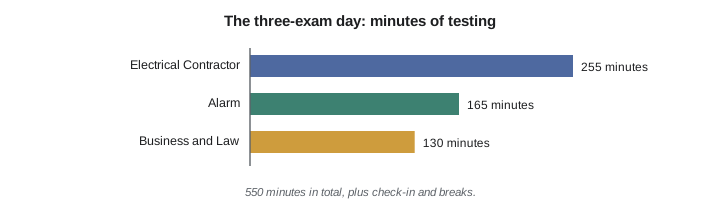
The Electrical Contractor exam has 100 questions in 255 minutes and requires 70 correct answers to pass. The Business and Law exam has 50 questions in 130 minutes and requires 35 correct. The Alarm exam, covering fire alarm and related systems, has 50 questions in 165 minutes and requires 35 correct. Candidates approved on or after March 16, 2015 take all three on the same day, which adds up to 550 minutes of testing plus check-in and breaks. Planning for that length of day is as important as knowing the content.
The references are different for each exam. For the Electrical Contractor exam, PSI provides an unmarked copy of the 2023 National Electrical Code at the test center, and candidates may not bring their own. For the Business and Law exam, candidates bring their own copy of the NASCLA business and law reference guide for New Jersey, in the edition the bulletin lists; highlighting and permanently attached tabs are allowed, but notes and loose papers are not. The Alarm exam references include NFPA 72 and other documents the bulletin lists. Check the bulletin for exactly which references are provided and which you must bring.
Studying for an unmarked code book
Because the code book at the test center is unmarked, the highlighting and tabs that help with other states' exams are no help here. What matters is knowing the structure of the code well enough to find any topic in seconds. Candidates should memorize the chapter structure, know the major article numbers by heart and practice using the index until it becomes automatic. Articles such as 90, 100, 110, 210, 215, 220, 225, 230, 240, 250, 300, 310, 314, 356 through 362 for raceways, 430, 445, 450, 480, 500 through 517, 690, 700, 701, 702 and 760 come up again and again, and knowing which article answers which kind of question saves minutes on every look-up.
Danielle practiced with a clean copy of the code for the last four weeks before her exam, so she would be used to finding things without her own tabs. She timed herself on sets of twenty questions and wrote down which articles she had to search for longest, then studied those articles until she could find them without the index. By test day she could open the book within a few pages of most sections on the first try.
Studying for the Business and Law exam
The Business and Law exam rewards knowing your reference guide. Its questions cover business organization, licensing law and rules, contracts, liens and payment, estimating and bidding, project management, accounting, tax, payroll, insurance, risk management, labor law and safety. Many questions are calculations, such as markup and margin, depreciation, payroll tax and break-even, and others ask about deadlines and requirements in New Jersey law. Tab the guide by chapter, highlight the key numbers, and practice finding answers quickly. Candidates also need to know the New Jersey statutes and rules this course covers, since not every state-specific requirement is answered word for word in the guide.
Danielle's mistake was spending too long on calculation questions she could have flagged and returned to. Business and Law gives roughly two minutes and thirty-six seconds per question, which sounds generous until a depreciation schedule takes six minutes. On her second pass she still had fourteen flagged questions and had to rush the last few. Practice the calculations until they are routine, and flag any that take longer than a couple of minutes.
| Exam | Questions | Minutes | Minutes per question | To pass |
|---|---|---|---|---|
| Electrical Contractor | 100 | 255 | 2.55 | 70 correct |
| Business and Law | 50 | 130 | 2.6 | 35 correct |
| Alarm | 50 | 165 | 3.3 | 35 correct |
The two-pass method
Open-book exams punish candidates who look up every question. The two-pass method keeps time under control. On the first pass, answer every question you know without the book, and for questions that need a look-up, make one quick attempt; if the answer is not found within about a minute, mark the question and move on. On the second pass, return to the marked questions with the time that remains, spending more time on those you can find and guessing on the rest. Never leave a question blank, since there is no penalty for a wrong answer.
# Two-pass pacing for the Electrical Contractor exam (study aid)
total_minutes = 255
questions = 100
first_pass_share = 0.55     # fraction of the time used on pass one
first_pass = round(total_minutes * first_pass_share)
second_pass = total_minutes - first_pass
print("Average per question:", total_minutes / questions, "minutes")
print("Pass one budget:     ", first_pass, "minutes")
print("Pass two budget:     ", second_pass, "minutes")
for checkpoint in (25, 50, 75, 100):
print("By question", checkpoint, "aim for minute", round(first_pass * checkpoint / questions))Average per question: 2.55 minutes Pass one budget: 140 minutes Pass two budget: 115 minutes By question 25 aim for minute 35 By question 50 aim for minute 70 By question 75 aim for minute 105 By question 100 aim for minute 140
Worked problem
Pacing a three-exam day
Danielle starts the Electrical Contractor exam at 8:30 a.m. She plans a short break after it, then Business and Law, a lunch break, then Alarm. Roughly when will she finish if each exam uses its full time and each break is fifteen minutes, with a thirty-minute lunch?
Show solution
- Electrical Contractor runs 255 minutes, from 8:30 to 12:45, followed by a fifteen-minute break to 1:00.
- Business and Law runs 130 minutes, from 1:00 to 3:10, followed by a thirty-minute lunch to 3:40.
- Alarm runs 165 minutes, from 3:40 to 6:25, so the day ends around 6:25 p.m. if every exam uses its full time; breaks and their order depend on PSI's procedures.
Answer: About 6:25 p.m., which is why food, water and pacing matter as much as content.
Practice exam review
Practice exams are most useful when the review takes longer than the test. For each missed question, write down why it was missed: the content was not known, the reference could not be found in time, the question was misread, or a calculation went wrong. Each cause has its own fix: study, practice look-ups, slow down on reading or practice calculations. Track results by topic so that study time goes where it does the most good. Danielle kept a spreadsheet of every practice question she missed by exam and topic, and her weakest topics in March were not the ones she expected.
The course final exam is a mixed review of all twelve lessons. Take it under timed conditions, then use the same review method. A score well above the passing line on several practice exams is a good sign that you are ready to book. If you are consistently close to the line, the time to fix that is before test day, because a retake means a six-month wait.
Test-day checklist
The day before, confirm the test center location, time and identification rules, pack the Business and Law reference guide and any other references you are allowed to bring, and get a full night's sleep. On test day, arrive early, follow the center's rules on personal items and breaks, read each question completely before answering, watch for words such as not, except, minimum and maximum, and keep an eye on the clock at each checkpoint. After each exam, put it out of your mind and focus on the next one. Score reports are given at the center, and candidates who pass all three follow the board's instructions to apply for the license.
Two months after she passed, Danielle signed her first permit application as Raritan Valley's qualifying licensee. Walter framed her score reports and hung them next to his own, from 1994, in the office in Edison.
A six-week study plan
Danielle's final six weeks followed a simple plan. In weeks one and two she worked through the Electrical Contractor content by article, timing herself on look-ups in a clean code book and logging every slow search. In weeks three and four she worked through the Business and Law reference guide by chapter, practicing calculations until each type took under two minutes, and reviewed the New Jersey statutes and rules from this course. In week five she studied the Alarm references and took one full practice exam for each test. In week six she reviewed only her error log, took one more timed practice exam for each test and rested on the final day.
Her error log showed patterns she had not expected. On the Electrical Contractor practice exams, most misses were look-up failures rather than gaps in knowledge, and they clustered in a few articles she rarely used at work, such as those on hazardous locations and health care facilities. On Business and Law, most misses were calculation errors made under time pressure. Fixing those patterns raised her practice scores more than any amount of general reading.
Reading the question
Many wrong answers come from reading the question too fast. Read the whole question and every option before answering. Identify what is being asked: a minimum or a maximum, a requirement or an exception, a definition or a calculation. Watch for qualifiers such as not, except, only, always, never and unless. For calculation questions, write down the given values on the scratch material the center provides and check that the answer has the right units. For code questions, confirm that the section found actually applies to the occupancy, voltage or equipment in the question before choosing an answer.
When two answers both look correct, the question usually turns on a detail. Return to the wording and look for the condition that rules one out. When no answer looks correct, the question may be testing an exception or a different article; a fresh look-up in the index often finds it.
Managing energy over a long day
Nine hours of testing is tiring. Eat a solid breakfast, bring food and water for breaks if the center allows it, and use each scheduled break to stand up, stretch and look away from screens. Between exams, avoid reviewing what you think you missed, since it cannot be changed. Start each exam fresh, with the same pacing plan, and expect the last exam of the day to feel harder than it is because you are tired. Danielle kept a written checkpoint plan for each exam on her scratch sheet and checked it every twenty-five questions, which kept her steady through the afternoon.
After the exams
Candidates who pass all three exams follow the board's instructions to apply for the license and, if they will qualify a business, the business permit with proof of insurance. Candidates who fail an exam retake only the failed exam after the waiting period, so the error log from that exam becomes the study plan for the next attempt.
Common mistakes
MistakeRelying on personal tabs and notes in the NEC.
InsteadPSI provides an unmarked code book for the Electrical Contractor exam; study with a clean copy.
MistakeLooking up every question on the first pass.
InsteadAnswer what you know, make one quick look-up and flag the rest for the second pass.
MistakeUnderestimating the Business and Law exam.
InsteadIts calculations and tight time per question catch many candidates; practice them.
MistakeLeaving questions blank.
InsteadThere is no penalty for wrong answers, so answer every question.
Summary and key terms
- The three exams total 550 minutes and are taken on the same day by candidates approved on or after March 16, 2015.
- The Electrical Contractor exam uses an unmarked 2023 NEC provided at the center, so article numbers and index skills matter.
- The Business and Law exam uses the candidate's own tabbed and highlighted reference guide.
- The two-pass method keeps look-ups from consuming the clock.
- Review practice exams by cause and topic, and book only when scores are well above the passing line.
- Two-pass method
- Answering known questions first and returning to flagged ones with the remaining time.
- Unmarked reference
- A code book provided at the test center without the candidate's notes or tabs.
- Checkpoint
- A planned time to reach a given question number during the exam.
- Score report
- The pass or fail result given at the test center.
- Error log
- A record of missed practice questions by cause and topic.
Practice problems
Work each problem on paper first, then reveal the answer to check.
How many minutes of testing does the three-exam day include?
Show answer
550 minutes.
May candidates bring their own NEC to the Electrical Contractor exam?
Show answer
No; PSI provides an unmarked copy.
What may candidates add to their Business and Law reference guide?
Show answer
Highlighting and permanently attached tabs, but not notes.
Is there a penalty for a wrong answer?
Show answer
No, so every question should be answered.
Lesson quiz · 5 questions
Score 60% or more to complete this lesson.
Create a free account to save your progress, take quizzes and earn a certificate.