
MELU-305 · Lesson 11 of 12 · 19 min
Renewal and continuing education
▶ Video coming soon A video version of this lesson is on the way.
A license that lapses is worse than no license at all, Walter liked to say, because the company keeps working as if nothing has changed. In his thirty years as Raritan Valley's qualifying licensee he never missed a renewal, and the reason was Priscilla's wall calendar, which showed every renewal, insurance date and continuing education deadline for the company in red. When Danielle took over, Priscilla added a new row with Danielle's name and the first date that mattered: March 31, 2027.
The renewal cycle
New Jersey electrical contractor licenses renew on a triennial cycle, every three years. The board's cycle has recently ended on March 31 of the renewal year, with the most recent cycle ending in 2024, so the next renewal is expected to fall due on March 31, 2027. A licensee who is first licensed partway through a cycle renews at the end of that cycle with everyone else, and the board's rules set how continuing education is prorated for a new licensee. The board sends renewal notices before the deadline, generally by email and through its online licensing system, but the licensee is responsible for renewing whether or not a notice arrives.
Renewal involves paying the renewal fee, attesting that the continuing education requirement has been met and confirming that the required insurance remains in force. A licensee who does not renew by the deadline cannot lawfully act as an electrical contractor until the license is reinstated, and the board's rules set late fees and reinstatement conditions, which become more demanding the longer the license has lapsed. Practicing on an expired license is unlicensed practice, which can lead to penalties under the Uniform Enforcement Act.
Continuing education requirements
Under N.J.S.A. 45:5A-13.1, each licensed electrical contractor must complete continuing education as a condition of renewal. The requirement is commonly stated as thirty-four credit hours in each triennial period. Course providers report that the requirement includes a ten-hour code update course, commonly described as nine hours on the current National Electrical Code and one hour on New Jersey law and regulation, taken in a live classroom or live online format, and that only a limited number of credits, commonly up to eight, may be earned through distance learning that is not live. Credits must come from courses and providers approved by the board.
Approved topics generally include the National Electrical Code, the Uniform Construction Code and its electrical subcode, New Jersey electrical contractor law and rules, safety, alarm and communications systems, and business practices related to electrical contracting. The board's rules may limit how many credits a licensee can earn in a single area or from repeating the same course within a cycle. Credits earned beyond the requirement in one cycle generally do not carry over into the next.
| Item | Study summary (confirm with the board) |
|---|---|
| Cycle | Triennial, ending March 31; next expected March 31, 2027 |
| Total credits | 34 credit hours per triennial period |
| Code update | A 10-hour course, about 9 hours NEC and 1 hour New Jersey law, taken live |
| Distance learning | Limited, commonly up to 8 credits not taken live |
| Approval | Courses and providers approved by the board |
| Records | Keep certificates for the period the board's rules require |
Keeping records and responding to audits
At renewal, licensees attest that they have completed the requirement, and the board may audit a sample of licensees afterward. An audited licensee must produce certificates of completion for the courses claimed. A false attestation is a serious matter; it can lead to discipline for misrepresentation in addition to any shortfall in credits. Licensees should keep their certificates for at least the period the rules require, and Priscilla keeps a scanned copy of every certificate in a folder for each cycle, with a running total of credits by category.
# Track continuing education credits for the 2024-2027 cycle (study aid)
required_total = 34
max_distance = 8
courses = [
    ("2023 NEC code update and NJ law (live)", 10, "live"),
    ("Grounding and bonding (live online)",     6, "live"),
    ("Arc flash and NFPA 70E (self-paced)",     4, "distance"),
    ("Fire alarm systems (live)",               8, "live"),
    ("Business practices (self-paced)",         5, "distance"),
]
live = sum(h for _, h, kind in courses if kind == "live")
distance = sum(h for _, h, kind in courses if kind == "distance")
counted = live + min(distance, max_distance)
print("Live credits:     ", live)
print("Distance credits: ", distance, "(counted:", min(distance, max_distance), ")")
print("Counted total:    ", counted, "of", required_total)
print("Still needed: ", max(0, required_total - counted))Live credits: 24 Distance credits: 9 (counted: 8 ) Counted total: 32 of 34 Still needed: 2
Danielle's plan for the remaining credits is to take a live course on the 2023 NEC changes for health care facilities, which also helps the company bid on more dental and medical work. Because the code update course must be taken in the cycle and must be live, she booked it early, through a provider whose course is approved by the board, rather than waiting for the crowded classes in the final winter before the deadline.
Keeping the business permit and seal current
Renewal covers more than the license. The business permit, which allows the company to offer electrical contracting services, is tied to the qualifying licensee and renews with the license. Raritan Valley's permit lists Danielle as the qualifying licensee, and if she left the company or her license lapsed, the company could not continue contracting without a new qualifying licensee and an updated permit within the time the rules allow. The licensee's identification card and seal are tied to the license and permit records, and the board may issue updated cards at renewal; contractors should follow the board's instructions about which cards and seals are current.
The general liability insurance or letter of credit required by N.J.S.A. 45:5A-9.1 must stay in force throughout the cycle, not just at renewal. The insurer must give the board advance notice of cancellation, and a lapse can lead to suspension of the business permit. Workers' compensation coverage, business registration and any public works registration renew on their own schedules. Priscilla's calendar includes each of these: the general liability renewal in June, workers' compensation in January, the business registration certificate as required and the public works contractor registration before the school bid season.
Worked problem
Planning a renewal
It is November 2026. Danielle has 33 counted credits and one self-paced hour beyond the distance cap. The company's general liability policy renews in June 2027. What should she do before March 31, 2027?
Show solution
- Complete at least one more approved live credit so the counted total reaches 34, keeping certificates for each course.
- Renew the license and confirm the business permit lists her as qualifying licensee, paying fees and attesting to the education requirement by March 31, 2027.
- Confirm the current general liability certificate is on file with the board, and diary the June renewal so the insurer files the new certificate before the old one expires.
Answer: Finish the credits with a live course, renew by March 31, 2027 and keep the insurance on file without a gap.
Inactive status and changes of status
A licensee who stops working as a qualifying licensee may be able to keep the license in a status the board's rules provide, which can preserve it without the full obligations of an active contractor, and return later by meeting reactivation conditions such as continuing education. A licensee who moves to another company must update the board's records, and the old company's business permit is affected if the licensee was its qualifying licensee. Walter planned to keep his license after retirement so that he could consult and teach, and he asked the board how to do so without holding a business permit.
Choosing continuing education that pays off
Continuing education is a requirement, but it is also an opportunity. A licensee can use the credits to build skills the company needs: health care facilities, emergency and standby systems, energy storage, solar, fire alarm and communications, or estimating and project management. Danielle chose courses that matched the work Raritan Valley wanted to bid over the next three years and asked Omar and the crew leaders which topics caused the most questions in the field. The answer was grounding and bonding on services and separately derived systems, so she chose a live course on that subject and shared the course materials with the crew leaders afterward.
Licensees should also watch for code cycle timing. A new NEC edition is published every three years, and New Jersey's adoption comes later through the Uniform Construction Code. A code update course taken early in a cycle may cover a different edition than one taken near the end. The board approves the code update course for the cycle, so the course listed for the current cycle is the one to take.
Changes the board must know about
Licensees must notify the board of changes in address, business name, business structure and the qualifying licensee for a business permit within the times the rules set. A company that converts from a sole proprietorship to a corporation, or adds a second location, may need an updated business permit. When Walter stepped down, Priscilla filed the change of qualifying licensee the same week, attaching Danielle's license number and the updated insurance certificate, and asked the board to confirm the record before Danielle signed her first permit application.
Planning the cycle
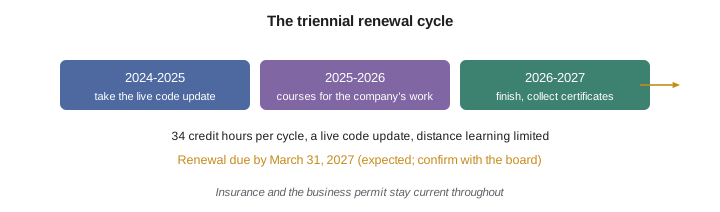
A simple plan keeps renewal from becoming a last-minute scramble. In the first year of the cycle, take the live code update course as soon as it is available. In the second year, take courses tied to the company's work and finish most of the remaining credits. In the final year, confirm the total, collect certificates, check the insurance on file and renew early, well before March 31. Priscilla's wall calendar shows those three steps for each licensee, and the red date at the end of the cycle has never yet been missed.
Candidates studying for the exam should remember one more point: the Business and Law exam can ask about renewal and continuing education requirements, and the answers may come from the law and rules rather than the reference guide. Knowing the triennial cycle, the credit total and the live course requirement can be worth points on test day as well as keeping the license active afterward.
If a renewal is missed
If the deadline passes without renewal, the licensee should stop acting as an electrical contractor and contact the board right away about reinstatement. The board's rules set the fees and conditions, which commonly include completing any missing continuing education and paying late or reinstatement fees, and they grow more demanding the longer the license has lapsed. Work performed while a license has lapsed can expose both the licensee and the business to penalties, and permit applications signed and sealed during the lapse may be questioned. The company's customers, insurers and enforcing agencies may also need to be told. Prevention is far easier: renew early, confirm that the board's online record shows the new expiration date, and keep a copy of the confirmation with the cycle's certificates.
Common mistakes
MistakeWaiting for the board's notice before starting the renewal.
InsteadThe licensee is responsible for renewing on time whether or not a notice arrives.
MistakeCounting all self-paced hours toward the total.
InsteadDistance learning that is not live is limited, commonly to eight credits.
MistakeTaking the code update course online on demand.
InsteadThe code update course must be taken live, in a classroom or live online.
MistakeLetting the liability policy lapse between renewals.
InsteadThe insurance must stay in force throughout the cycle, and a lapse can lead to suspension.
Summary and key terms
- New Jersey electrical contractor licenses renew every three years, with the next renewal expected by March 31, 2027.
- Each cycle requires 34 credit hours from approved providers, including a live code update course.
- Distance learning that is not live is limited, commonly to eight credits.
- Licensees attest at renewal and must keep certificates in case of an audit.
- The business permit, insurance, workers' compensation and registrations must stay current alongside the license.
- Triennial
- Every three years; New Jersey's renewal cycle for electrical contractor licenses.
- Code update course
- The required live course on the current NEC and New Jersey law.
- Distance learning
- Courses not taken live, which count only up to a limit.
- Audit
- A board review of a licensee's certificates after renewal.
- Reinstatement
- Restoring a lapsed license under conditions in the board's rules.
Practice problems
Work each problem on paper first, then reveal the answer to check.
How often do New Jersey electrical contractor licenses renew?
Show answer
Every three years.
How many continuing education credits are required in each cycle?
Show answer
Thirty-four credit hours.
What format must the code update course use?
Show answer
Live, in a classroom or live online.
What must a licensee produce in a continuing education audit?
Show answer
Certificates of completion for the courses claimed.
Lesson quiz · 5 questions
Score 60% or more to complete this lesson.
Create a free account to save your progress, take quizzes and earn a certificate.