
MELU-223 · Lesson 9 of 12 · 18 min
Contracts and mechanics' liens in Minnesota
▶ Video coming soon A video version of this lesson is on the way.
The Waite Park dental clinic was the job Lars still talked about. Crow River wired the clinic as a subcontractor to a general contractor that had always paid on time, until it did not. The last progress payment stalled, then the general contractor stopped answering calls, and Crow River was owed a little over 48,000 dollars for work the clinic was already using. "What saved us," Lars told Nadia, "was that Becky had a calendar with three dates on it, and we didn't miss any of them. A lien is the strongest tool a contractor has in Minnesota, and it disappears the day after you miss a deadline."
This lesson covers the contracts and lien law a Minnesota electrical contractor works with: the parts of a good contract, payment terms and change orders, the mechanics' lien under Minnesota Statutes chapter 514, the pre-lien notice, the deadlines for recording and serving a lien statement and for starting a foreclosure action, and practical record keeping. The master exam tests the main ideas and the key numbers, and a responsible master who understands them protects the company's cash.
Contracts
Every job should start with a written contract that identifies the parties, the property, the scope of work, the price or pricing method, the schedule, payment terms, change order procedures, warranty terms, insurance requirements and how disputes will be resolved. On commercial jobs, the electrical contractor is usually a subcontractor working under a general contractor's form, and that form often favors the general contractor. On residential jobs, Crow River is often the prime contractor dealing directly with the homeowner, which brings its own notice duties under the lien law.
Change orders deserve special attention. Electrical scopes change constantly as owners add equipment, designers revise drawings and existing conditions turn out different from the plans. A contract that requires written change orders before extra work begins protects both sides, but only if the contractor follows it. Many payment disputes are really disputes about undocumented extras that the crew did in good faith on a verbal request.
| Clause | Why it matters to an electrical contractor |
|---|---|
| Scope and exclusions | Defines what is included, such as permits, fixtures and temporary power |
| Payment terms | Sets when progress payments and retainage are due |
| Change orders | Requires written approval of extra work and price |
| Pay-when-paid | May tie the subcontractor's payment to the owner paying the general contractor |
| Insurance and indemnity | Shifts risk; may require higher limits than the license minimums |
| Dispute resolution | Sets mediation, arbitration or court, and sometimes the location |
What a mechanics' lien is
A mechanics' lien is a claim against the real property that was improved. Minnesota's lien law, in chapter 514, gives contractors, subcontractors, suppliers and certain others who contribute labor, skill or materials to the improvement of real estate the right to a lien on that property for the value of their contribution. The lien gives the unpaid party security in the property itself, so that even if the party who hired them cannot pay, the property can be sold to satisfy the claim through a court action.
The lien is powerful because it reaches the owner's property even when the owner has paid the general contractor. That is also why the statute protects owners with notice requirements and short deadlines. A contractor who wants the benefit of the lien must follow every step precisely and on time.
The pre-lien notice
Minnesota requires a pre-lien notice to the owner in many situations, under section 514.011. The purpose is to warn owners that unpaid contractors and suppliers may have lien rights, so that owners can protect themselves by getting lien waivers or paying parties directly. The statute sets out what the notice must say, often in specific wording and type size.
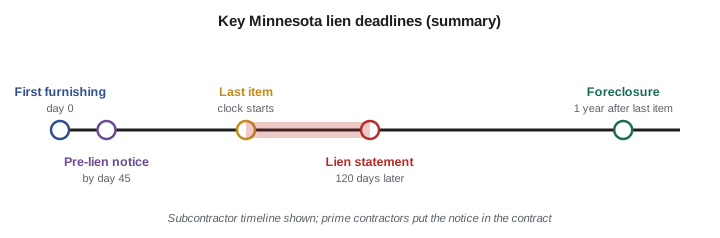
Prime contractors who contract directly with the owner generally give the notice by including it in the written contract. Subcontractors and suppliers who do not contract with the owner generally must give the notice to the owner within 45 days after they first furnish labor, skill or materials to the job. The statute has exceptions, including for some larger commercial and industrial projects and certain other situations, and the notice rules differ between residential and other property. Because the exceptions are detailed, the safe practice is to give the notice unless a lawyer has confirmed that an exception applies.
Crow River's practice is simple. On every residential job where Crow River contracts directly with the homeowner, the contract includes the statutory notice. On every job where Crow River is a subcontractor, Becky sends a pre-lien notice to the owner within the first week of work, by a method that leaves a record, and files a copy in the job folder. A notice sent early costs a stamp; a notice missed can cost the lien.
The lien statement
To keep a lien, the claimant must record a lien statement with the county where the property is located, and serve a copy on the owner, within 120 days after the claimant last furnished labor, skill or materials to the improvement, under section 514.08. The lien statement identifies the claimant, the owner, the property, the person who hired the claimant, the amount claimed and the dates of first and last furnishing, and it must be verified. The 120 days run from the last item actually furnished for the improvement under the contract, not from the date of the last invoice.
The last-item date is often argued about. A return visit to correct a minor defect or a warranty call may not extend the date, while genuine contract work does. Courts look at whether the work was part of the original contract and done in good faith, not done just to stretch the deadline. Crow River records the last date of real contract work on each job in the job file the day it happens.
# Minnesota lien calendar from the dental clinic job (study aid)
from datetime import date, timedelta

first_furnished = date(2025, 9, 15)
last_furnished = date(2026, 3, 12)

pre_lien_by = first_furnished + timedelta(days=45)      # subcontractor notice
record_by = last_furnished + timedelta(days=120)        # lien statement recorded and served
foreclose_by = date(last_furnished.year + 1, last_furnished.month, last_furnished.day)

print("Pre-lien notice by:  ", pre_lien_by.isoformat())
print("Lien statement by:   ", record_by.isoformat())
print("Foreclosure action by:", foreclose_by.isoformat())Pre-lien notice by: 2025-10-30 Lien statement by: 2026-07-10 Foreclosure action by: 2027-03-12
Foreclosing the lien
A recorded lien does not pay anyone by itself. If the claim is not paid, the claimant must start a court action to foreclose the lien within one year after the last item was furnished, under section 514.12. If the year passes without an action, the lien is lost, even if the lien statement was recorded on time. In practice, many lien claims settle once a lien is recorded, because owners and lenders want clear title, but the one-year deadline must be calendared from the start.
On the dental clinic job, Crow River's last real contract work was the final connection of the sterilization equipment circuits on March 12, 2026. Becky had sent the pre-lien notice within the first week, back in September 2025. When the general contractor stopped paying, she worked with the company's lawyer to record and serve the lien statement in May, well inside the 120 days. The clinic owner's lender wanted the lien removed before refinancing, and the owner paid Crow River directly in June. No foreclosure action was needed, but the March 2027 date was on the calendar anyway.
Good faith and overstated liens
The lien statement must claim only what is actually owed for lienable work. A claimant who knowingly overstates the claim, for example by including work on other jobs, disputed extras without basis or inflated charges, risks losing the lien and may face liability. Minnesota courts recognize only a narrow exception for an innocent mistake in good faith. The lesson for a master is to make every lien statement accurate, supported by the contract, change orders and invoices.
Lien waivers and payment
Owners, lenders and general contractors protect themselves by asking for lien waivers when they pay. A lien waiver is a signed statement that the contractor gives up lien rights for a stated amount or period, usually in exchange for a payment. There are conditional waivers, which take effect only when the payment actually clears, and unconditional waivers, which take effect when signed. A contractor should never sign an unconditional waiver for money it has not received. Becky's rule is to sign conditional waivers with each pay application and unconditional waivers only after the check has cleared.
Payment problems usually start small. A late progress payment, a request to hold invoices or a general contractor that stops returning calls are all warning signs. The master's job is to notice them early, check the lien dates and decide with the owner of the business whether to keep working. Continuing to work on a job that is not paying only increases the amount at risk.
Retainage and closeout
Many commercial contracts hold back part of each progress payment, called retainage, until the job is complete. Retainage often makes up most of the money still owed at the end of a job, which is exactly when lien deadlines are running. A contractor waiting for retainage should not let the 120-day clock run out while waiting for a punch list to be signed off. If closeout drags, the master should check the last-item date, talk with the general contractor about when retainage will be released, and decide with counsel whether a lien statement is needed to protect the claim.
Closeout documents are also part of getting paid. Owners and general contractors commonly ask for final lien waivers, as-built drawings, panel schedules, warranty letters and proof of final inspection before releasing the last payment. Having these ready the week the work finishes, rather than a month later, shortens the wait and keeps the payment inside the lien period. Becky starts a closeout checklist the day rough-in passes, so the paperwork grows alongside the job instead of piling up at the end.
Records that support a lien
A lien is only as good as the records behind it. Crow River's job folders hold the signed contract or subcontract, the pre-lien notice and proof of delivery, every change order, daily logs showing who worked and what was installed, delivery tickets for materials, invoices and payments, and the permit and inspection records from lesson 6. The inspection records also help prove when the last work was done, since a passed final inspection is strong evidence of completion.
Worked problem
A late start on a lien
Crow River finished contract work on a Sartell lake home addition on June 2. The homeowner disputes the bill and refuses to pay. Becky discovers the problem on September 25 while reviewing receivables. Crow River was the prime contractor and its contract included the statutory pre-lien notice. Can Crow River still record a lien statement, and by when?
Show solution
- As prime contractor, Crow River gave the pre-lien notice through its contract.
- The lien statement must be recorded and served within 120 days after the last item furnished.
- From June 2, 120 days runs to September 30.
- Crow River must act at once, with a lawyer, to record and serve before September 30, and then calendar the one-year foreclosure deadline of June 2 the following year.
Answer: Yes, if it records and serves by September 30; foreclosure must start by June 2 of the next year.
Common mistakes
MistakeWaiting to send a pre-lien notice until payment is late.
InsteadSubcontractors generally must give notice within 45 days after first furnishing.
MistakeCounting the 120 days from the last invoice.
InsteadCount from the last item of real contract work furnished.
MistakeThinking a recorded lien lasts indefinitely.
InsteadA foreclosure action must start within one year after the last item.
MistakeSigning unconditional waivers before payment clears.
InsteadUse conditional waivers until the money is received.
Summary and key terms
- Minnesota's mechanics' lien law is in chapter 514 and gives contributors a lien on the improved property.
- Prime contractors generally put the pre-lien notice in the contract; subcontractors generally give it within 45 days of first furnishing.
- The lien statement must be recorded and served within 120 days after the last item furnished.
- A foreclosure action must start within one year after the last item, or the lien is lost.
- Overstated liens risk the lien; only a narrow good-faith exception applies.
- Mechanics' lien
- A claim against improved real property for unpaid labor, skill or materials.
- Pre-lien notice
- The statutory notice to the owner that lien rights may arise.
- Lien statement
- The verified document recorded with the county and served on the owner to perfect a lien.
- Foreclosure
- The court action that enforces a lien by sale of the property.
- Lien waiver
- A signed release of lien rights, conditional or unconditional.
Practice problems
Work each problem on paper first, then reveal the answer to check.
How long does a subcontractor generally have to give the pre-lien notice?
Show answer
45 days after first furnishing labor, skill or materials.
Within how many days after the last item must a lien statement be recorded and served?
Show answer
120 days.
When must a lien foreclosure action be started?
Show answer
Within one year after the last item furnished.
Lesson quiz · 5 questions
Score 60% or more to complete this lesson.
Create a free account to save your progress, take quizzes and earn a certificate.