
MELU-223 · Lesson 4 of 12 · 18 min
The exam format and the references allowed
▶ Video coming soon A video version of this lesson is on the way.
Nadia's approval email arrived on a Tuesday in late September with her exam date, the testing site and a short list of rules. One line stopped her: the references would be provided at the exam. "So I don't bring my own code book?" she asked Lars. "Not in Minnesota," he said. "They hand you a clean one. No tabs, no highlighting, no notes. Whatever you've done to your own copy, you leave at home. You have to know where things are without your tabs telling you." Nadia had spent two weeks tabbing her personal copy of the 2026 NEC. She kept the tabs, but from that day she practiced with an untabbed book.
This lesson explains how the Minnesota electrical exams are set up: who writes them, what is provided, what is forbidden, what is known about the format, how the master exam differs from the journeyworker exam, and how to prepare for an open-book exam where the book is clean. It also covers pacing and how to use the laws and rules booklet efficiently.
Who writes and gives the exam
The Department of Labor and Industry writes, administers and grades Minnesota's electrical licensing exams itself. That is different from states that hand the exam to a national testing company, and it has two practical effects. First, the exam is built around Minnesota law and practice, using the department's own question bank and its own laws and rules booklet. Second, the details of the exam, such as the references provided and the rules at the testing site, are set by the department rather than by a vendor's candidate bulletin.
The department describes different difficulty targets for different licenses. According to exam preparation providers summarizing the department's approach, questions for master-level licenses, such as the Class A master, maintenance electrician and power limited technician, are aimed at a higher difficulty than journeyworker questions. In practice that means more design-level calculations, more questions that need two or three lookups, and more questions on the laws and rules that govern a master's responsibilities.
What is provided and what is forbidden
Providers describe the department supplying three things at the exam: a soft-cover copy of the National Electrical Code without tabs or other aids, a Laws and Rules booklet containing the Minnesota Electrical Act and Minnesota Rules chapters 3800 and 3801, and a basic desk calculator. Personal code books, tabbed or not, and other study materials are not allowed. Electronic devices, including cell phones, are not allowed in the building. Because the department supplies the books, the edition question is settled for you: the code book on the desk is the edition the exam is based on, which from September 8, 2026 is the 2026 NEC.
| Item | Status at the exam (as described for 2026) |
|---|---|
| NEC, soft-cover, current edition | Provided by the department, untabbed |
| Laws and Rules booklet (Act, rules 3800 and 3801) | Provided by the department |
| Basic desk calculator | Provided by the department |
| Personal code book, tabbed or untabbed | Not allowed |
| Study guides, notes, formula sheets | Not allowed |
| Phones and other electronic devices | Not allowed in the building |
What is known about the format
For the Class A journeyworker exam, exam preparation providers describe 80 multiple-choice questions, each worth the same, with no partial credit, a time limit of five and a half hours, which is 330 minutes, and a passing mark of 56 correct out of 80, which is seventy correct out of every hundred. They do not publish a separate question count, time or passing mark for the master exam. Candidates should therefore plan with the journeyworker figures as a rough guide and read the master figures in their approval instructions as soon as they arrive.
Whatever the exact numbers, the shape of the exam is predictable. Expect questions across the whole code, with emphasis on the areas the core courses treat as master-level: services and feeders, load calculations, conductor sizing with adjustment and correction, overcurrent protection, grounding and bonding, motors and transformers, and special occupancies and equipment. Expect a block of questions on Minnesota law: license classes and their scopes, supervision, the responsible licensed master, contractor requirements, permits and inspections, and renewal and continuing education.
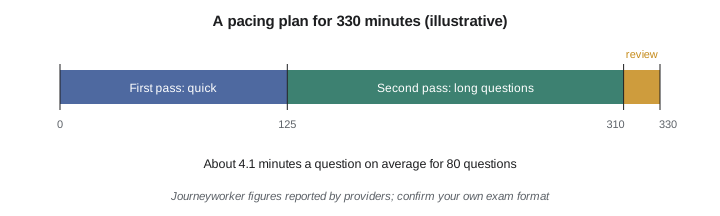
# Pacing with the journeyworker figures as a rough guide (illustrative)
questions, minutes = 80, 330
per_q = minutes / questions
print(f"Average budget: {per_q:.1f} minutes per question")

quick, long_items = 50, 30
quick_budget = 2.5
first_pass = quick * quick_budget
reserve = 20                      # minutes kept for review at the end
second_pass = minutes - first_pass - reserve
print(f"First pass: {quick} quick questions in about {first_pass:.0f} minutes")
print(f"Second pass: {long_items} long questions share {second_pass:.0f} minutes, about {second_pass / long_items:.1f} each")
print("Correct answers needed at 56 of 80:", 56, "so at most", questions - 56, "misses")Average budget: 4.1 minutes per question First pass: 50 quick questions in about 125 minutes Second pass: 30 long questions share 185 minutes, about 6.2 each Correct answers needed at 56 of 80: 56 so at most 24 misses
Preparing for a clean book
In states where candidates bring their own tabbed books, much of exam preparation is tabbing. In Minnesota the tabs stay home, so preparation shifts to knowing the book's structure. The NEC is organized consistently: Article 90 and the definitions in Article 100 at the front, then Chapters 1 through 4 of general rules that apply everywhere, Chapters 5 through 7 that modify the general rules for special occupancies, equipment and conditions, Chapter 8 or its successor material for communications, and Chapter 9 tables and the informative annexes at the back. Within Chapter 3, wiring method articles follow a common numbering of their parts, so a candidate who knows that pattern can find the uses permitted or the securing and supporting section of an unfamiliar raceway article quickly.
Three skills replace tabs. The first is the index: a candidate who can turn a question's key phrase into an index term and an article number in under a minute is far ahead. The second is the table of contents at the front of each article, which lists its parts. The third is memory of the handful of articles and tables that answer a large share of questions, such as the services article, the overcurrent protection article, the conductor ampacity tables, the grounding article and its sizing tables, the motor article and Chapter 9. The 2026 edition reorganized several of these, which the core courses describe, so practice in the 2026 book specifically.
Nadia's routine for the last month was simple. Each evening she took ten practice questions, opened a clean copy of the 2026 NEC, and timed how long each lookup took using only the index and the article outlines. She logged any lookup over three minutes and repeated those the next night. By exam day her slow lookups had dropped from a dozen a night to two or three.
Kinds of questions to expect
Master exam questions fall into a few recognizable types, and recognizing the type early saves time. Direct lookup questions ask for a single rule or value, such as the minimum size of a conductor in a given situation or the clearance required in front of equipment; they reward a fast index search. Calculation questions ask for a load, a conductor size, an overcurrent device rating or a voltage drop, and usually need a lookup as well as arithmetic; they reward a written setup on scratch material if it is provided, so that a mistake can be found and fixed. Application questions describe a situation and ask which rule applies or whether an installation complies; they reward careful reading of the question's details, such as whether a location is damp or wet, or whether a dwelling is one-family or multifamily.
Law questions ask about license classes, supervision, contractor requirements, permits and inspections, and renewal. Some are simple facts; others describe a situation, such as an unlicensed person doing work outside supervision, and ask what the law requires. All law questions can be confirmed in the booklet, and a confirmed answer is worth the same as a hard calculation.
A useful habit is to read the last sentence of a question first, so you know what is being asked before you read the details. Then mark the details that matter: voltage, phase, occupancy, location, conductor material, insulation temperature rating, terminal rating, continuous or noncontinuous load. Many wrong answers on master exams come from a correct method applied to the wrong detail.
Handling uncertain questions
Providers describe every question as carrying the same weight, with no partial credit. A question left blank earns nothing, so unless your exam instructions say otherwise, answer every question before time runs out. On the first pass, if you can narrow a question to two choices but cannot confirm quickly, mark your best choice, flag it and move on. On the second pass, return to flagged questions in order of how close you were. In the last few minutes, check that every question has an answer recorded.
Avoid changing answers on a hunch. Change an answer when a lookup or a recalculation shows the first answer was wrong, not because the first answer suddenly feels doubtful. Candidates who review with a reason gain points; candidates who second-guess without one often lose them.
Using the laws and rules booklet
The laws and rules booklet is short compared with the code, and that makes it the most efficient source of points on the exam. Read it cover to cover at least twice before the exam. Learn where the definitions are, where the license classes and their experience requirements are, where the responsible licensed individual rules are, where the inspection and permit provisions are, and where the renewal and continuing education rules are. On exam day a question about, for example, how many hours of continuing education a master needs and how many must be on the code should take a minute to confirm, not ten.
Candidates who are strong in the trade sometimes treat these questions as common sense and answer from memory. That is how points are lost. The details are specific, they change from time to time, and the booklet is on the desk precisely so that candidates will look them up.
Nadia printed the current Act and chapter 3800 from the Revisor's website, read them with a pencil, and then practiced answering law questions using a clean printout without her pencil marks, the same way she practiced with the code. By the week of the exam she could open the booklet to the right section on the first try for most topics.
Worked problem
Testing a pacing plan
On a timed practice set of 80 questions, Nadia finds that 28 questions need a calculation or several lookups and take her about seven minutes each, while the rest take about two and a half minutes. Does her pace fit within 330 minutes with 20 minutes kept for review?
Show solution
- Quick questions: 52 questions at 2.5 minutes each is 130 minutes.
- Long questions: 28 questions at 7 minutes each is 196 minutes.
- Working time is 326 minutes; adding 20 minutes of review gives 346 minutes.
- That is 16 minutes over, so she needs faster lookups on the long questions or a shorter review.
Answer: No; about 16 minutes over. Faster index lookups on long questions would close the gap.
Common mistakes
MistakeBringing a tabbed personal code book.
InsteadThe department provides an untabbed book; personal books are not allowed.
MistakeStudying with tabs right up to the exam.
InsteadPractice lookups in a clean copy of the current edition so exam conditions feel familiar.
MistakeAnswering law questions from memory.
InsteadConfirm each one in the laws and rules booklet; the details are specific.
MistakeAssuming the master format is the same as the journeyworker format.
InsteadRead the master figures in your approval instructions and plan your pace from them.
Summary and key terms
- The department writes, gives and grades Minnesota's electrical exams.
- References are provided: an untabbed soft-cover NEC, the Laws and Rules booklet and a basic calculator; personal books and electronics are not allowed.
- Providers describe the journeyworker exam as 80 questions in 330 minutes with 56 correct needed; confirm the master figures.
- Master questions aim at a higher difficulty, with more calculations and law questions.
- Prepare by mastering the index, article outlines and key tables in a clean book, and by learning the booklet's layout.
- Laws and Rules booklet
- The department's booklet of the Minnesota Electrical Act and rules chapters 3800 and 3801.
- Untabbed code book
- A copy of the NEC without index tabs or markings, as provided at the exam.
- Two-pass method
- Answering quick questions first and returning to flagged long questions.
- Article outline
- The list of parts at the start of an NEC article.
- Difficulty target
- The department's intended level of challenge for a given license class.
Practice problems
Work each problem on paper first, then reveal the answer to check.
Who provides the code book at the Minnesota electrical exams?
Show answer
The department, as an untabbed soft-cover copy.
What does the Laws and Rules booklet contain?
Show answer
The Minnesota Electrical Act and Minnesota Rules chapters 3800 and 3801.
Using providers' journeyworker figures, how many misses can a candidate afford?
Show answer
24 (80 questions with 56 correct needed).
Lesson quiz · 5 questions
Score 60% or more to complete this lesson.
Create a free account to save your progress, take quizzes and earn a certificate.