
MELU-223 · Lesson 7 of 12 · 18 min
Duties and responsibilities of the Master Electrician License holder
▶ Video coming soon A video version of this lesson is on the way.
Lars Halvorsen had been Crow River Electric's responsible licensed master for twenty-two years, and he did not intend to hand the role to Nadia without a talk. They sat in his pickup outside the Waite Park office remodel on a gray October afternoon. "When the department looks at a Crow River job," he said, "the first name on the paperwork is the company, and the second name is mine. In a few months it will be yours. That means every permit, every crew, every registered unlicensed electrician on our payroll is partly your responsibility, even on the days you are on a different job. The license lets you do more. It also means you answer for more."
This lesson covers the duties that come with a Minnesota master license: what the master license allows, the role of the responsible licensed master for a contractor and the rules that limit it, supervision of journeyworkers and registered unlicensed electricians, the master's duties toward permits and inspection, record keeping, and the grounds on which the department can take action against a license. The exam draws regularly on this material from the laws and rules booklet.
What the master license allows
A Minnesota Class A master electrician license allows its holder to plan, lay out and supervise electrical work, as well as to perform it, and qualifies the holder to serve as the responsible licensed master for an electrical contractor. A Class A journeyworker can perform electrical work and supervise others under the rules, but cannot serve as a contractor's responsible master. The master license is therefore the license that lets a business contract for electrical work: without a responsible master, a business cannot hold an electrical contractor license.
Like other personal licenses, the master license does not by itself allow its holder to contract with the public. An electrical contractor license is a separate license held by the business, as lesson 8 explains. A master who does side jobs for neighbors without a contractor license, a permit and an inspection is doing unlicensed contracting, whatever the quality of the work.
The responsible licensed master
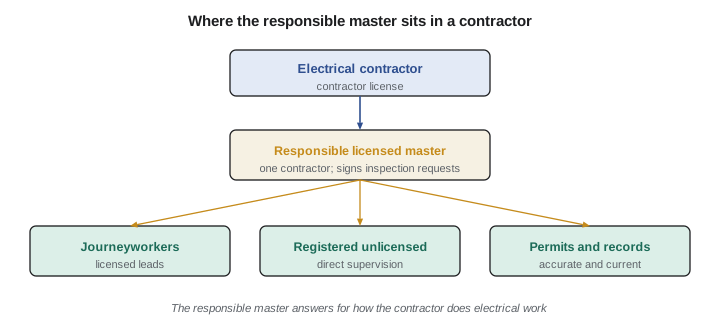
Every electrical contractor must designate a responsible licensed master. Section 326B.33, subdivision 17, sets the main conditions. The responsible master must be an active Class A master electrician, and an individual may serve as the responsible master for only one contractor at a time. The responsible master must be an owner, officer, partner or member of the contractor, or an employee, and if the master is a managing employee rather than an owner, the master must actively perform or supervise electrical work for that contractor. The department's contractor page summarizes the same idea: the responsible licensed individual is an owner or officer, or a W-2 employee, and is not working for another contractor.
The responsible master is the contractor's licensed face. The Act requires that the responsible master sign the contractor's requests for electrical inspection, and contractor license applications and renewals must include a verified statement that the designated master meets the requirements. The statute makes the responsible master responsible for the contractor's electrical work being done in compliance with the Act, the rules and the code. In plain terms, the department expects the responsible master to be a real part of the company, involved in how work is done, not a name on a form.
| Rule | What it means in practice |
|---|---|
| Active Class A master license | The license must be current, not lapsed or inactive |
| One contractor only | A master cannot be the responsible master for two companies |
| Owner, officer, member or employee | The master must be part of the business |
| Managing employee actively involved | A hired master must actually do or supervise the contractor's electrical work |
| Signs requests for inspection | Permits carry the responsible master's signature |
| Verified statement | Applications and renewals confirm the designation is valid |
Renting a license
The one-contractor rule and the active involvement rule exist to stop the practice sometimes called renting a license, in which a master lets a company list him as its responsible master in exchange for a monthly payment, without ever seeing the company's jobs. In Minnesota that arrangement violates the Act for both the master and the company. A master who wants to help a friend's new company should take a real job there and actually direct its work, or decline.
Lars was offered such an arrangement twice in his career. Both times he said no, and both times the company that asked later had its license questioned. He told Nadia the story, then added a practical point: if Crow River ever lost its responsible master, the company should tell the department promptly and designate a new one, rather than keep working on a name that no longer applied.
Supervision of the crew
Minnesota allows unlicensed individuals to do electrical work only if they are registered with the department as registered unlicensed electricians and work under the direct supervision of a licensed master or journeyworker of the appropriate class. The Act and rules limit how many unlicensed individuals one licensed electrician may supervise at a time and describes what direct supervision means; read the current text for the exact limits. Registration must be renewed every year, with two hours of continuing education, and the registration is also how the individual's work experience is recorded for later licensing.
Direct supervision means a licensed person who is on the same job, directing and checking the work, not a licensed person somewhere else in the company. A master is responsible for setting up crews so that every registered unlicensed electrician has a licensed supervisor on site. At Crow River, Lars's rule was that each crew sheet named the licensed lead and listed each registered unlicensed electrician under that lead's name, and no one was sent to a job alone without a license of their own.
# Checking crew sheets for licensed supervision (illustrative; the limit is a placeholder)
LIMIT = 2   # placeholder: check the Act for the current supervision limit
crews = {
    "Sartell addition": {"licensed": 1, "registered_unlicensed": 2},
    "Waite Park remodel": {"licensed": 2, "registered_unlicensed": 3},
    "Cold Spring shop": {"licensed": 0, "registered_unlicensed": 1},
}
for job, c in crews.items():
    ok = c["licensed"] > 0 and c["registered_unlicensed"] <= LIMIT * c["licensed"]
    print(f"{job:20} licensed {c['licensed']}  unlicensed {c['registered_unlicensed']}  ->",
"ok" if ok else "fix crew")Sartell addition licensed 1 unlicensed 2 -> ok Waite Park remodel licensed 2 unlicensed 3 -> ok Cold Spring shop licensed 0 unlicensed 1 -> fix crew
Tyler Vang, a registered unlicensed electrician in his third year, was the reason Nadia took the crew sheets seriously. One morning a scheduling mix-up left him alone at the Sartell addition with a list of devices to install while the journeyworker was across town. Nadia caught it at eight in the morning, sent Tomas to the site and moved Tyler to drilling and pulling cable under Tomas's direction. Nothing went wrong that day, but the job would have been a violation for the company and its responsible master if Tyler had worked alone.
Duties toward permits and inspection
The responsible master must make sure that the contractor's work is permitted before it is done, inspected at the right points and corrected when an inspector writes a correction. Lesson 6 covers the steps. The master does not have to file each permit personally, but signs the requests for inspection and is accountable for their accuracy. A permit that understates the scope to save a fee, or a job left without a final inspection, is the master's problem as well as the company's.
Records
A master should keep records that show the company's compliance: permits and their inspection results, crew sheets showing supervision, registrations and licenses of each worker, continuing education certificates and the employer-signed experience forms the company has issued. These records matter in three situations: when an employee applies for a license and needs experience verified, when the department investigates a complaint, and when a customer disputes payment or quality. Becky keeps these files for Crow River, but Nadia will be the person who signs for them.
Grounds for action against a license
The department's commissioner has enforcement powers under chapter 326B. The commissioner can deny, suspend, revoke or refuse to renew a license, impose penalties and issue orders when a licensee violates the Act, the rules or an order, or engages in fraud, deception or conduct showing incompetence or untrustworthiness. For masters, the classic violations are working without permits, letting unlicensed people work without supervision, serving as a responsible master in name only, falsifying experience forms, and contracting without a contractor license.
Complaints may come from customers, inspectors, competitors or employees. The department investigates and may ask the master for records and an explanation. A master who receives such a request should respond promptly and completely, keep copies and seek advice if the matter is serious. Most complaints are settled with corrections and education, but a pattern of violations can end a career.
Handing over the role
Crow River's change of responsible master is a planned one, which is the best kind. Lars and Nadia agreed on a sequence: Nadia passes the exam and pays the license fee; the company updates its contractor record in iMS to designate her, with the verified statement; Lars stays on for a few months as a second licensed master so that open permits and warranty calls have continuity; and the crew is told who now signs for the company. Open permits filed under Lars's signature stay valid, but Nadia reviews each one so she knows what she is inheriting.
An unplanned change is harder. If a responsible master dies, quits suddenly or lets the license lapse, the contractor has no qualified master behind its license. The company should contact the department at once, stop starting new electrical work it cannot lawfully perform, and designate a new active master as soon as possible. A master who leaves a company should also make sure the department's records show the change, so that his name is not attached to work he no longer controls.
Ethics in the trade
Many of the master's duties come down to honesty. Signing an experience form for an employee means certifying that the months and categories are true; padding them helps no one and can cost the employee a license later. Answering an inspector's question means telling the truth about what is behind the wall. Quoting a customer means including the permit. Nadia had watched Lars do all of these things for years, and the lesson she took was simple: the license is a public trust, and the easiest way to keep it is never to do anything you would not want written on the permit.
Worked problem
A master stretched too thin
A master electrician who works full time as a plant electrician at a manufacturer is asked by his cousin to be the responsible master for the cousin's new contracting company. He would visit the company's jobs on weekends. Is this allowed?
Show solution
- A responsible master must be an owner, officer, member or employee of the contractor.
- If he is only a managing employee, he must actively perform or supervise the contractor's electrical work.
- Weekend visits while working full time elsewhere suggest a name-only arrangement, which the rules are meant to prevent.
- He should decline unless he takes a real role in the cousin's company and directs its electrical work.
Answer: Not as described; it looks like renting a license. He would need a real, active role in the company.
Common mistakes
MistakeThinking a master license allows contracting with the public.
InsteadContracting requires a separate contractor license held by the business.
MistakeServing as responsible master for two companies.
InsteadA master may be the responsible master for only one contractor.
MistakeSending a registered unlicensed electrician to work alone.
InsteadUnlicensed individuals need direct supervision by a licensed electrician on the job.
MistakeTreating experience forms as a formality.
InsteadSigning them certifies that the months and categories are true.
Summary and key terms
- A Class A master may plan, lay out and supervise electrical work and serve as a contractor's responsible licensed master.
- The responsible master must be active, serve only one contractor and be an owner, officer, member or actively involved employee.
- The responsible master signs requests for inspection, and applications include a verified statement of the designation.
- Registered unlicensed electricians must work under direct supervision of a licensed electrician of the same contractor, within the Act's limits.
- The commissioner can deny, suspend or revoke licenses and impose penalties for violations.
- Responsible licensed master
- The active master designated to answer for a contractor's electrical work.
- Registered unlicensed electrician
- An individual registered with the department to do electrical work under direct supervision.
- Direct supervision
- Supervision by a licensed electrician on the same job who directs and checks the work.
- Verified statement
- A sworn statement in a contractor application that the designation rules are met.
- Renting a license
- Lending a master's name to a company without real involvement, which the Act prohibits.
Practice problems
Work each problem on paper first, then reveal the answer to check.
For how many contractors may one master serve as responsible licensed master?
Show answer
Only one.
Who signs a contractor's requests for electrical inspection?
Show answer
The responsible licensed master.
How often must a registered unlicensed electrician renew, and with how much continuing education?
Show answer
Every year, with two hours of continuing education.
Lesson quiz · 5 questions
Score 60% or more to complete this lesson.
Create a free account to save your progress, take quizzes and earn a certificate.