
MELU-223 · Lesson 1 of 12 · 18 min
How electrical licensing works in Minnesota
▶ Video coming soon A video version of this lesson is on the way.
Crow River Electric has wired homes, farms and small commercial buildings around St. Cloud for thirty-one years. Its founder, Lars Halvorsen, holds a Class A master electrician license and has been the company's responsible licensed master since the day he hung out his shingle. This fall Lars told his crew he plans to step back within two years, and he asked Nadia Okafor, a Class A journeyworker who joined the company as a registered unlicensed electrician in 2016, whether she wanted to be the person who takes his place. Nadia said yes before he finished the question, then spent the evening finding out what saying yes actually meant. "In Minnesota the state is involved in almost everything," Lars told her the next morning. "Licensing, inspection, the code. Learn how the pieces fit before you open a code book."
This course follows Nadia from that conversation to the day she holds a master license and can serve as Crow River's responsible licensed master. It is built on the master electrician core courses (MELU-101 to MELU-107), which teach the National Electrical Code and the business topics shared by every state. This course adds what is specific to Minnesota: the agencies and laws, the eligibility rules, the exam, the code as adopted, permits and inspections, contractor licensing, liens, safety and workers' compensation, and renewal.
The agencies
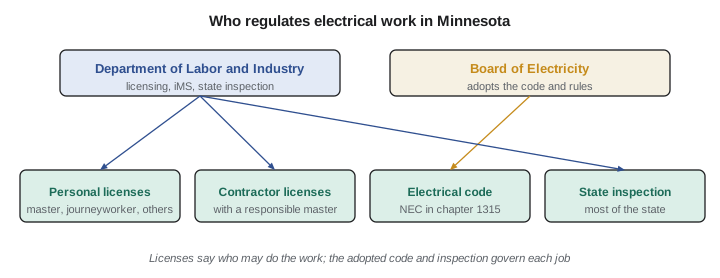
Electrical licensing and inspection in Minnesota sit within the Department of Labor and Industry, usually called DLI. The department administers the Minnesota Electrical Act, issues personal licenses and contractor licenses, writes and gives the licensing examinations, and runs the state electrical inspection program. Alongside it sits the Board of Electricity, a board appointed under the Act whose members include licensed electricians, contractors, inspectors and members of the public. The board adopts the rules that govern licensing and the electrical code, approves continuing education, and hears certain matters, while the department carries out the day-to-day work.
The working arrangement is easiest to remember as a split between rules and operations. When the electrical code changes edition, it is the Board of Electricity that adopts the new edition as part of the State Building Code. When Nadia files her application, schedules her exam or later files a permit, she deals with the department through its online system, called iMS. Questions about whether her experience counts go to the department's licensing unit, and questions about a particular installation go to the inspector who has jurisdiction over that job.
Personal licenses and the contractor license
Minnesota separates two questions that some states blend together: who is qualified to do electrical work, and which businesses may offer that work to the public. The first question is answered by personal licenses held by individuals. The second is answered by the electrical contractor license held by a business. A person can hold a master license and never run a company, and a company can hold a contractor license without its owner holding any personal license, as long as it has a responsible licensed individual on staff.
The personal licenses relevant to this course form a ladder. A registered unlicensed electrician may perform electrical work only under the direct supervision of a licensed electrician employed by the same company, and registration lets the person build documented experience. A Class A journeyworker electrician has passed the journeyworker exam after at least four years of experience and may do electrical work without that direct supervision, but cannot serve as the responsible licensed person for a contractor. A Class A master electrician has met the master experience or education criteria, passed the master exam, and may be designated as the responsible licensed master for one contractor or employer.
The Act also provides other personal licenses with narrower scopes, among them the power limited technician for technology and power limited circuits, the maintenance electrician for maintenance work for an employer, the lineman, the elevator constructor, and the satellite system installer. Class B master and journeyworker licenses also appear in the statute, but the Class B master license has not been issued to new applicants since August 1, 1985. Existing holders may renew, which is why you may still meet one on an older job.
| License or registration | What it allows (summary) | Experience before the exam |
|---|---|---|
| Registered unlicensed electrician | Work under direct supervision of a licensed electrician at the same company | None; registration builds experience |
| Class A journeyworker | Electrical work without direct supervision | At least 48 months |
| Class A master | All of the above, and may be a contractor's responsible licensed master | 60 months, or 1 year as a licensed journeyworker, or a four-year electrical degree |
| Power limited technician | Technology and power limited circuits | 36 months |
| Electrical contractor (business) | Offer and perform electrical work for others | Must designate a responsible licensed individual |
Why the state is the usual inspector
Minnesota has one feature that surprises electricians from many other states: electrical inspection is largely a state function. In most of the state, the electrical inspector is a state inspector or an inspector working under contract with the department, and permits, which Minnesota has historically called requests for electrical inspection, are filed with the department. A number of cities and other local governments have taken on electrical inspection themselves under the Act, and in those places the permit and inspection run through the local authority. The department publishes an inspector directory that shows, for each area, whether the authority having jurisdiction is the state or a local body.
For a contractor this means the first question on any new job is not which city it is in but who the authority is. Crow River works in Stearns, Benton, Sherburne and Wright counties, and Becky Lindgren, the office manager, keeps a printed list of the towns where a local inspector handles electrical permits. Lesson 6 covers permits and inspections in detail.
Statewide licensing, statewide code
Because licensing is statewide, a Minnesota license is good everywhere in the state; cities do not issue their own electrician licenses. Because the electrical code is adopted by the Board as part of the State Building Code, the same edition of the National Electrical Code applies statewide on the same effective date, whether the inspector is a state inspector or a local one. In 2026 the Board adopted the 2026 NEC with an effective date of August 17, 2026, and the department moved its licensing exams to the 2026 NEC beginning September 8, 2026. Lesson 5 explains how the effective date and the permit filing date work together.
# Which agency handles what? A small lookup used in the office (study aid)
roles = {
    "adopts the electrical code": "Board of Electricity",
    "issues personal licenses": "Department of Labor and Industry",
    "issues contractor licenses": "Department of Labor and Industry",
    "writes and gives license exams": "Department of Labor and Industry",
    "approves continuing education": "Board of Electricity",
    "inspects jobs in most areas": "State inspectors and contract inspectors",
}
for task in sorted(roles):
print(f"{task:32} -> {roles[task]}")adopts the electrical code -> Board of Electricity approves continuing education -> Board of Electricity inspects jobs in most areas -> State inspectors and contract inspectors issues contractor licenses -> Department of Labor and Industry issues personal licenses -> Department of Labor and Industry writes and gives license exams -> Department of Labor and Industry
The laws you will see on the exam
Three sources of law matter most for the Minnesota-specific part of the master exam. The first is the Minnesota Electrical Act itself, which defines electrical work, sets out the license classes and their experience requirements, requires contractors to designate a responsible licensed individual, sets the contractor bond, and gives the department its inspection and enforcement powers. The second is Minnesota Rules chapter 3800, which fills in details such as how experience is counted, how licenses and registrations are renewed, and continuing education. The third is Minnesota Rules chapter 3801 and the electrical code adoption in chapter 1315, which together connect the National Electrical Code to Minnesota law.
Exam candidates are not expected to memorize statute numbers, but they are expected to know what the law requires. The department provides a booklet of the Act and rules at the exam, which means a candidate who knows the booklet's layout can find an answer quickly. Lesson 4 explains the exam setup and what is provided, and lessons 7, 8 and 11 cover the parts of the Act and rules most likely to be tested.
How the pieces fit for Crow River
Put together, the system works like this for Nadia. Her experience, documented through her registration and her journeyworker license, qualifies her to apply for the master exam. The department approves her application, she takes the exam, and she receives a master license. Crow River then updates its contractor license to show Nadia as its responsible licensed master. From that point every permit Crow River files names a licensed contractor whose responsible master answers for the work, and every installation is inspected by the authority having jurisdiction against the code edition in effect on the date the permit was filed.
What the master license adds
Nadia already does nearly every kind of electrical work Crow River sells. What changes when she becomes a master is responsibility rather than skill. As the responsible licensed master she will answer to the department for every installation Crow River's crews make, whether or not she touched it herself. She will sign inspection requests, decide how the registered unlicensed electricians are supervised, and be the person an inspector calls when a correction order is issued. If an installation is unsafe or a permit was never filed, it is her license, as well as the company's, that is exposed to discipline.
That is why the master exam goes deeper than the journeyworker exam into design-level calculations, the laws and rules, and the business of contracting. The department's own description of its exams says master-level licenses are aimed at a higher difficulty than the journeyworker exam. The core courses in this series prepare you for the code and calculation side; this course prepares you for the Minnesota side, where many otherwise strong candidates lose points they could have kept with an hour in the laws and rules booklet.
Lars put it in one sentence: "The license says you can do it, the contractor license says the company can sell it, the permit says this job is being done, and the inspector checks that it was done right." Each lesson in this course takes one of those links and looks at it closely.
Worked problem
Sorting the roles
Becky asks Nadia to sort four tasks: (1) deciding that the 2026 NEC applies statewide, (2) approving Nadia's exam application, (3) issuing Crow River's contractor license, and (4) inspecting a service upgrade in a town listed as State in the inspector directory. Who handles each?
Show solution
- Adopting a code edition is a rule-making act of the Board of Electricity.
- Exam applications are reviewed and approved by the Department of Labor and Industry.
- Contractor licenses are issued by the department.
- In an area listed as State, a state inspector or a contract inspector working for the department inspects the job.
Answer: Board of Electricity; DLI; DLI; a state or contract inspector.
Common mistakes
MistakeAssuming the city issues electrician licenses, as some other states' cities do.
InsteadMinnesota licenses are issued by the state and are valid statewide; check the AHJ only for permits and inspection.
MistakeTreating a journeyworker license as enough to qualify a contractor.
InsteadA contractor's responsible licensed individual for electrical work must be a master electrician (or the right class of license for limited work).
MistakeFiling a permit with the department in a town that does its own electrical inspection.
InsteadCheck the inspector directory's AHJ column first; local areas take local permits.
MistakeThinking the Board of Electricity issues licenses and schedules exams.
InsteadThe department does that; the Board adopts rules, the code and continuing education approvals.
Summary and key terms
- The Department of Labor and Industry administers the Minnesota Electrical Act: licenses, exams and state inspection.
- The Board of Electricity adopts rules and the electrical code and approves continuing education.
- Personal licenses qualify individuals; the contractor license allows a business to offer electrical work, through a responsible licensed individual.
- Inspection is a state function in most of Minnesota, with some local authorities; the inspector directory shows which applies.
- The 2026 NEC took effect statewide on August 17, 2026, and exams moved to it on September 8, 2026.
- DLI
- The Minnesota Department of Labor and Industry.
- Board of Electricity
- The board that adopts electrical rules and the code and approves continuing education.
- Registered unlicensed electrician
- A person registered to do electrical work under direct supervision while gaining experience.
- Responsible licensed master
- The master electrician a contractor designates to answer for its electrical work.
- Authority having jurisdiction
- The state or local body that issues permits and inspects in a given area.
Practice problems
Work each problem on paper first, then reveal the answer to check.
Which body adopts the edition of the NEC used in Minnesota?
Show answer
The Board of Electricity, as part of the State Building Code.
May a Minnesota city require its own electrician license in addition to the state license?
Show answer
No. Personal electrical licenses are issued by the state and are valid statewide.
Since what date has the Class B master license not been issued to new applicants?
Show answer
August 1, 1985.
Lesson quiz · 5 questions
Score 60% or more to complete this lesson.
Create a free account to save your progress, take quizzes and earn a certificate.