
MELU-223 · Lesson 8 of 12 · 18 min
Contractor licensing, insurance and bonding
▶ Video coming soon A video version of this lesson is on the way.
Becky Lindgren spread three folders across the office table: Crow River's electrical contractor license, the insurance certificates and the surety bond. "When you become the responsible master," she told Nadia, "you won't be the one paying the premiums, but you'll be the one signing that all of this is true. If the bond lapses, or the insurance agent forgets to send the certificate, the department can stop us cold. So you need to know what's in each folder and when it expires."
This lesson explains the Minnesota electrical contractor license: who needs one, what the application requires, the bond, the general liability and workers' compensation requirements, the fee and renewal cycle, and how the license interacts with the master's personal license. The exam includes questions on these requirements, and the figures here are among the easiest points to earn if they have been memorized.
Who needs a contractor license
In Minnesota, a business that offers or performs electrical work for others must hold an electrical contractor license, unless an exemption applies. The license belongs to the business, which may be a sole proprietorship, partnership, corporation or limited liability company. A personal license, such as a master or journeyworker license, allows an individual to do electrical work; the contractor license allows a business to contract for it. A master who does work for customers on his own account needs both: his master license and a contractor license for his business, with himself as the responsible master.
The Act also provides for other contractor types, such as technology system contractors for power limited work and elevator contractors. Some businesses do electrical work only on their own property or through their own employees for their own operations; those situations are governed by specific provisions and exemptions, and a business in doubt should ask the department. For the master exam, the key point is the general rule: offering electrical work to the public requires a contractor license.
The application
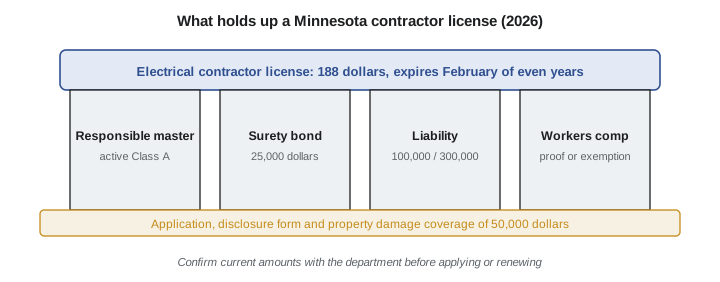
Contractor applications are made through iMS. According to the department's contractor licensing page, the application requires the business information, the designation of a responsible licensed individual who holds an active master license and meets the rules in lesson 7, proof of general liability insurance, proof of workers' compensation coverage or an exemption, the surety bond and a disclosure form. The disclosure form asks about matters such as prior license actions, judgments and unpaid obligations, and the answers must be truthful and complete.
The department's page lists a contractor license fee of 188 dollars. The license expires on the last day of February in even-numbered years, so a contractor license issued in late 2026 reaches its first expiration on the last day of February 2028. Master licenses, by contrast, expire on the last day of February of odd-numbered years, so a company and its responsible master renew in alternate years. Becky keeps both dates on the office calendar.
| Requirement | Figure or rule (2026) | Source |
|---|---|---|
| Responsible licensed master | Active Class A master, one contractor only | 326B.33, subd. 17 |
| Surety bond, electrical contractor | 25,000 dollars | 326B.33 |
| Surety bond, installer license | 1,000 dollars | 326B.33 |
| General liability, bodily injury | 100,000 dollars per occurrence, 300,000 dollars aggregate | Department contractor page |
| Property damage | 50,000 dollars | Department contractor page |
| Workers' compensation | Proof of coverage or exemption | Department contractor page |
| Contractor license fee | 188 dollars | Department contractor page |
| Expiration | Last day of February, even-numbered years | Department contractor page |
The surety bond
An electrical contractor must file a surety bond with the department. Section 326B.33 sets the amount at 25,000 dollars for an electrical contractor and 1,000 dollars for certain installers. A surety bond is not insurance for the contractor. It is a promise by a surety company that, if the contractor fails to meet obligations covered by the bond, such as compliance with the Act, the surety will pay valid claims up to the bond amount, and then seek repayment from the contractor. The bond protects customers and the public, not the contractor.
The bond must stay in force for the whole license period. If the surety cancels the bond, it notifies the department, and the contractor's license is at risk unless a replacement bond is filed. Becky's practice is to renew the bond a month before it expires and send the continuation certificate to the department immediately, rather than wait for a letter.
General liability insurance
A contractor must carry public liability insurance, which the department's page describes as general liability coverage with limits of at least 100,000 dollars per occurrence and 300,000 dollars aggregate for bodily injury, and 50,000 dollars for property damage, or a combined limit that meets the same total. The insurer must be authorized in Minnesota, and the department expects the policy to stay in force for the whole license period, with notice to the department if it is canceled.
These are minimums, not recommendations. A minimum general liability policy would not cover much of a serious fire or injury, and many customers, general contractors and lenders require much higher limits as a condition of the contract. Crow River carries far more than the minimum because the Waite Park office remodel's general contractor required it, and because Lars learned long ago that one bad loss can end a small company.
# Checking an insurance certificate against the 2026 minimums (study aid)
MIN_PER_OCCURRENCE = 100_000
MIN_AGGREGATE = 300_000
MIN_PROPERTY = 50_000

certificate = {"per_occurrence": 1_000_000, "aggregate": 2_000_000, "property": 1_000_000}
checks = {
    "per occurrence": certificate["per_occurrence"] >= MIN_PER_OCCURRENCE,
    "aggregate": certificate["aggregate"] >= MIN_AGGREGATE,
    "property damage": certificate["property"] >= MIN_PROPERTY,
}
for name, ok in checks.items():
print(f"{name:16} {'meets minimum' if ok else 'BELOW minimum'}")per occurrence meets minimum aggregate meets minimum property damage meets minimum
Workers' compensation
Minnesota law requires most employers to carry workers' compensation insurance, and the contractor application asks for proof of coverage. A sole proprietor with no employees may be able to claim an exemption under the workers' compensation law, but the moment the business hires anyone, coverage is required. Lesson 10 covers the injury reporting side of workers' compensation; for licensing, the point is that the department checks for coverage at application and renewal, and a lapse can affect the license.
Workers' compensation also matters on the job site. General contractors usually require certificates of insurance from every subcontractor before work begins, and a subcontractor without coverage may leave the general contractor responsible for its workers' injuries. Becky sends Crow River's certificate with every bid, and she checks the certificates of the few subcontractors Crow River hires, such as an excavator for long trenches.
Keeping the license in good standing
A contractor license stays valid only while its supports stay in place. If the responsible master leaves, the bond lapses, the liability insurance is canceled or workers' compensation coverage ends, the department may act against the license. The contractor should notify the department of changes such as a new responsible master, a new business name or address, or a change in ownership, and should keep the iMS record current. Doing electrical work as a contractor while the license is expired, or without a responsible master, is unlicensed contracting.
Renewal follows the same pattern as the original application: confirm the responsible master, confirm the bond, insurance and workers' compensation are in force, complete the disclosure and pay the fee before the last day of February in the even-numbered year. Late renewals are possible within limits, with additional fees, but a contractor that lets the license expire must stop contracting until it is renewed.
Contractor license and personal license together
The contractor license and the master's personal license depend on each other. The contractor needs an active master as its responsible licensed master; if the master's license lapses, the contractor loses its responsible master. The master, in turn, can serve only one contractor at a time. In practice, that means two renewal calendars, two sets of fees and a shared interest in keeping both current. When Nadia takes over, the company will renew its contractor license in February 2028, and she will renew her master license in the odd year before, February 2027, which makes her first renewal only a few months after she passes.
Changes in ownership and structure
Business changes can affect the license in ways owners do not expect. When Lars retires, he plans to sell Crow River to Nadia and Becky over several years. If the business stays the same legal entity, with the same name and tax identity, the change is mostly a matter of updating owners, officers and the responsible master in iMS. If the buyers form a new company and buy the old one's assets, the new company is a different business and needs its own contractor license, its own bond naming it as principal, and insurance and workers' compensation policies issued in its name. A license is not an asset that can be sold with the trucks.
The same caution applies to a name change or a move. A contractor that starts doing business under a new name should update the department and make sure the bond and insurance certificates show the name the department has on file. Mismatched names between the license, the bond and the insurance are a common reason renewals are delayed.
Other licenses a contractor may need
The electrical contractor license is the license the department cares about, but it is not always the only one a business needs. Some cities require a local business registration or contractor registration in addition to the state license, and work for public agencies may carry its own bidding and prequalification rules. Work on residential buildings can also bring residential building contractor rules into play when a company does more than electrical work. A master planning to expand beyond electrical work should ask the department which other licenses apply before taking on the job.
A small company's checklist
Lars gave Nadia a one-page list that he had kept on the office wall for years, and Becky added the iMS steps to it. It reads, in order: confirm the master license is active; confirm the contractor license and its expiration date; confirm the bond is in force and the continuation certificate is on file; confirm the liability certificate shows at least the minimum limits and names the department as a certificate holder if required; confirm workers' compensation coverage is in force; review the disclosure answers; update iMS with any changes; and put the next renewal date on the calendar with a reminder sixty days ahead.
Nadia added a line of her own at the bottom: keep copies of everything. If a customer, a general contractor or the department ever asks whether Crow River was licensed, bonded and insured on a particular date, the answer should take five minutes to find, not five days. Old certificates and bond records should be kept for years after they expire, because claims can arrive long after a job is finished.
Worked problem
A lapsed bond
In January, Crow River's surety sends a notice that the bond will be canceled at the end of the month for nonpayment, because a premium invoice was sent to an old address. What should happen?
Show solution
- The bond is a license requirement, and the surety will notify the department of cancellation.
- Becky should pay the premium at once or obtain a replacement bond before the cancellation date.
- The continuation or replacement bond should be filed with the department, and the iMS record checked.
- The company should update its address with the surety and the insurance agent so notices reach the office.
Answer: Pay or replace the bond before cancellation, file it with the department, and fix the address.
Common mistakes
MistakeThinking a master license allows the master to contract with customers.
InsteadThe business needs an electrical contractor license as well.
MistakeTreating the bond as insurance for the contractor.
InsteadA surety bond protects the public; the contractor must repay the surety.
MistakeTreating the minimum liability limits as enough.
InsteadThey are minimums; contracts and good sense often require more.
MistakeConfusing the renewal years.
InsteadContractor licenses expire in even-numbered years; master licenses in odd-numbered years.
Summary and key terms
- A business offering electrical work to others needs an electrical contractor license with a responsible licensed master.
- The contractor bond is 25,000 dollars; certain installers file a 1,000 dollar bond.
- General liability must be at least 100,000 dollars per occurrence and 300,000 dollars aggregate, with 50,000 dollars property damage.
- Proof of workers' compensation coverage or an exemption and a disclosure form are required.
- The contractor license fee is 188 dollars, and the license expires on the last day of February in even-numbered years.
- Electrical contractor license
- The license that lets a business offer and perform electrical work for others.
- Surety bond
- A surety's promise to pay valid claims if the contractor fails covered obligations.
- General liability insurance
- Coverage for bodily injury and property damage caused by the contractor's operations.
- Aggregate limit
- The most an insurer will pay for all claims in a policy period.
- Disclosure form
- The application form reporting prior license actions, judgments and similar matters.
Practice problems
Work each problem on paper first, then reveal the answer to check.
What bond amount applies to a Minnesota electrical contractor?
Show answer
25,000 dollars.
In which years do Minnesota electrical contractor licenses expire?
Show answer
On the last day of February in even-numbered years.
What minimum property damage coverage does the department list?
Show answer
50,000 dollars.
Lesson quiz · 5 questions
Score 60% or more to complete this lesson.
Create a free account to save your progress, take quizzes and earn a certificate.