
MELU-223 · Lesson 6 of 12 · 18 min
Permits, inspections and the inspection authority
▶ Video coming soon A video version of this lesson is on the way.
The Cold Spring farm shop job was a good one: a new 400-ampere service, a 60-foot pole building with welding receptacles, a grain-bin aeration fan feed and a long underground run to the house. Becky opened iMS on the Monday before the crew mobilized and looked up the job site in the department's inspector directory. The authority column said State. "Good," she told Nadia. "Then it's our permit, the state's inspector, and Doug Ruiz's schedule, not the city's." Nadia had wired dozens of jobs under permits Becky filed, but this was the first time she had been asked to understand every step, because soon the permits would be filed under her name as the responsible master.
Minnesota is one of the few states where the state itself inspects most electrical work. This lesson explains who the inspection authority is for a given address, how a contractor files a permit, how inspections are requested and carried out, what happens when the inspector finds a problem, and what the master's role is at each step. The exam asks about this material because it is where licensing law meets daily work.
Who is the inspection authority
Under the Minnesota Electrical Act, the department is responsible for electrical inspection throughout the state, but a city or county may take on electrical inspection for its own area by agreement and ordinance. Some larger cities do their own electrical inspection; most of the state, including most rural townships and many smaller cities, is inspected by the state. For any job, the first question is therefore which authority has jurisdiction at that address.
The department's answer to that question is its electrical inspector directory. Each area in the directory shows an authority having jurisdiction column marked either State or Local. If the column says State, the contractor files the permit with the department and a state inspector, or an inspector working under contract to the state, does the inspection. If it says Local, the contractor follows that city's or county's permit process and fees, and its inspector does the work. Either way the same adopted NEC applies, since the code is adopted statewide.
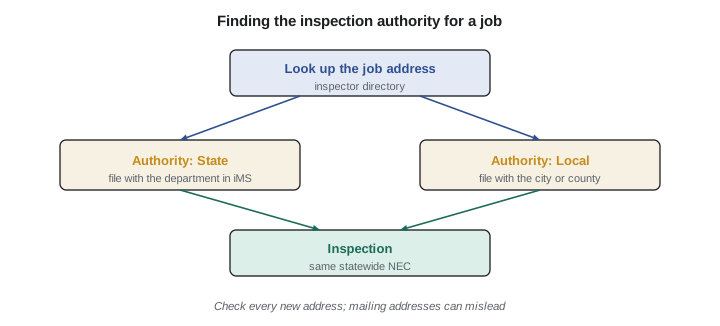
Crow River's area shows why the check matters. St. Cloud and its neighbors sit across four counties, and boundaries between cities and townships are not always where a crew expects them. Becky checks the directory for every new job address, even in towns where Crow River has worked for years, because a single mistaken filing means a wasted fee, a delay and an inspector who is not expecting the job.
When a permit is needed
The Act requires that electrical work be inspected, and the contractor doing the work is responsible for filing a request for electrical inspection, usually called a permit, before the work is done. In practice, nearly all new installations, alterations, additions and service changes need a permit. A small number of minor activities, such as replacing a device with an identical one, may be handled differently by rule, and the rules give details. The cautious habit is to treat every job as needing a permit unless the rule clearly says otherwise.
Starting work before filing is a common source of trouble. The permit establishes which code edition applies, as lesson 5 explained, and it puts the job on the inspector's list. Work done without a permit can lead to a correction order, extra fees and a demand to uncover finished work. A master who signs off on unpermitted work also risks discipline against the license.
Filing a permit in iMS
For state-inspected jobs, contractors file electrical permits online through iMS. The permit identifies the contractor, the responsible licensed master, the job address, the owner, the type of work and the scope used to calculate the fee. The fee is set by rule and depends on the work: services and feeders, circuits, and certain equipment each contribute. Becky enters the scope from Nadia's take-off, and the system calculates the fee.
The Act requires that the responsible licensed master sign requests for inspection for the contractor, and the master is accountable for what the permit says. In iMS that signature is usually electronic, tied to the master's account. When Nadia becomes the responsible master, the permits Becky files will carry Nadia's name, and Nadia will be the person the inspector calls.
| Permit item | Who supplies it | Why it matters |
|---|---|---|
| Job address and owner | Office from the contract | Decides authority and notifies the owner |
| Contractor and responsible master | iMS account | Identifies who answers for the work |
| Scope of work | Master's take-off | Sets the fee and tells the inspector what to expect |
| Filing date | Recorded by iMS | Decides the governing NEC edition |
| Inspection process | Issued email | Sets contract, virtual or state inspection route |
After the permit is issued
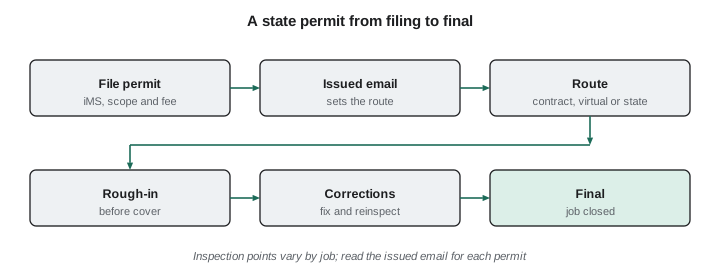
When a state permit is issued, iMS sends an issued email. According to the department's contractor permits page, that email tells the contractor which inspection process applies to the job. Depending on the area and the work, the job may be assigned to a contract inspector who schedules directly with the contractor, may be eligible for a virtual inspection using photos or video, or may follow the state process in which the contractor marks the job ready for inspection in iMS when the work is ready. Reading the issued email carefully is part of the job, because each route has its own steps.
Nadia now reads every issued email herself, not just Becky. On the Cold Spring job the email assigned the work to the state inspector for the area, Doug Ruiz, with the ready-for-inspection process. That meant Nadia had to mark the job ready in iMS when the underground and the service were ready for a look, and Doug would come out within his normal schedule.
Rough-in, final and other inspections
Most jobs have at least two inspection points. The rough-in inspection happens before the wiring is concealed: before insulation and drywall in a building, before trenches are backfilled, before a slab is poured over conduit. The final inspection happens when the work is complete and the equipment is installed and energized or ready to be. Larger jobs may have several partial inspections, and service work often needs an inspection before the utility will connect.
Timing is the contractor's responsibility. If the crew covers work before the rough-in inspection, the inspector can require it to be uncovered. On the Cold Spring job the underground run to the house was the critical point. Nadia scheduled the trench so that it would stay open overnight, marked the job ready that morning, and kept a crew on site doing pole-building work until Doug had signed off. Backfilling a 300-foot trench and digging it back up would have cost more than the whole day of waiting.
Being ready for inspection means more than finishing the work. The permit should be posted or available on site if the inspector asks for it, the panel directory should be filled in at final, access to every part of the work should be clear, and someone who knows the job should be there or reachable by phone. Inspectors in rural areas cover large territories, and a wasted trip to a locked building or an unfinished job can push the next visit back by days. Nadia keeps a short readiness checklist in the truck and runs through it before marking any job ready.
Corrections and disputes
When an inspector finds a violation, the inspector issues a correction order describing what must be fixed. The contractor makes the correction and requests reinspection, and some reinspections carry a fee. Most correction orders are routine: a missing bushing, a box fill problem, a grounding electrode conductor that is not properly protected. A few are not, and the difference between a good master and a struggling one is how those few are handled.
The first step in a disagreement is to read the cited rule carefully, in the right edition. The second is a calm conversation with the inspector, ideally on site and before the work is changed, with the code book open. Inspectors are usually glad to explain a call, and sometimes a master's explanation changes their view. If the disagreement remains, the master can ask the department how to have the decision reviewed by the inspector's supervisor, and further review is available under the department's procedures. Arguing in front of a customer or a crew is never the right step.
Doug wrote one correction on the Cold Spring rough-in: a section of conduit where it emerged from the trench lacked the protection Doug believed the rule required for that location. Nadia read the rule with him, agreed, and the crew fixed it before lunch. She made a note in the job file and added the item to the crew's checklist, so the same correction would not appear on the next farm job.
# Tracking inspections on a job (illustrative job record)
inspections = [
    ("Underground run", "rough-in", "passed"),
    ("Service and meter base", "rough-in", "correction"),
    ("Service and meter base", "reinspection", "passed"),
    ("Shop branch circuits", "rough-in", "passed"),
    ("Whole job", "final", "pending"),
]
open_items = [i for i in inspections if i[2] in ("correction", "pending")]
for item, kind, status in inspections:
    print(f"{item:24} {kind:13} {status}")
print("Open items:", len(open_items))Underground run rough-in passed Service and meter base rough-in correction Service and meter base reinspection passed Shop branch circuits rough-in passed Whole job final pending Open items: 2
Local inspection areas
In a local inspection area, the steps are similar but the details belong to the city or county. The local permit form, fee schedule and inspection request method may differ from the state's. The local inspector applies the same adopted NEC and the same licensing law, and local inspection does not change who may do electrical work. Crow River keeps a one-page sheet for each local authority it works in, listing how to file, how to request inspection and the inspector's contact number.
The master's role at each step
A responsible master does not need to file every permit personally, but must make sure each one is accurate and filed on time. The master decides the scope, checks the authority, reads the issued email, sets the inspection timing, meets the inspector on difficult calls and makes sure corrections are closed. The master also makes sure the people doing the work are licensed or properly supervised registered unlicensed electricians, which lesson 7 covers in detail.
Good permit habits protect the company as well as the license. A job file that shows the permit, the issued email, each inspection result and each correction closed is the best defense if a customer later complains or a lien dispute arises. Lesson 9 explains why that record matters when payment is in question.
Worked problem
Wrong authority
A new customer asks Crow River to add a subpanel in a house just outside a city that does its own inspection. Tomas assumes the house is in the city and files with the city. The city's clerk calls back to say the address is in the township. What went wrong and what should happen next?
Show solution
- The authority depends on the address, and the directory shows State or Local for each area.
- The township is state-inspected, so the permit must be filed with the department in iMS.
- Tomas should ask the city about a refund under its own policy and file the state permit before work starts.
- Crow River should check the directory for every new address, not rely on mailing addresses.
Answer: File a state permit in iMS before starting, and check the directory every time.
Common mistakes
MistakeAssuming a mailing address decides the inspection authority.
InsteadCheck the inspector directory's authority column for the actual job site.
MistakeCovering work before the rough-in inspection.
InsteadKeep work open until the inspector has passed it, or expect to uncover it.
MistakeIgnoring the issued email.
InsteadIt says which inspection route applies; follow its steps.
MistakeArguing with the inspector in front of the customer.
InsteadRead the rule together, then use the department's review process if needed.
Summary and key terms
- The department inspects most electrical work in Minnesota; some cities and counties inspect their own areas.
- The inspector directory's authority column, State or Local, decides where to file.
- State permits are filed in iMS, and the responsible master signs requests for inspection.
- The issued email sets the inspection route: contract inspector, virtual inspection or state ready-for-inspection.
- Rough-in inspection must happen before work is concealed; corrections must be fixed and reinspected.
- Authority having jurisdiction
- The body responsible for inspection at a job site, State or Local in Minnesota.
- Request for inspection
- The permit a contractor files before doing electrical work.
- Issued email
- The iMS message that confirms a permit and sets its inspection route.
- Rough-in
- The inspection of wiring before it is concealed.
- Correction order
- An inspector's written notice of a violation that must be fixed.
Practice problems
Work each problem on paper first, then reveal the answer to check.
Where does a contractor check whether an address is state or locally inspected?
Show answer
In the department's electrical inspector directory, in the authority column.
Who must sign requests for inspection for a contractor?
Show answer
The responsible licensed master.
What is the risk of covering work before rough-in inspection?
Show answer
The inspector can require it to be uncovered.
Lesson quiz · 5 questions
Score 60% or more to complete this lesson.
Create a free account to save your progress, take quizzes and earn a certificate.