
MELU-223 · Lesson 12 of 12 · 25 min
Practice exam review and test-day strategy
▶ Video coming soon A video version of this lesson is on the way.
Ten days before her exam, Nadia sat in Crow River's conference room with an untabbed soft-cover 2026 NEC, a printed copy of the electrical laws and rules, a plain desk calculator, a kitchen timer and a practice set of 80 questions. Her phone was in the truck. Lars had insisted on one full session under conditions as close to the real ones as she could make them. "Five and a half hours with a clean book is a different job from an hour after supper," he said. When the timer went off, she had answered every question, but she had rushed the last fifteen and scored 53 out of 80. That result shaped her final week more than anything else in her preparation.
This lesson pulls the course together: a study plan built for an exam with provided references, the calculations and Minnesota topics most worth reviewing, worked practice questions, how to review a practice session, and a plan for exam day. The figures for the exam format are the journeyworker figures that exam preparation providers describe, used as a guide, because the department does not publish a master question count or pass mark on its main pages.
A ten-week plan
Most candidates who pass on the first attempt follow some version of the same plan. They spend the first weeks learning the layout of the current NEC, the middle weeks on the technical content and calculations, a block on the Minnesota laws and rules and the business topics in this course, and the last weeks on timed practice and weak areas. In Minnesota the plan has one special feature: because the department provides a clean, untabbed book, the candidate cannot rely on tabs and must practice finding things in a book with no aids at all.
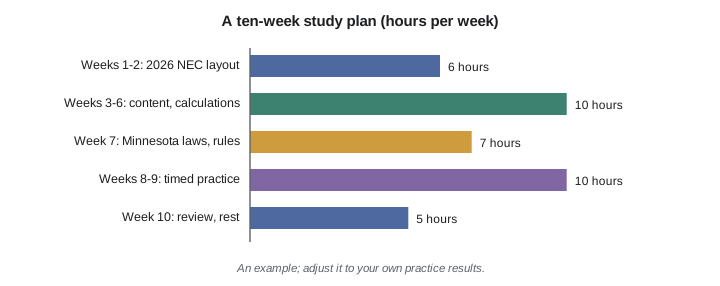
| Weeks | Focus | Output |
|---|---|---|
| 1-2 | The 2026 NEC layout: chapters, articles, the index and the tables | A one-page map of the book from memory |
| 3-6 | Services, feeders, load calculations, grounding and bonding, wiring methods, motors, transformers | A calculation notebook and timed lookups |
| 7 | Minnesota laws and rules: licensing, supervision, contractors, permits, inspection | Summary sheets by topic (for study only) |
| 8-9 | Full timed practice sessions with a clean book | Scores and a miss log by cause |
| 10 | Weak areas, a light final session, rest before exam day | Confidence and a test-day plan |
Learning a book without tabs
Candidates who learned on a tabbed book often find the clean book slower at first. The fix is to learn the book's structure well enough to open it near the right page. Chapters 1 through 4 apply generally; chapters 5 through 7 cover specific occupancies, equipment and conditions; chapter 9 holds the tables. Within chapters, article numbers rise steadily, so a candidate who knows that load calculations now sit in Article 120 and grounding in Article 250 can open the book close to the right spot and adjust in a few page turns. The index is the other route: a key word, then the article and section.
Nadia practiced a simple drill every night for two weeks. Becky read out a topic, such as a motor branch circuit, an EV charger feeder or a grain dryer in a wet location, and Nadia found the governing article in the clean book against a 60-second timer. At first she missed half. By the end she found nine out of ten, and she knew which topics sent her to the index rather than straight to an article.
Technical review: the calculations that keep coming back
The same calculations appear again and again on electrical exams: Ohm's law and power, single-phase and three-phase current, voltage drop, conductor sizing with temperature correction and adjustment, motor branch circuits, transformer current and protection, box and conduit fill, and dwelling and commercial load calculations. The master core courses covered each one. In the last weeks the goal is speed and accuracy: knowing which formula applies, which article or table to open, and how to check an answer for reasonableness before moving on.
# Quick practice: transformer and three-phase current (illustrative values)
import math
kva = 75
for volts in (208, 480):
    amps = kva * 1000 / (math.sqrt(3) * volts)
    print(f"{kva} kVA at {volts} V three-phase: {amps:.1f} A")

# Single-phase voltage drop (illustrative: 2-wire, K = 12.9 for copper)
load_amps, length_ft, cmil, volts = 40, 150, 16510, 240
vd = 2 * 12.9 * load_amps * length_ft / cmil
print(f"Voltage drop: {vd:.2f} V, or {vd / volts * 100:.1f} in every 100 volts")75 kVA at 208 V three-phase: 208.2 A 75 kVA at 480 V three-phase: 90.2 A Voltage drop: 9.38 V, or 3.9 in every 100 volts
The first result, about 208 amperes on the 208-volt side of a 75 kVA transformer and about 90 amperes on the 480-volt side, is worth remembering because it lets you check transformer questions quickly. The voltage drop example uses the common approximate formula with a constant for copper and an illustrative conductor area; on the exam, take conductor properties from the tables in chapter 9 and use the method the question asks for. A result of about 9.4 volts on a 240-volt circuit is close to four volts in every hundred, which should prompt a check of whether the question wants a larger conductor.
Minnesota review
The Minnesota questions draw on the Act and the rules in the laws and rules booklet. The topics most worth a final review are the license classes and experience routes, the exam and application process, the responsible licensed master rules, supervision of registered unlicensed electricians, the contractor license requirements, permits and inspection, the NEC adoption and transition dates, and renewal. The business topics, including liens and workers' compensation, are useful in practice and may appear on the exam in general form.
| Topic | Main reference | Minnesota points from this course |
|---|---|---|
| Eligibility | 326B.33; department pages | Degree, 1 year as journeyworker, or 5 years; 60 months with category minimums |
| Exam | Department approval message | Provided untabbed NEC, laws booklet and calculator; no personal books |
| Code | Chapter 1315; department codes page | 2026 NEC for permits filed on or after August 17, 2026 |
| Permits | Department permits page | Directory authority column; iMS; issued email route |
| Responsible master | 326B.33, subd. 17 | One contractor; owner, officer or active employee; signs inspection requests |
| Contractor | 326B.33; department contractor page | 25,000 dollar bond; 100,000 and 300,000 liability; 50,000 property |
| Liens | Chapter 514 | 45-day notice; 120-day statement; one-year foreclosure |
| Renewal | Department licensing pages | February of odd years; 16 hours, 12 on the NEC |
# Quick practice with the Minnesota numbers from this course (2026 sources)
questions, minutes, to_pass = 80, 330, 56   # journeyworker figures from providers, used as a guide
print("Minutes per question:", round(minutes / questions, 1))
print("Correct answers needed, in every 100:", round(to_pass / questions * 100))

ce_total, ce_code = 16, 12
print("Non-code hours allowed at most:", ce_total - ce_code)

bond, per_occurrence, aggregate, property_damage = 25_000, 100_000, 300_000, 50_000
print("Liability aggregate is", aggregate // per_occurrence, "times the per-occurrence minimum")Minutes per question: 4.1 Correct answers needed, in every 100: 70 Non-code hours allowed at most: 4 Liability aggregate is 3 times the per-occurrence minimum
Worked practice questions
Worked problem
Supervision
A master sends a registered unlicensed electrician alone to replace a damaged receptacle in an occupied office while the master works across town. Is this consistent with the supervision rules in lesson 7?
Show solution
- Registered unlicensed electricians must work under the direct supervision of a licensed electrician.
- Direct supervision means a licensed electrician on the job, directing and checking the work.
- The master should send a licensed electrician along or reschedule the work.
Answer: No; the registered unlicensed electrician needs a licensed electrician supervising on the job.
Worked problem
Code edition
A permit for a new pole building is filed on August 12, 2026. The work is done in October. Which NEC edition applies?
Show solution
- The governing edition is set by the permit filing date.
- The 2026 NEC applies to permits filed on or after August 17, 2026.
- This permit was filed before that date.
Answer: The 2023 NEC.
Worked problem
Lien deadline
Crow River's last contract work on a job was on April 20. How long does it have to record and serve a lien statement, and when must any foreclosure begin?
Show solution
- The lien statement must be recorded and served within 120 days after the last item.
- From April 20, 120 days runs to August 18.
- Foreclosure must begin within one year after the last item, by April 20 of the next year.
Answer: Record and serve by August 18; foreclose by April 20 of the following year.
Worked problem
Reading the ask
A question describes a 40-ampere continuous load and asks for the minimum rating of the overcurrent device, not the conductor size. A candidate sizes the conductor and picks that answer. What went wrong?
Show solution
- The question asked for the overcurrent device rating.
- For a continuous load, the device generally must be rated above the load by the factor the code requires; confirm the rule in the code book.
- The candidate solved a related question instead of the one asked.
Answer: Underline what the question asks for before starting; here it was the device rating.
Reviewing a practice session
A practice session is only as useful as the review that follows it. Nadia's first full session came in at 53 out of 80, three short of the journeyworker passing figure, and her first reaction was to study everything again. Lars asked her to sort the misses instead. She had lost six on grounding and bonding, four on load calculations, three on motors, three on the laws and rules and the rest scattered. Only eight of her misses came from not knowing the material. The rest came from slow lookups in the clean book, misread questions, arithmetic slips and the rushed final fifteen.
| Cause of miss | What it looks like | Fix |
|---|---|---|
| Did not know it | No idea where to look | Study the topic, then retest within a week |
| Slow lookup | Found the answer but ran out of time | Drill the book layout and the index |
| Misread the question | Answered a different question | Underline the ask; restate it before calculating |
| Arithmetic slip | Right method, wrong number | Write each step; check reasonableness |
| Rushed at the end | Errors bunched in the last questions | Set checkpoints and keep a review reserve |
Keep a running log of every miss with its cause, the article or rule where the answer lives and the time it took. Over several sessions the log shows patterns: an article that always takes too long, a kind of question you misread, a formula you keep inverting. Nadia's second full session, five days later, came in at 61 out of 80, and almost all of the gain came from faster lookups and a steadier pace at the end rather than from new knowledge.
# Practice session tracker (illustrative scores)
sessions = [("Session 1", 53), ("Session 2", 61), ("Session 3", 64)]
guide_pass = 56
for name, correct in sessions:
    status = "above" if correct >= guide_pass else "below"
print(f"{name}: {correct}/80, {status} the guide mark by {abs(correct - guide_pass)}")Session 1: 53/80, below the guide mark by 3 Session 2: 61/80, above the guide mark by 5 Session 3: 64/80, above the guide mark by 8
Exam day
Prepare the night before: identification that matches the name on the application exactly, the approval message with the site address, directions and a plan for weather, water and a snack if allowed, and an early alarm. Leave the phone and any electronics in the vehicle, because they are not allowed in the building. Sleep matters more than a last evening of cramming. Arrive early and check in calmly. Open the provided code book and spend the first minute confirming it is the edition you studied and noting where chapter 9 begins. Then write your checkpoints on the scratch paper, such as 40 questions by the 150-minute mark, work steadily, flag slow questions and keep the last 20 minutes for the flagged ones. Answer every question.
Fatigue is the enemy late in a five-and-a-half-hour exam. Nadia's practice sessions taught her that her accuracy dropped in the last hour, so she planned a short pause every hour to stretch her hands and look away from the page. She also carried a rule from her miss log: change an answer only when the book gives a specific reason, never on a feeling.
After the exam
Nadia drove back to St. Cloud from the testing site with a passing result. Becky started the paperwork the next morning: the license fee in iMS, then the change to Crow River's contractor record designating Nadia as the responsible licensed master, with the verified statement. Lars made the change official at the Monday crew meeting, and Tyler Vang asked Nadia whether she would sign his experience form when the time came. She said yes, and that the months would be exactly right.
If you do not pass on the first try, write down the topics that felt slow while the memory is fresh, reapply after the waiting period and use the time for the drills that fix those topics. Many good masters passed on their second attempt. What matters is the plan you follow afterward and the honesty of your review.
Common mistakes
MistakePracticing with a tabbed, highlighted book.
InsteadPractice with a clean book, because that is what the department provides.
MistakeDoing practice questions without a timer.
InsteadDo at least one full session under exam conditions.
MistakeLeaving flagged questions until there is no time.
InsteadSet checkpoints and keep a review reserve.
MistakeBringing a phone into the building.
InsteadLeave electronics in the vehicle.
Summary and key terms
- Plan around a clean, provided code book: learn the layout and the index before drilling content.
- Practice the recurring calculations until they are fast and checked for reasonableness.
- Review the Minnesota points: eligibility, exam, code adoption dates, permits, the responsible master, contractor requirements, liens and renewal.
- Sort practice misses by cause and fix lookups, reading and pacing.
- On exam day, check the book, set checkpoints, flag slow questions and answer everything.
- Clean book
- A code book with no tabs, notes or highlighting, as provided at the exam.
- Miss log
- A record of practice misses with their causes and references.
- Checkpoint
- A planned number of questions to have answered by a given time.
- Flagging
- Marking a question to return to later.
- Review reserve
- Time kept at the end of the exam for flagged questions.
Practice problems
Work each problem on paper first, then reveal the answer to check.
What is the three-phase current of a 45 kVA transformer at 208 volts, to the nearest ampere?
Show answer
45,000 divided by (1.732 times 208) is about 125 amperes.
Using the journeyworker guide figures, about how many minutes per question are available?
Show answer
About 4.1 minutes.
What should you check first when you open the provided code book?
Show answer
That it is the edition you studied, and where the main parts such as chapter 9 begin.
Lesson quiz · 5 questions
Score 60% or more to complete this lesson.
Create a free account to save your progress, take quizzes and earn a certificate.