
MELU-223 · Lesson 5 of 12 · 17 min
The NEC as adopted in Minnesota and state amendments
▶ Video coming soon A video version of this lesson is on the way.
In August 2026 Crow River had two jobs in Sartell that looked almost identical: lake home additions with new subpanels, EV charger circuits and a heated garage. Becky filed the permit for the first on August 10. The homeowners on the second could not decide on a layout, and that permit went in on August 20. "Same crew, same materials, same town," Lars said, "and two different code books." Nadia frowned until he explained: the 2026 NEC took effect in Minnesota on August 17, and it is the permit's filing date, not the day the crew shows up, that decides which edition applies.
This lesson explains how the National Electrical Code becomes Minnesota law, which edition applies to a given job and how the transition between editions works, what is known about Minnesota amendments, how the department's bulletins fit in, and what the 2026 edition changed in ways that matter for exam preparation. It builds on the core course MELU-101, which explains how to navigate the NEC itself.
How the NEC becomes Minnesota law
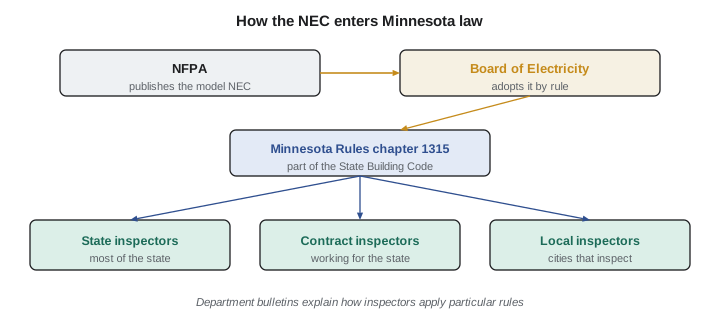
The National Electrical Code is a model code written by the National Fire Protection Association. It has no force in Minnesota until it is adopted. The Minnesota Electrical Act gives the Board of Electricity the authority to adopt the electrical code, and the Board does so by rule as part of the Minnesota State Building Code, in Minnesota Rules chapter 1315. Once adopted, the NEC applies statewide to electrical installations covered by the Act, whether the inspector is a state inspector, a contract inspector or a local inspector in a city that does its own electrical inspection.
Because the adoption is statewide, Minnesota does not have the patchwork seen in some states where each city adopts its own edition on its own schedule. A contractor working in Duluth, Rochester and St. Cloud in the same week uses the same edition in all three, provided the permits were filed in the same period. That uniformity is one reason Minnesota can license electricians statewide and test them on one edition.
Which edition applies: the permit filing date
The department's codes page states the transition rule plainly for the 2026 edition. The 2026 NEC took effect on August 17, 2026. Electrical permits filed before August 17, 2026 must comply with the 2023 NEC, and electrical permits filed on or after August 17, 2026 must comply with the 2026 NEC. The rule ties the edition to the permit, so a long job that started under a permit filed in July continues under the 2023 edition even if the crew is still working in October.
That is why Crow River's two Sartell additions fell under different editions. The first permit, filed August 10, was a 2023 job from start to finish; the second, filed August 20, was a 2026 job. Lars made a habit of writing the governing edition on the job folder next to the permit number, so the crew and the inspector were never working from different assumptions.
# Which NEC edition governs a Minnesota permit? (based on the 2026 transition rule)
from datetime import date

EFFECTIVE_2026 = date(2026, 8, 17)

def governing_edition(filed):
    return "2026 NEC" if filed >= EFFECTIVE_2026 else "2023 NEC"

jobs = {"Sartell addition A": date(2026, 8, 10),
        "Sartell addition B": date(2026, 8, 20),
        "Cold Spring farm shop": date(2026, 8, 17)}
for name, filed in jobs.items():
print(f"{name:22} filed {filed.isoformat()} -> {governing_edition(filed)}")Sartell addition A filed 2026-08-10 -> 2023 NEC Sartell addition B filed 2026-08-20 -> 2026 NEC Cold Spring farm shop filed 2026-08-17 -> 2026 NEC
Two other dates mattered in 2026. The department moved its licensing exams to the 2026 NEC beginning September 8, 2026, a few weeks after the effective date, which gave candidates and instructors a short overlap. And the department offered free online access to the 2026 NEC through the NFPA's free account, which made it easier for electricians to read the new edition before buying a printed copy.
| Date (2026) | Event |
|---|---|
| Before August 17 | Permits filed must comply with the 2023 NEC |
| August 17 | 2026 NEC takes effect statewide |
| On or after August 17 | Permits filed must comply with the 2026 NEC |
| September 8 | Licensing exams move to the 2026 NEC |
Minnesota amendments and bulletins
Some states adopt the NEC with long lists of amendments. When the department's codes page described the 2026 adoption, it did not identify Minnesota-specific amendments; it linked separately to the electrical laws and rules and listed bulletins on particular topics. A candidate should not assume from this that there are no Minnesota differences at all. Chapter 1315, the Act and chapter 3801 can contain provisions that modify or add to the national code, and the department's bulletins explain how inspectors apply particular rules.
Bulletins are the department's guidance on how rules are applied in practice. In 2026 the codes page listed bulletins on topics such as cable bracing and overcurrent protection coordination. A bulletin is not a separate code, but it tells contractors what state inspectors will look for, and it is often the fastest way to resolve a disagreement about how a rule applies. Crow River keeps a folder of current bulletins, and Lars reads each new one aloud at the Monday crew meeting.
For the exam, the safest approach is to answer code questions from the edition provided on the desk unless a question clearly asks about a Minnesota requirement, in which case the laws and rules booklet is the place to look. Questions about Minnesota-specific provisions are much more likely to concern licensing, supervision, permits and inspections than individual code rules.
When the Board adopts a new edition, it also has to decide whether earlier Minnesota provisions carry forward. A master who wants to be certain about a Minnesota difference should read the current text of chapter 1315 on the revisor's website rather than rely on a training handout, a supply-house flyer or an older bulletin. Handouts age quickly, and a rule that was true under the 2020 adoption may have been dropped or renumbered since.
What changed in the 2026 edition
The core courses describe the 2026 NEC in detail, but several of its changes reshape how candidates navigate the book, which matters more in Minnesota because the exam book is untabbed. Load calculation material that sat in Article 220 in earlier editions moved to Article 120, and energy management material moved to Article 130. Medium and high voltage material was gathered into Articles 265 through 270. Chapter 8 material for communications systems was folded into Chapter 7, so communications articles are no longer a separate island at the back. New articles were added and some older ones deleted, the titles of Chapters 5 through 7 now speak of specific rather than special occupancies, equipment and conditions, and an informative annex previews a larger reorganization planned for a future edition.
For Nadia, who learned her trade on the 2017 and 2020 editions, the move of load calculations to Article 120 was the biggest adjustment. Her fingers still went to the back half of Chapter 2 when a question mentioned a dwelling load. She spent a week doing nothing but load calculation lookups in the 2026 book until Article 120 became the first place she looked.
The code beside the laws and rules
A Minnesota master works with two bodies of requirements at once. The NEC says how an installation must be built. The Minnesota Electrical Act, Minnesota Statutes sections 326B.31 to 326B.399, and the department's rules say who may do the work, who must supervise it, when a permit is needed and how inspection happens. A wiring method can comply perfectly with the NEC and still be unlawful if it was installed without a permit or by someone not licensed or registered to do it. The reverse is also true: a properly permitted job by a fully licensed crew still fails inspection if it breaks a code rule.
The exam reflects that split. Questions drawn from the NEC test lookup and calculation skill in the provided code book. Questions drawn from the Act and rules test knowledge of licensing classes, supervision, contractor obligations, permits and inspections, and they are answered from the laws and rules booklet the department provides. Lessons 6 through 8 and lesson 11 cover the Minnesota legal side; this lesson is the bridge between the two.
Studying across two editions
Candidates in late 2026 face an unusual situation. Many of the jobs they are wiring are still under 2023 permits, while their exam is on the 2026 edition. Nadia handled this by keeping two clearly marked books at the office. Her study book was the 2026 edition, untabbed and unmarked, exactly like the one she would see at the exam. Her job reference was the 2023 edition, tabbed and annotated, used only for the open permits filed before August 17. She never studied from the 2023 book, because every hour spent learning old article numbers made the 2026 lookups slower.
It also helps to keep a short list of the rules that changed between the editions on jobs she actually does: dwelling load calculations, EV charging, energy storage and generator interconnection, surge protection and ground-fault and arc-fault requirements. When a question on a 2023 job and a question on a 2026 job give different answers, the list reminds her why, and the explanation becomes useful material for the crew meeting.
Free access and the exam book
The department's codes page pointed electricians to free read-only access to the 2026 NEC through an NFPA account. Free access is useful for reading a section on a phone at a job site or checking a rule before buying the printed book. It is not a substitute for practice with the printed, untabbed book the department supplies at the exam, because finding a rule by flipping pages uses different habits than searching a screen. Nadia used the free access to read, and the printed book to practice timing, and she never practiced lookups with search.
Code questions on a Minnesota job
When a question comes up on site, Crow River follows a simple order. First, confirm the governing edition from the permit date. Second, read the rule in that edition, not from memory. Third, check whether a Minnesota provision or a department bulletin addresses the issue. Fourth, if there is still doubt, ask the inspector before the work is covered. An inspector's correction order after cover means removing finished work, which is expensive; a phone call before cover is free.
Worked problem
Two permits, two editions
A homeowner in Waite Park asks Crow River to add a garage circuit. Becky files the permit on August 14, 2026, but the work is not done until September 3. A week later the same homeowner asks for a second, separate addition with its own permit, filed September 10. Which editions apply?
Show solution
- The governing edition is set by the permit filing date, not the work date.
- The first permit was filed August 14, before the August 17 effective date, so it falls under the 2023 NEC even though the work was done in September.
- The second permit was filed September 10, on or after August 17, so it falls under the 2026 NEC.
- The crew should note the edition on each job folder so both the crew and the inspector apply the right one.
Answer: The first job follows the 2023 NEC; the second follows the 2026 NEC.
Common mistakes
MistakeDeciding the edition by the day the work is done.
InsteadUse the permit filing date: before August 17, 2026 means 2023 NEC; on or after means 2026 NEC.
MistakeAssuming each Minnesota city adopts its own edition.
InsteadThe Board adopts the NEC statewide in chapter 1315.
MistakeIgnoring department bulletins.
InsteadBulletins show how inspectors apply rules; read them and keep them current.
MistakeLooking for load calculations in Article 220 of the 2026 book.
InsteadIn the 2026 edition they moved to Article 120.
Summary and key terms
- The Board of Electricity adopts the NEC statewide as part of the State Building Code, in Minnesota Rules chapter 1315.
- The 2026 NEC took effect August 17, 2026; permits filed before that date follow the 2023 NEC and permits filed on or after it follow the 2026 NEC.
- Licensing exams moved to the 2026 NEC on September 8, 2026.
- The department's codes page did not list Minnesota amendments in 2026; check chapter 1315, the rules and the bulletins.
- The 2026 edition moved load calculations to Article 120 and reorganized several areas, so practice lookups in the 2026 book.
- Adoption
- The legal act that makes a model code enforceable in a state.
- Chapter 1315
- The part of the Minnesota State Building Code that adopts the NEC.
- Effective date
- The date from which new permits must follow the newly adopted edition.
- Bulletin
- Department guidance on how a rule is applied in practice.
- Permit filing date
- The date a permit is filed, which decides the governing code edition.
Practice problems
Work each problem on paper first, then reveal the answer to check.
A permit is filed on August 16, 2026 and the work finishes in November. Which edition applies?
Show answer
The 2023 NEC, because the permit was filed before August 17, 2026.
From what date did Minnesota licensing exams use the 2026 NEC?
Show answer
September 8, 2026.
In the 2026 NEC, where did load calculation material move?
Show answer
To Article 120.
Lesson quiz · 5 questions
Score 60% or more to complete this lesson.
Create a free account to save your progress, take quizzes and earn a certificate.