
MELU-223 · Lesson 11 of 12 · 18 min
Renewal and continuing education
▶ Video coming soon A video version of this lesson is on the way.
Lars let his license lapse exactly once, in February 1999, during a winter when he was running three jobs and caring for his father. The renewal notice sat under a stack of invoices, and on the first of March he was, on paper, not a master electrician. "It took two weeks and a late fee to fix," he told Nadia, "and for two weeks I couldn't sign a permit. The crews kept working on old permits, but we couldn't start anything new. Put the date on three calendars, not one." Nadia laughed until she realized that her own first renewal would come only months after she passed.
This lesson covers how a Minnesota master keeps the license in force: the two-year renewal cycle, the continuing education requirement and how it is met, renewal fees and late renewal, what happens when a license lapses, how the contractor license and the registered unlicensed registrations fit on the same calendar, and practical habits that keep renewals routine.
The renewal cycle
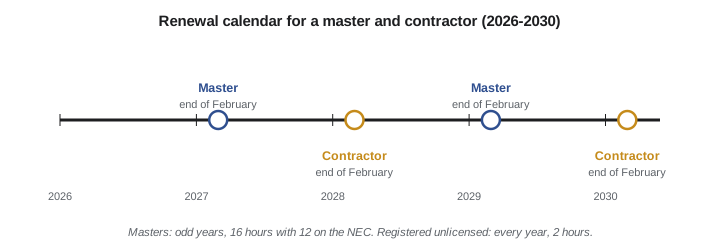
Minnesota electrical licenses renew on a two-year cycle. According to the department, master electrician licenses expire on the last day of February of each odd-numbered year. That means every master in the state renews by the same date: the last day of February 2027, then 2029, and so on. Journeyworker licenses follow a two-year cycle as well. Electrical contractor licenses expire on the last day of February of even-numbered years, so a company and its responsible master renew in alternate years. Registered unlicensed electricians renew every year.
Because all master licenses expire on the same date, a master who passes the exam in late 2026, as Nadia plans to, has a short first term that ends on the last day of February 2027. How the first term's continuing education is handled for a newly issued license is set by the rules, and a new master should ask the department exactly what is required for that first renewal, rather than assume either that the full requirement applies or that none does.
Continuing education
To renew a master license, the department requires 16 hours of continuing education in the two-year period, and at least 12 of those hours must be on the National Electrical Code. The remaining hours may cover other approved topics, such as the Minnesota Electrical Act and rules, safety or other electrical subjects as the department allows. Journeyworkers have the same 16-hour requirement with at least 12 hours of code. Registered unlicensed electricians need 2 hours of continuing education with each annual renewal.
Hours count only if they come from courses the department has approved for electrical continuing education. Providers include trade associations, unions, technical colleges, suppliers and private training companies. Each approved course has a number, and the provider reports attendance to the department or gives a certificate. A master should keep certificates for every course until well after the renewal they support, in case the department audits the record.
| License | Renews | Continuing education | Renewal fee (2026) | Late fee (2026) |
|---|---|---|---|---|
| Master electrician | Last day of February, odd years | 16 hours, at least 12 on the NEC | 93 dollars | 40 dollars |
| Journeyworker | Two-year cycle | 16 hours, at least 12 on the NEC | 53 dollars | 20 dollars |
| Registered unlicensed | Every year | 2 hours | 19 dollars | Not listed here |
| Electrical contractor | Last day of February, even years | None for the business | 188 dollars | Check iMS |
Choosing courses
The code hours are the core of continuing education, and a new edition makes them especially useful. A master renewing in February 2027 will have spent the period in the transition from the 2023 to the 2026 NEC, and courses on the 2026 changes count as code hours while preparing the master for permits filed after August 17, 2026. The other hours are a chance to cover something the master needs: changes to the Minnesota laws and rules, NFPA 70E, energy storage and EV charging, or a topic the crew struggles with.
Nadia's plan for the first cycle was practical. She would take a 2026 NEC changes course in the winter, a Minnesota laws and rules update and an arc flash course in the following year, and keep a spreadsheet of each certificate with the course number, date and hours. Lars, renewing for the last time before retirement, took the same code course, which he said was the first time in years he had learned something new about Article 100.
# Tracking continuing education toward a master renewal (study aid)
courses = [
    ("2026 NEC changes", 8, True),
    ("Minnesota laws and rules update", 2, False),
    ("NFPA 70E arc flash", 2, False),
    ("Grounding and bonding in the 2026 NEC", 4, True),
]
total = sum(h for _, h, _ in courses)
code_hours = sum(h for _, h, is_code in courses if is_code)
print("Total hours:", total, "of 16")
print("Code hours:", code_hours, "of at least 12")
print("Ready to renew:", total >= 16 and code_hours >= 12)Total hours: 16 of 16 Code hours: 12 of at least 12 Ready to renew: True
Checking that hours are recorded
Taking a course and having it count are two different things. The provider is responsible for reporting completion, but mistakes happen: a license number typed wrong, a course reported under the wrong license type, a provider that reports late. A master should look at the continuing education record in iMS a few weeks after each course and compare it with the certificate. If the hours are missing, the fix is a call to the provider with the certificate in hand, long before the renewal date.
Hours also have to fall inside the right window. Courses taken before the start of the renewal period, or after the license expires, may not count toward that renewal. A master who takes a large block of courses just before the deadline runs the risk that one of them is reported after the expiration date. Spreading courses across the cycle avoids that risk.
Some masters hold more than one license, such as a master electrician license and a power limited technician license, or licenses in more than one state. Each license has its own requirements, and a course may or may not count for more than one. Minnesota's requirements govern the Minnesota license, whatever another state accepts. A master with licenses in neighboring states, such as North Dakota or Wisconsin, should keep a separate list of requirements for each and check which courses are approved where.
Renewing in iMS
Renewals are made online through iMS. The licensee logs in, confirms personal information, confirms continuing education, answers any disclosure questions and pays the renewal fee. The department's licensing pages list a master renewal fee of 93 dollars and a late fee of 40 dollars for a renewal received after the expiration date. The license is renewed when the department processes the application, so renewing early, in January rather than on the last day of February, leaves time to fix problems such as a course that was not reported.
Renewal is also a moment to confirm the license is linked to the right contractor in iMS. A master whose employer has changed, or who has become a company's responsible master since the last renewal, should check that the records match. Mismatches can hold up both the master's renewal and the contractor's.
When a license lapses
A master license that is not renewed by the last day of February expires. The holder may not work as a master, and if the holder is a contractor's responsible master, the contractor no longer has a valid responsible master for new work. The department's rules allow late renewal for a period after expiration, with a late fee, and longer lapses can require more, including possibly retaking the exam. A lapse also matters for reciprocity: under the Act, a reciprocal license is not available to someone whose Minnesota license has lapsed for two years or more.
The practical damage of a lapse comes before the paperwork. A contractor without an active responsible master cannot properly file new permits, and inspectors and customers may notice. Lars's two-week lapse in 1999 cost Crow River two weeks of new starts, which in a busy season was more than a late fee.
Keeping the whole company current
A responsible master has to watch more than one license. Crow River's renewal calendar has four kinds of dates: Nadia's master license in odd-numbered years, Tomas's and the other journeyworkers' licenses, every registered unlicensed electrician's annual registration, and the contractor license in even-numbered years, along with the bond and insurance renewals from lesson 8. Becky runs the calendar, but the responsible master is the one who answers if a registered unlicensed electrician is working on an expired registration.
Registered unlicensed electricians need particular attention. Their registrations renew every year, each renewal needs 2 hours of continuing education and a work experience form, and the registration is how their hours count toward a future license. A lapsed registration means the worker should not be doing electrical work and may lose credit for experience during the lapse. Becky starts reminding each registered worker six weeks before the date.
Journeyworkers deserve the same attention. Their renewals carry the same 16-hour requirement as a master's, and a journeyworker whose license lapses cannot supervise registered unlicensed electricians, which can leave a crew short of licensed leads on a Monday morning. Crow River's calendar lists every journeyworker's expiration date beside the master's, and each journeyworker's hours are checked at the same January review as Nadia's own.
Habits that keep renewal routine
Lars's three-calendar rule became Crow River's system. The renewal dates live in the office calendar, in each person's phone and on a whiteboard in the shop. Continuing education is spread across the two years rather than crammed into January of the renewal year. Certificates go into a shared folder the day they are received. And each license holder renews in January, a month early, so that any problem has time to be fixed.
A master who teaches the habit to the crew also builds the next generation of license holders. Tyler Vang, the registered unlicensed electrician whose supervision lesson 7 described, began keeping his own spreadsheet of hours and certificates after Nadia showed him hers. When he applies for his journeyworker exam, his records will be ready.
Continuing education as preparation
Continuing education is easy to treat as a box to check, but the best masters use it to stay ahead. Code courses explain why rules changed, which helps when an inspector applies a new rule. Laws and rules updates explain changes in licensing, permits and supervision that the master must apply to the whole company. Safety courses keep the company's program current. And for a candidate still preparing for the exam, the same courses are a structured way to learn the 2026 edition before the test.
Worked problem
A short first term
Nadia passes the master exam in late October 2026 and receives her license in November. Her journeyworker license had been due to renew on its own schedule. When must she renew the master license, and what should she check?
Show solution
- Master licenses expire on the last day of February of odd-numbered years.
- Her first master renewal is due by the last day of February 2027.
- The continuing education required for a short first term is set by rule; she should ask the department what applies to her.
- She should renew early in iMS, confirm her hours are reported and confirm her designation as Crow River's responsible master.
Answer: By the last day of February 2027; confirm the first-term education requirement with the department and renew early.
Common mistakes
MistakeAssuming each master renews on the anniversary of licensing.
InsteadAll master licenses expire on the last day of February of odd-numbered years.
MistakeCounting any training as continuing education.
InsteadOnly department-approved courses count.
MistakeTaking fewer than 12 code hours.
InsteadAt least 12 of the 16 hours must be on the NEC.
MistakeForgetting the registered unlicensed workers.
InsteadTheir registrations renew every year with 2 hours of continuing education.
Summary and key terms
- Master licenses expire on the last day of February of each odd-numbered year.
- Renewal requires 16 hours of approved continuing education, at least 12 on the NEC.
- The 2026 master renewal fee was 93 dollars, with a 40 dollar late fee.
- Contractor licenses renew in even-numbered years; registered unlicensed electricians renew yearly with 2 hours.
- A lapse stops the master from acting as a master and can leave the contractor without a responsible master.
- Renewal
- The process of keeping a license in force for another term.
- Continuing education
- Approved courses required between renewals.
- Code hours
- Continuing education hours on the National Electrical Code.
- Late fee
- An additional fee for renewing after the expiration date.
- Lapse
- The state of a license that was not renewed by its expiration date.
Practice problems
Work each problem on paper first, then reveal the answer to check.
When do Minnesota master electrician licenses expire?
Show answer
On the last day of February of each odd-numbered year.
How many continuing education hours are required for master renewal, and how many on the NEC?
Show answer
16 hours, at least 12 on the NEC.
How often do registered unlicensed electricians renew?
Show answer
Every year, with 2 hours of continuing education.
Lesson quiz · 5 questions
Score 60% or more to complete this lesson.
Create a free account to save your progress, take quizzes and earn a certificate.