
MELU-223 · Lesson 10 of 12 · 18 min
Workplace safety law and OSHA for electrical contractors
▶ Video coming soon A video version of this lesson is on the way.
The near miss happened at a grain dryer outside Cold Spring in October 2025. A Crow River crew was replacing the dryer's feeder, and a farmhand moving an auger with a tractor raised it toward the overhead distribution line that crossed the yard. Tomas saw it, shouted and waved, and the farmhand stopped with the auger tip a few feet short of the conductors. Nobody was hurt. That evening Lars called the whole crew to the shop. "We have a pre-job briefing form," he said. "Tomorrow it gets a new line: overhead lines on site, who is moving equipment near them, and who is watching." Nadia wrote the line herself, and she has led the briefing at every farm job since.
This lesson covers the safety law and insurance duties that apply to a Minnesota electrical contractor and the master who runs its work. It explains Minnesota OSHA, the state plan that enforces workplace safety in Minnesota, the employer's general duty and the main construction standards that affect electrical work, NFPA 70E and electrical safe work practices, the written safety program Minnesota expects, injury and illness records, and workers' compensation reporting. The master exam asks about these topics in general terms, and they matter every day on the job.
Minnesota OSHA, the state plan
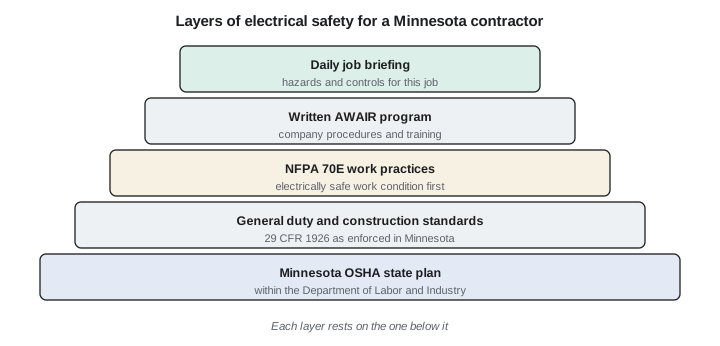
The federal Occupational Safety and Health Act allows states to run their own workplace safety programs, called state plans, if they are at least as effective as federal OSHA. Minnesota runs a state plan called Minnesota OSHA, or MNOSHA, within the Department of Labor and Industry, the same department that licenses electricians and inspects electrical work. MNOSHA covers private employers and public employers in the state, enforces safety standards through inspections and citations, and offers a separate consultation service that helps small employers find and fix hazards without penalty.
Minnesota generally adopts the federal OSHA standards for general industry and construction, and it may add state standards. A Minnesota electrical contractor therefore works under the familiar federal construction standards in 29 CFR Part 1926, together with any Minnesota additions. When a MNOSHA inspector visits a job, the questions are the same ones a federal inspector would ask: were the hazards known, were they controlled and were the workers trained.
The general duty and the employer's responsibility
Under Minnesota's occupational safety and health law, as under the federal law, every employer must furnish employment and a place of employment free from recognized hazards that are causing or likely to cause death or serious harm, and must comply with the safety standards. Employees, in turn, must follow the rules that apply to their own actions. For an electrical contractor, the employer is the company, and the responsible master is usually the person who sets and enforces its safety practices.
On a multi-employer construction site, several employers may be responsible for the same hazard. The employer whose workers are exposed, the employer who created the hazard, the employer who controls the site and the employer responsible for correcting it can each be cited under the multi-employer approach OSHA uses. Crow River, as a subcontractor, cannot assume that the general contractor has handled fall protection or overhead line clearance; it must protect its own workers.
Construction standards that affect electrical work
Several parts of the construction standards apply directly to electrical contractors. Subpart K covers electrical safety in construction, including ground-fault protection for temporary power through ground-fault circuit interrupters or an assured equipment grounding conductor program, and requirements for working near energized parts. Subpart V covers power transmission and distribution work. Rules for working near overhead power lines, especially with cranes and other equipment, set minimum clearances and require planning before equipment is moved near lines. Fall protection, ladders, scaffolds, excavations and lockout of energy sources are also everyday concerns on electrical jobs.
| Hazard | Typical control on a Crow River job |
|---|---|
| Shock from energized parts | De-energize, lock out and test before work |
| Arc flash | Risk assessment, labels, PPE and safe approach distances |
| Overhead lines | Pre-job survey, clearance planning and a spotter for moving equipment |
| Temporary power | GFCI protection or an assured grounding program |
| Falls | Ladder rules, guardrails or personal fall arrest |
| Trenches | Sloping, shoring or trench boxes; spoil set back from the edge |
NFPA 70E and electrical safe work practices
NFPA 70E, the Standard for Electrical Safety in the Workplace, is a consensus standard rather than a law, but OSHA and state plans treat it as the recognized way to meet the general requirement to protect workers from electrical hazards. NFPA 70E's first rule is to establish an electrically safe work condition, meaning the equipment has been disconnected, locked and tagged, tested for absence of voltage and grounded where needed, before work begins. Energized work is allowed only when de-energizing would create a greater hazard or is infeasible, and then only with a documented justification, an energized work permit and a risk assessment.
The risk assessments in NFPA 70E have two parts. The shock risk assessment determines the boundaries within which only qualified persons may approach and what protective equipment they need. The arc flash risk assessment determines the incident energy or category of protective equipment and the arc flash boundary. Equipment that is likely to be serviced while energized must be labeled. Lesson material in the core courses covers the details; for a master, the key responsibility is making sure workers are trained, qualified for the tasks they do and equipped properly.
# A pre-job briefing checklist generator (illustrative)
job = "Cold Spring grain dryer feeder"
hazards = ["overhead distribution line in yard", "energized MCC in dryer building",
           "moving farm equipment", "trench for new feeder"]
controls = {
    "overhead distribution line in yard": "spotter assigned; equipment kept clear; owner informed",
    "energized MCC in dryer building": "lockout and test before work; 70E PPE for testing",
    "moving farm equipment": "owner agrees to stop yard traffic during work",
    "trench for new feeder": "spoil set back; trench inspected each morning",
}
print("Briefing:", job)
for n, h in enumerate(hazards, 1):
print(f" {n}. {h}: {controls[h]}")Briefing: Cold Spring grain dryer feeder 1. overhead distribution line in yard: spotter assigned; equipment kept clear; owner informed 2. energized MCC in dryer building: lockout and test before work; 70E PPE for testing 3. moving farm equipment: owner agrees to stop yard traffic during work 4. trench for new feeder: spoil set back; trench inspected each morning
Minnesota's written safety program
Minnesota requires many employers, including construction employers, to have a written workplace accident and injury reduction program, known by its initials as AWAIR. The program sets out how the company will identify hazards, train workers, investigate incidents and assign responsibility for safety, and it must be reviewed periodically. Crow River's program is a binder in the office and a shorter version in each truck. The binder includes the lockout procedure, the 70E program, the fall protection plan, the trenching procedure and the new overhead line briefing.
A program on paper is not enough. MNOSHA inspectors, like federal inspectors, ask workers what they were trained to do and watch how they do it. Lars's view was that the best safety program is the one the crew can explain without looking at the binder. Nadia keeps the program alive with a ten-minute talk every Monday and by asking each new worker to walk her through a lockout on the first day.
Training and qualified persons
OSHA and NFPA 70E use the term qualified person for someone who has the skills and knowledge to work safely on specific equipment and has received safety training on the hazards involved. A worker can be qualified for some tasks and not others. A journeyworker who is qualified to troubleshoot a 480-volt motor control center may not be qualified to work on medium-voltage switchgear. A master should keep training records for each worker that show what they were trained on and when, and should retrain when work methods, equipment or standards change.
Injury records and reporting
Employers covered by recordkeeping rules must keep a log of work-related injuries and illnesses that meet the recording criteria and post an annual summary. Serious events, such as a work-related death or an injury requiring in-patient hospitalization, amputation or loss of an eye, must be reported promptly to MNOSHA within short deadlines set by the rules. A master should know the current reporting deadlines before an incident happens and post the reporting number in every truck.
Workers' compensation reporting
Minnesota's workers' compensation law requires employers to report work injuries. According to the department, the employer must report a claim to its workers' compensation insurer within 10 days after the employer knows of an injury that causes lost time from work. The insurer, in turn, files the first report of injury with the department if the disability lasts more than three days. The employer must give the injured employee a copy of the first report and the department's information sheet that explains the employee's rights and responsibilities.
Crow River's practice is to report every injury, even a minor one, to the insurer and to record it internally, because a cut that seems trivial on Monday can become a lost-time claim by Friday. Becky keeps the first report form and the employee information sheet ready in the office, and the crew leads know to call her the same day.
Safety on farm and rural jobs
Rural work brings hazards that a city electrician may not meet often. Grain bins and dryers create dust that can ignite and confined spaces that can trap a worker. Livestock buildings bring corrosive atmospheres and wet locations. Long service runs mean deep trenches in uneven ground. And farmyards are full of tall moving equipment, such as augers, elevators and loaders, working under overhead lines that the farm owner may have stopped noticing years ago. Crow River's briefing form now asks about each of these on every farm job, and Nadia walks the yard with the owner before work starts.
After an incident
If an incident happens, the first priority is care for the injured worker and making the scene safe. Then the master should preserve the scene as far as possible, collect statements while memories are fresh, report as required, and investigate the cause without hunting for blame. The goal is to find the gap in planning, training or equipment that allowed the incident and to close it. After the Cold Spring near miss, the investigation found that nobody had asked the farm owner what equipment would be moving that day. The briefing form now asks.
Worked problem
Who is responsible for the overhead line?
On a farm job, the general contractor for a new machine shed has its own crew setting trusses with a boom truck near an overhead line. Crow River is wiring the shed. A Crow River apprentice is asked to guide the boom truck because he is standing nearby. What should the Crow River lead do?
Show solution
- Crow River must protect its own workers, even on a site controlled by another employer.
- The boom truck near an overhead line needs clearance planning and a qualified spotter under the crane and line rules.
- The apprentice should not take on a spotter role he has not been trained for.
- The lead should stop the task, raise the line hazard with the general contractor and the line owner, and document the conversation.
Answer: Stop the apprentice from spotting, raise the hazard, and make sure clearance planning is done before work resumes.
Common mistakes
MistakeAssuming federal OSHA inspects Minnesota job sites.
InsteadMinnesota runs its own state plan, MNOSHA, within the department.
MistakeTreating NFPA 70E as optional because it is not a statute.
InsteadRegulators treat it as the recognized way to protect against electrical hazards.
MistakeWaiting to report an injury until it becomes serious.
InsteadReport to the insurer within 10 days of knowing of a lost-time injury, and record every injury.
MistakeAssuming the general contractor handles all site hazards.
InsteadEach employer must protect its own exposed workers.
Summary and key terms
- Minnesota OSHA is the state plan that enforces workplace safety in Minnesota, within the department.
- Employers must keep workplaces free of recognized serious hazards and follow the construction standards.
- NFPA 70E sets electrical safe work practices, starting with an electrically safe work condition.
- Many Minnesota employers, including construction employers, need a written AWAIR program.
- Employers report lost-time injuries to their insurer within 10 days; the insurer files with the department if disability exceeds three days.
- MNOSHA
- Minnesota OSHA, the state plan for workplace safety and health.
- State plan
- A state-run safety program approved as at least as effective as federal OSHA.
- Electrically safe work condition
- Equipment disconnected, locked out, tested and grounded as needed before work.
- AWAIR
- A written workplace accident and injury reduction program required of many Minnesota employers.
- First report of injury
- The workers' compensation form reporting a work injury.
Practice problems
Work each problem on paper first, then reveal the answer to check.
Who enforces workplace safety on Minnesota job sites?
Show answer
Minnesota OSHA, the state plan within the Department of Labor and Industry.
What is the first step NFPA 70E requires before electrical work?
Show answer
Establish an electrically safe work condition.
When does the insurer file the first report of injury with the department?
Show answer
When the disability lasts more than three days.
Lesson quiz · 5 questions
Score 60% or more to complete this lesson.
Create a free account to save your progress, take quizzes and earn a certificate.